Imitation and tradition

TD Rule 7 – AI edit for clarity / concise (but no new ideas).John Hudson said:Okay, here goes the tangent...Let me begin by saying that the term imitation probably means different things to different people, some more positive and some more negative, and it is a word that comes weighted with a lot of proverbial baggage — ‘imitation is the sincerest form of flattery’ etc. — that I intend to ignore. I want to contrast imitation with tradition, which means using the term in a fairly specific way. By imitation, I mean a fairly close copying of something done from outside of the tradition in which the thing was originally made. I think there is a continuum between inspiration and reproduction, and imitation floats on that continuum but tending towards the reproduction end.There are positive understandings of imitation, like that proposed by KP, which see it as part of a creative process. There are acts of what most people would identify as imitation within tradition, and some traditions promote formal reproduction as a measure of mastery (when looking at two nearly identical pieces of Arabic calligraphy separated by more than 100 years, one is aware of both tradition and imitation in this sense). I want to look at imitatiom differently: not necessarily negatively, and not absolutely, but as something distinct from and outside of ways of working within a tradition.I have been spending a lot of time recently thinking about what it means to work within a tradition, which is something that people used to do more-or-less without thinking about it because of the way society and culture were organised, and which now is quite difficult to do even if you do think about it. In this context, imitation is a useful concept to juxtapose against developing works within a tradition. In this context, imitation is a symptom of the fracturing of tradition.To keep this vaguely on-topic for this thread, an ‘AI’ is an imitation machine because it necessarily begins outside of tradition. It has access to the vast pile of everything that humans have made that can be represented in digital form as text descriptions, pictures, moving images, sound, but it can only imitate or ‘remix’ those things. It doesn’t have access to the traditions within which many of those things were originally made. Now, I would say there are also a lot of humans whose work is also imitation, not because they’re bad people or lousy artists, but simply because they are also working outside of a tradition, in a fractured culture. Like ‘AI’, they view the works of the past from the outside, as a kind of big pile of resource material to be mined, for inspiration, imitation, or reproduction.Before you think I am getting romantic about a notion of tradition, let me say that the way in which individual creative people respond to the fracturing of culture is at the core of much important art of the past 100 years. People make new things that address their new conditions, that express the world in which they find themselves. You don’t need to work within a tradition, and a lot of interesting stuff has been made by treating the past — and indeed, other cultures — as a resource to be mined. And traditions have often been associated with or organised within a guild mentality that made it difficult to gain access to a tradition, especially for women, for immigrants, for minorities.In this latter respect, the fracturing of tradition might even be seen as a good thing, because it levels the field for access: we all start on the outside. The question is, do we remain on the outside, where imitation happens, or do we find a way to enter the tradition?That’s the question I have been thinking about a lot recently. There are some surviving traditions that still have practitioners who entered through something like an apprenticeship, in succession with people who had themselves gone through the same process. This is true tradition in the radical sense: handing on from person to person. In a lot of fields, though, including type design, that really isn’t an option (maybe to some extent it is at KABK, where you can trace the pedagogical lineage of the instructors within a tradition of Dutch typography, and the course material draws on and critically engages with that tradition). So how does someone go about entering a tradition, and what does that even mean?I don’t have complete answers to those questions, which I suspect indicates that I have not entirely entered the tradition in which I try to work and in which I do feel myself to be operating. I try not to look at the works of the typographic past as a resource to be mined, but examine my own work in continuity with that past. I think this has involved a slow and gradual and — until recently — unconscious process of entering into, but in some sense has always been part of my approach because I’ve mostly avoided imitation. I think the most imitative thing I have made is a Javanese typeface that is closely modeled on a Dutch metal type, in part because of needing to analyse and understand the unitised layout system it used; I couldn’t learn that except by training myself on it like an LLM.
John Hudson said:I have been spending a lot of time recently thinking about what it means to work within a tradition, which is something that people used to do more-or-less without thinking about it because of the way society and culture were organised, and which now is quite difficult to do even if you do think about it.
Last year, one of the ISTD's (International Society of Typographic Designers) student briefs was called "Trade Matters". It explored renewed interest in locally rooted production, the circular economy and “slow” practices, in response to mass consumption and global trade.
In the introduction, Michael Prodger writes: "Traditional craft industries, now vanished or endangered, used to play a vital role in cementing communities. Why might they not do so again?" It also reflected on James Fox's Craftland, which explores endangered crafts and trades, and the distinctive materials and practices rooted in their localities.
John Hudson said:The question is, do we remain on the outside, where imitation happens, or do we find a way to enter the tradition?
Since type has to be adapted to modern font production processes, we can't simply reproduce the conditions of an earlier tradition. Perhaps translation is a better way to think about it. Think about translated poetry or literature – who would want a strictly literal translation? It would be clunky and unhelpful to its intended audience.
I sense a few strands here:
We translate traditions into contemporary practice, taking account of changes in culture and technology. I think we see this frequently used to a very positive effect in revivals.
Type design can also be a way of entering a tradition, but there's a risk of entering the “uncanny valley” if we profess expertise we don't have, or can't get meaningful guidance from those who do. We might produce results that seem unconvincing to people familiar with the tradition, or that are misaligned with our intentions, despite our efforts. It can be a lifelong task.
- In my own practice, I use the term “fidelity” as a way of honouring content. When designing a printed product, I would select materials that are conceptually loyal to, or visually supportive of, the source material. When reproducing artwork, I consider which print process will best optimise its reproduction, as well as how fidelity to the original can be improved or developed conceptually (budget permitting).
John Hudson said:So how does someone go about entering a tradition, and what does that even mean?
In the UK, the King's Foundation advocates for the preservation of heritage craft skills. Given the right budget, I'd prefer to contract someone with a specific skill rather than attempt it myself. That supports those who have dedicated themselves to their craft and deserve to be rewarded for it. But it can also create an unfair barrier to entry: not everyone has the right contacts, willingness, budget, ability (or luck!) and time to make those connections. That said, there is also value in learning these skills ourselves.
Comments
-
Since type has to be adapted to modern font production processes, we can't simply reproduce the conditions of an earlier tradition.Changes in technology are not necessarily disruptive of tradition: there are things that pass across without any need to try to reproduce earlier conditions. Everyone working within a tradition does so within the conditions of their time and place. It just happens that in our time and place, most traditions are fractured. Changes in social relations are much more likely to be disruptive, which is why capitalism is so wonderful or terrible depending on whether you are benefiting from its disruptions or being alienated by them.Broadly, I look at my own work within traditions of text manufacture, rather than specifically type design or typography, and there is a lot that passes across when considering a digital font in continuity with a palm leaf manuscript. This is why I tend to spend at least as much time looking at manuscripts and engraved or lithographic texts as I do at type.There’s a notion of a creator or a particular work ‘embodying the tradition’. I find this a problematic phrase, mostly because the word ‘embody’ is vaguely define while over-used, but there is a sense in which I can be sympathetic to it. This is why I employed a deliberate Biblical allusion in the other thread, when I wrote of ‘the variety of ways in which type designers — or other makers of useful things — engage with the traditions within which they live and move and have their being’. I wanted to give some indication of the intimacy involved in working within a tradition, of the inseparability of the self from the well-spring of what has come before while also making things that are personal and not imitative.I am very much aware that I experience that intimacy imperfectly, because of where I exist socially and culturally, and it has taken more than thirty years of working at a thing to experience it at all.
0 -
This discussion reminds me of something that two of my Orthodox friends like to say: ‘Tradition is the living faith of the dead. Traditionalism is the dead faith of the living.’ I remind myself of this regularly, because its important to avoid a performative imitation of tradition.4
-
Great quote – and very much aligns with your question "what it means to work within a tradition", and what the limits on that might be.John Hudson said:‘Tradition is the living faith of the dead. Traditionalism is the dead faith of the living.’
Who decides?John Hudson said:Changes in technology are not necessarily disruptive of tradition: there are things that pass across without any need to try to reproduce earlier conditions.
Depending on how this is approached, this could be viewed either in the light of a "translation" or the concept of "fidelity" to honour content/origins. The latter is a form of intimacy, I feel very humbled when thinking about it. I know poets who also consider their translation in a similar light.John Hudson said:
This is why I employed a deliberate Biblical allusion in the other thread, when I wrote of ‘the variety of ways in which type designers — or other makers of useful things — engage with the traditions within which they live and move and have their being’. I wanted to give some indication of the intimacy involved in working within a tradition, of the inseparability of the self from the well-spring of what has come before while also making things that are personal and not imitative.
Sasha Dugdale (poet) is a former client of mine, she has some very insightful views on this. Since I have no written recordings of our conversations nor even of a relevant lecture I attended, I asked ChatGPT.Sasha Dugdale said:
I always used to say that translation is a duty – and I do feel it is a duty, I do feel that it’s my obligation to translate, to bring two worlds of different cultures closer, towards some point of proximity – primarily, really, to enrich the English language. To bring something to us that we didn’t have before, so that we can widen our empathies.The AI also suggested reading:
– Making a Patch of Land for Myself (2020)
– I Sometimes Wonder Why I Translate (interview, 2021)John Hudson said:
Do we also risk that a mechanical interpretation of text manufacture becomes a form of "traditionalism", preserving features that are no longer relevant to the intended audience? What parts do we keep?
… there is a lot that passes across when considering a digital font in continuity with a palm leaf manuscript.
I still like Jeremy Tankard's Fenland that injected an entirely new approach to contrast. There is no tradition to this, but it works extremely well. Would a writing system with origins using a monolinear stylus also adapt so well? This would be an interesting experiment.2 -
I have admired Jeremy’s work since I first met him in the mid-1990s. He is a designer who is always looking for a new idea around which to build a typeface, and while the results are often novel and not obviously related to previous designs, I think he is also quite deeply rooted in particularly English traditions of lettering and typography, which you see in his notebooks and in the reference materials that he shows in explaining his designs. For example, the idea around which Fenland is built incorporates Johnston’s concept of ‘essential forms’ and references to regional English graveyard lettering. Now, those are things that could be approached as imitation, as the past viewed as resource to be mined, but Jeremy has been at this long enough to have absorbed a lot of that tradition, so he is able to make something that is, as you say, entirely new and not imitative.Jeremy is a braver and more daring designer than I am. In comparison, I would say most of my work is more conventional, although right now I am spending my down time noodling away on the least conventional typeface I have ever made, and am enjoying it very much.1
-
Would a writing system with origins using a monolinear stylus also adapt so well? This would be an interesting experiment.This is basically the experience of south Indian and Sri Lankan scripts in the 19th Century, and is something I have been investigating on trips to the British Library in recent visits. If you look at metal type for these scripts, it is clear that conventions for where thick and thin stroke contrast are applied are already quite established, even though the long preceding palm leaf manuscript tradition involves a monolinear stylus. So I went looking for the missing link, the medium in which those conventions were worked out. Unsurprisingly — in fact, very predictably — it’s in the work of professional scribes adapting the scripts to being written with European split-nib pens, helpfully reproduced in engraved and lithographed copybooks as well as in a new style of manuscript. Occasionally, one sees variations in the conventions, with some writing and some display types exhibiting different arrangements of thick and thin strokes, but mostly these scripts seem to have settled into their new models very quickly and consistently.0
-
Regarding your question ‘Who decides?’, in response to my point that changes in technology do not necessarily disrupt traditions, and that things ‘pass across’, I don’t think it is a question of deciding but observing.In the other thread, you gave the example ‘the early types of the Gutenberg press adopted the style of the scribal hand’ as evidence of a combination of imitation and innovation. One way to look at it is indeed that Gutenberg imitated the shapes that scribes were making. Another way to look at it is that Gutenberg inhabited a culture of literacy in which this is what text looked like, so he is working in that regional tradition and the shapes are what is passed across in the change of technology. The revolution in publishing and dissemination of information and knowledge that followed from Gutenberg’s invention can be seen as disruptive in various ways — many of those disruptions broadly viewed a positive developments —, but possibly the thing they were least disruptive of was living traditions of shaping text.Another example I spend a lot of time thinking about is John Baskerville, whom we mostly celebrate as a type founder and printer, but who worked very much within a tradition of writing masters and professional scribes inventing and perfecting new styles of lettering. The style of English roman typography that we associate with Baskerville is based on letterforms that originate within that tradition in the 1690s (in the copybooks of John Seddon and John Ayres). By the time Baskerville prints his first book, these letterforms are firmly established in the standard repertoire of English writing masters — in Joseph Champion’s set of model alphabets published in Bickham’s Universal Penman, they are even labeled ‘Print Roman’, even though no typeface in the style yet existed —, and between announcing his intent and that first publication, Baskerville spends seven years figuring how to bring this writing tradition into the technology of typography and print (with a lot of that time spent developing new kinds of paper).0
-
I've always thought it curious that (perhaps until recently) modulated/contrasted letterforms remained the "default" look of the printed word in the West, even though throughout my lifetime (and I'm pretty old) the writing utensils I've used have been nearly exclusively monolinear—ballpoint pens, roller pens, pencils sharpened with a rotary sharpener, etc. Contrasted types survived all through this, what, 3/4 of a century? that we could see as the Age of Monoline Writing Implements, now fading as keyboards eclipse pens as the most common text-generation tool. Monoline (sans) types of course existed and proliferated in this age, but its probably fair to say that fonts used for continuous reading almost always had contrast, at least until earlier computer screens tipped the scales. This I think reaffirms John's point about how to read Gutenberg above.2
-
KP, thank you for pointing me towards Sasha Dugdale, and for your thoughts about translation. I do think this is a useful notion in type design: a similar pattern of constraint and interpretation applies. Obviously, this notion applies most directly in the translation of a typeface into another script. This is an illustration from a lecture I delivered at St Brides in 2009, and then in a modified form at Serebro Nabora in 2014:
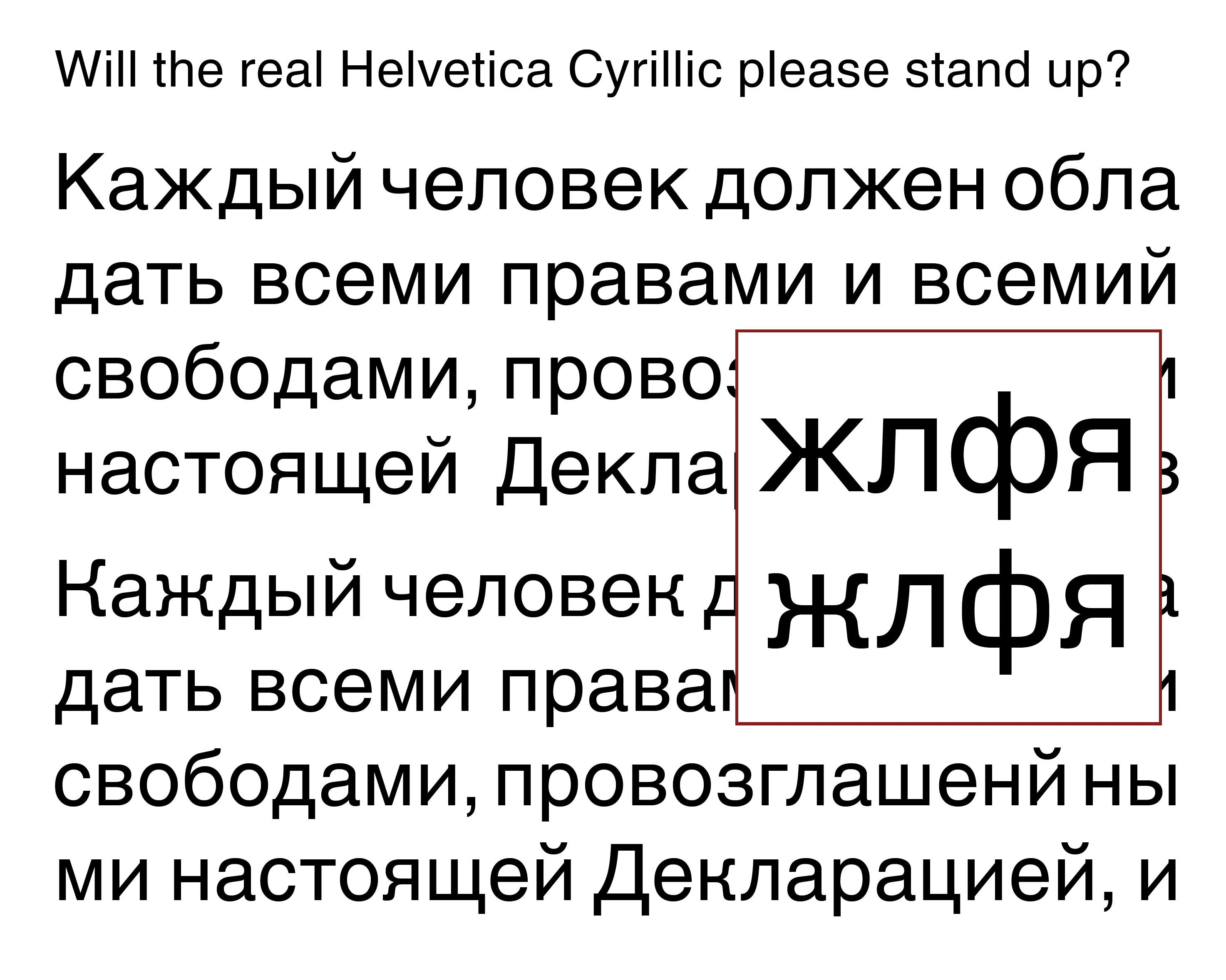 The point I made in the lecture is that it makes no more sense to ask ‘What is the real Helvetica Cyrillic?’ than to ask ‘What is the real English Anna Karenina?’ (a novel of which Wikipedia lists seventeen English translations).There are multiple ways to translate a typeface into another script. I suppose the ‘imitative’ way is to see shapes in one script and try to find similar shapes in the other script, and then try to bolt those shapes together. In approaching Cyrillic, I was always encouraged by Maxim Zhukov to take an ‘idiomatic’ approach, and to look for parallel traditions in typographic and lettering cultures, as a way to understand the place of the shapes within the idioms or styles of design in those traditions and cultures.Translating a typeface into another script seems to me much more like translating a poem into another language than, say, directions for a foreign tourist to find their way to a hotel. This is why when I ask an ‘AI’ bot to produce a Cyrillic version of one of my Latin typefaces, the results are a dull and lifeless as a word-for-word translation of a poem.0
-
John Hudson said:Regarding your question ‘Who decides?’, in response to my point that changes in technology do not necessarily disrupt traditions, and that things ‘pass across’, I don’t think it is a question of deciding but observing.If we're talking prescriptivism vs. descriptivism, can we refer back to definitions please? Rhetorically, it is difficult to have a productive conversation when there are shifts between individual definition and observed practice. Lexicographers put a lot of effort into representing consensus."Imitation" and "tradition", what do these mean in dictionary terms?John Hudson said:So I went looking for the missing link, the medium in which those conventions were worked out. Unsurprisingly — in fact, very predictably — it’s in the work of professional scribes adapting the scripts to being written with European split-nib pens, helpfully reproduced in engraved and lithographed copybooks as well as in a new style of manuscript.
My MATD project focussed on the south-indic script of Kannada, so I am familiar with this stroke contrast and its origins. From what I have read, there was a clear superiority issue that guided European scribes in their choice of tool and substrate (See Non-Latin Scripts: From Metal to Digital Type, ed. by F. Ross and V. Singh). That puts things very lightly, I'd recommend reading the book.
John Hudson said:Will the real Helvetica Cyrillic please stand up?Isn't Slim Shady a deliberate act of transgression?John Hudson said:Translating a typeface into another script seems to me much more like translating a poem into another language than, say, directions for a foreign tourist to find their way to a hotelOne method to start a poetry translation is with a literal translation.John Hudson said:Gutenberg’s invention can be seen as disruptive in various ways — many of those disruptions broadly viewed a positive developments —, but possibly the thing they were least disruptive of was living traditions of shaping text.The living tradition of shaping text was by the scribal hand. If Gutenberg only "inhabited a culture of literacy", I doubt he would have made the effort to incorporate so many sorts (approx. 270). To say that it was not disruptive is only defensible in the context where a "living tradition" refers only to a visual convention.In an age where we are facing another new technology (AI), don't people and industry matter?Craig Eliason said:I've always thought it curious that (perhaps until recently) modulated/contrasted letterforms remained the "default" look of the printed word in the West, even though throughout my lifetime (and I'm pretty old) the writing utensils I've used have been nearly exclusively monolinear—ballpoint pens, roller pens, pencils sharpened with a rotary sharpener, etc. Contrasted types survived all through this, what, 3/4 of a century? that we could see as the Age of Monoline Writing Implements, now fading as keyboards eclipse pens as the most common text-generation tool. Monoline (sans) types of course existed and proliferated in this age, but its probably fair to say that fonts used for continuous reading almost always had contrast, at least until earlier computer screens tipped the scales. This I think reaffirms John's point about how to read Gutenberg above.Craig, I like your example, but I'm not sure how it reaffirms John's point? Could you elaborate.0 -
I’m sorry, KP, you lost me with the prescriptivism vs. descriptivism question, and I think we might be talking past each other.I was saying that some things get carried across changes in technology, and you asked ‘Who decides?’, but now I think I might have misunderstood that question. I thought you were asking who decides whether things have been carried across, which is why I suggested that one could simply observe the carrying across happening. But now it strikes me that perhaps you meant who decides what gets carried across. Which, in retrospect, is a much more interesting question, so perhaps what you meant?In the other thread, you mentioned that you sometimes use ‘AI’ to help you be concise. Now I am chuckling, because apparently I don’t do well with concision and need to have things spelled out verbosely._____PS. On the subject of things that don’t get carried across changes in technology: The Beneventan Memory.0
-
Just that in my lifetime, cultural expectations of typeforms are notably NOT emulations of prevailing written forms, which I see as support for considering norms as reflective of a “culture of literacy” as John put it, even in eras/situations where the emulation of writing seems more direct.Craig, I like your example, but I'm not sure how it reaffirms John's point? Could you elaborate.
0 -
JH's statement: "Changes in technology are not necessarily disruptive of tradition: there are things that pass across without any need to try to reproduce earlier conditions."John Hudson said:I was saying that some things get carried across changes in technology, and you asked ‘Who decides?’, but now I think I might have misunderstood that question.
KPM's question: "Who decides [what counts as disruptive]?" – but also what gets carried across.
Prescriptivism: how language should be used (decide)John Hudson said:I don’t think it is a question of deciding but observing.
Descriptivism: how language is used (observe)
L'Académie française often defines word meanings, whereas the OED observes them – which is why the emoji (😂) was named Oxford Dictionaries' Word of the Year in 2015. It had widespread use.
Since you offered particular definitions in your opening statement, I tried to adopt those definitions. But, my actual definitions when I first spoke about "imitation" were quite different. And I'm still not entirely sure that I fully understand your definition of "tradition". It's a bit fuzzy to me.
Ultimately, I can't possibly also know all your observations.
So I asked if we could return to established use – how society actually uses those terms, as documented by lexicographers.
I'm a fan of the "plain language" movement. I also love the word sesquipedalian (and to have a good excuse to use such long words). I try to be concise by choice; it predates AI.John Hudson said:Now I am chuckling, because apparently I don’t do well with concision and need to have things spelled out verbosely.
0 -
As Tom Phinney suggested in the other thread, it would be nice if we had some better language to talk about these things, and words that don’t come with various kinds of value judgements. Dictionary definitions are by their nature limited to how words have been previously used, so can sometimes be limiting. Philosophers and poets often need to use existing words in new ways, to reach towards the ideas that are forming.I am trying to talk about a sense that has formed over my working life of tradition as something that can be — has to be, really — inhabited, whereas I see imitation as something that happens from the outside. And because our present socio-economic and cultural circumstance puts us outside of tradition, I think we have a tendency to look at the past in a distorted way, because we see people doing stuff that looks to us like imitation, but which I don’t think they experienced as such because they inhabited traditions. The etymological, radical meanings of tradition all involve transmission, and back in the Latin origins notions of delivering, surrendering, handing something down. That’s the sense in which I understand tradition (hence, why I think traditionalism is something different, and more akin to imitation). If you are inhabiting a tradition, you are involved in this transmission, both receiving and delivering.I don’t think we know what was going through Gutenberg’s mind regarding this, or if he had thoughts at all about what he was doing in terms of this discussion. I think there are different ways to look at what he was doing in terms of the relationship of his typography to the shaping of text by contemporary scribes in his particular, regional culture. The way I have encountered most often, is that he was imitating scribal text, and I understand that makes sense looked at from our perspective. But I am not sure it was Gutenberg’s perspective. Another way to look at it is that he is working within this text culture: maybe not as directly as Baskerville was working within the scribal text culture of his own time and place, but in terms of living with this particular, regional understanding of what text looks like. For him, that meant being able to accurately present that, as it appeared in large format, prestige Bibles, without simplifications or reductions; whereas, type founders and typesetters fairly quickly started adopting simpler systems, to meet the market demands of the new publishing industry and different kinds of texts.I am reminded of conversations with Tom Milo and others about the need to accurately present the text grammar of the Qur'an, and hence why typical Arabic fonts are inadequate for this purpose. Maybe Gutenberg is looking at large format Bibles in this way: as something that should follow a specific textual form, down to the microtypographic level? If one looks at an Islamic calligrapher working on a mushaf that too can look like imitation if we don’t understand the context of the tradition in which that calligrapher is working, and all the things that have needed to be passed on, taken on and internalised to make that work possible. So I am cautious about using the term imitation to describe what someone has done in the past, because we often lack that kind of context.2
-
John Hudson said:As Tom Phinney suggested in the other thread, it would be nice if we had some better language to talk about these things, and words that don’t come with various kinds of value judgements. Dictionary definitions are by their nature limited to how words have been previously used, so can sometimes be limiting. Philosophers and poets often need to use existing words in new ways, to reach towards the ideas that are forming.
Agreed! But, I am not convinced these are new ideas.
A working life is often deliberate, seeking to enter from the outside to the inside of a tradition. Where Gutenberg inherited his "culture of literacy", a type designer may have to immerse themselves. This can be much harder. [edited paragraph – for meaning]
A type designer working in a previously unfamiliar writing system or classification starts as a student – they look for "parallel traditions", they study, they may "imitate" as a form of study. And, they will naturally carry over a certain sentiment from their own "culture of literacy", even if only fractional.
Arguably, as a student they may gain a greater understanding of the culture than those who never study it. But, the framing of their understanding will never fully align with those who both study and inherit that culture. But for its diversity, the insights of those who start outside a culture will have a different breadth.
When I live in a country different from home, I do not automatically inhabit the culture. I start as a tourist – and I may remain a visitor, depending on how I approach things. This becomes more interesting for those with mixed heritage. But it is interesting to hear you talk of those who live and move and have their being. This is a testament to the very greatest form of immersion – to literally have your being intimately, perhaps permanently, involved with the tradition.
On imitation, I'll admit there might be a better word. Are the dictionary definitions you've read problematic? I have suggested a few alternatives for "inhabit" – as I think it is important to make clear the difference between inheritance and immersion.
But… I keep thinking about how a child imitates its parents (inside the culture).
So I searched this (note, the "-ai" basic expression)
"what are the most common forms of imitation -ai"Wikipedia said:Imitation is also a form of learning that leads to the "development of traditions, and ultimately our culture. It allows for the transfer of information (behaviors, customs, etc.) between individuals and down generations without the need for genetic inheritance."This makes me pause for thought, because the words in the description surprised me: "traditions", "culture", "inheritance". If we can find a better language to talk about these things (quoting Thomas Phinney), it is possible that we may actually agree on the underlying reality.
Reading a little further, it talks of social (e.g. imitation) and asocial learning. It even goes as far as to link an article suggesting that asocial learning might be faster and more advantageous. At this stage, I am already out of my depth – which is fun.1 -
Where Gutenberg inherited his "culture of literacy", a type designer may have to immerse themselves. This can be much harder.Yes. As I said, the fractured nature of our culture, in which traditions have broken down, mean that we all start on the outside (well, not entirely on the outside if we’re talking about type design, because we are readers so are at least engaged in a culture of literacy to that extent). This is why I think the (re)inhabitation of a tradition is something that takes time and active involvement — your ‘immersion’ — and I am agreeing that imitation may be involved, especially in the early stages of that, because imitation is the default engagement of the outsider. What I caution against is extrapolating from that experience to describing the way people in other times or other cultures have made things. That’s why I don’t like the characterisation of Gutenberg as ‘imitating’ what scribes were doing. It doesn’t make sense to me that someone in his position relative to the culture of text into which he was introducing new technology, would need to imitate.I spent some time, inspired by this discussion, thinking more about the 42-line Bible, and about how and perhaps why it looks the way it does. The first thing to say, always, about Gutenberg’s Bible is that it is incredibly good.
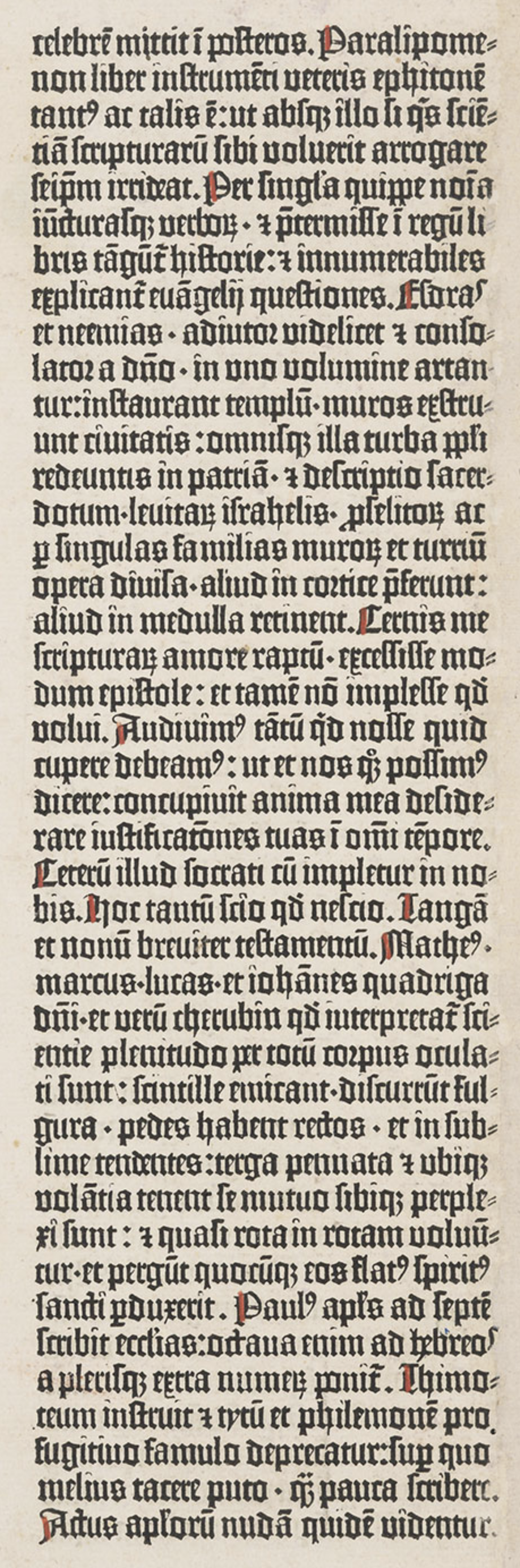 One of the things that makes it so good, and that I don’t think gets enough attention, is the quality of the justification of the columns and the evenness of the texture across every line. Earlier, I understood you to be questioning whether Gutenberg’s type would have included so many sorts if he had not been imitating scribal text. Wouldn’t it have been easier, as later type founders and printers demonstrated, to use a smaller number of sorts, gravitating to one form per letter? I can easily imagine Gutenberg making test settings with an initial, small set of sorts with limited variation for each letter, and immediately noticing two things: the justification isn’t very good, with loose and tight lines abounding, and the text looks a bit dead on the page compared to what he is used to seeing in such books; dare I say, a bit mechanical. I think the number and variety of sorts he ends up casting to achieve the justification, to achieve that evenness and liveliness of texture, involves implementing — not imitating — scribal practice. [Based on the documented later involvement of professional scribes in the work of printer publishers, I think it is very likely that Gutenberg was working with someone with intimate knowledge and experience of that practice.]
3 -
We're getting a bit academic here – so I've dug up from my BA Typography (UoR) as well as some lecture notes from James Mosley's lectures that Sallie Morris kindly shared with me many years ago.
John Hudson said:
Based on the documented later involvement of professional scribes in the work of printer publishers, I think it is very likely that Gutenberg was working with someone with intimate knowledge and experience of that practice.Yes, Gutenberg is documented as working with J.Fust (funding) and P.Schoffler (scribe). If you enjoy the quality of the 42-line Bible, then the later work of the Psalter (1457) by Fust and Schoffler (not Gutenberg, as Fust foreclosed on him c.1456), is considered to be stunning presswork.
John Hudson said:
One of the things that makes it so good, and that I don’t think gets enough attention, is the quality of the justification of the columns and the evenness of the texture across every line.Gutenberg is an inventor. The invention of the matrix necessitated the use of a grid (as you rightly highlight), as all modular type elements had to be located and locked into the frame. He also invented the contemporary roles for his compositors and printers. His background in metallurgy is essential to the invention of the printing press, in the same way that Garamond and Bodoni needed a knowledge of metallurgy to make their punches from steel – a harder, more resilient metal than lead.
The idea that one person creates everything is unusual, no? Knuth is an interesting example here, and again leads me to revisit the meaning of "imitate". He created Computer Modern, but intentionally modelled it on the types used in The Art of Computer Programming. In this commemorative lecture, Knuth describes his "chicken-and-egg" problem of needing type for his MetaFont – and describes the subsequent process from p.93.
Both Knuth and Gutenberg are working from outside the "tradition", although are definitely engaged readers of their culture of literacy. Arguably, the types used in their work are examples of "form follows function", rather than asserting a personal aesthetic.
Asking a friend programmer, they agreed "imitation" is the wrong word and suggested "transpile" instead (a type of compiling). As Knuth converted the fonts from one media to another.
This is also similar to "transmediate" – if we are focussed on the media, rather than the technology.
While reviewing old notes – I think this quote raises a good point: ‘we take it for granted that a composition of Beethoven interpreted by Toscanini will give us a richer experience that the same work performed by a conductor of no creative ability; yet we are expect to believe that a literary work of art is best served by an innocuous mechanically adequate printing job. The outstanding characteristic of all modern design is the independent, creative approach to the individual problem, as opposed to the application of formulas and conventions.’ (Lee, M., ‘What Is Modern Book Design?’, p. 20)
John Hudson said:
I think the number and variety of sorts he ends up casting to achieve the justification, to achieve that evenness and liveliness of texture, involves implementing — not imitating — scribal practice.Reflecting on the justification, is this due to the "sorts" or the spacing? In terms of variety, I am not clear that scribal practice can be "implemented" in such a totally different process of casting metal type. One is a series of strokes, the other is more similar to a sculpture (carving a solid punch/counterpunch).
Here we can return to a nice aphorism from Harry Carter that "type is something that you can pick up and hold in your hand" – reflecting better the times of metal type.
1 -
John Hudson said:The point I made in the lecture is that it makes no more sense to ask ‘What is the real Helvetica Cyrillic?’ than to ask ‘What is the real English Anna Karenina?’ (a novel of which Wikipedia lists seventeen English translations).I am puzzled by this statement.Anna Karenina is a novel by Leo Tolstoy, originally published in 1878. As such, its original Russian-language text is in the public domain, and so of course anyone can try rendering it into English.The typeface Helvetica, on the other hand, is the property of the Haas Type Foundry, or of whoever has currently bought it or them. So the real Helvetica Cyrillic is the Cyrillic associated with the official licensed release of Helvetica.Now, it may be that more than one Cyrillic accompanied the typeface over the years. Also, there's currently a typeface by the name of Helvetica Neue in existence. And then it's possible that a Helvetica knockoff has a Cyrillic that is a better Cyrillic than the official one.But even with these caveats, the question of what Cyrillic looks like in Helvetica seems to be orders of magnitude more meaningful than the question of what Anna Karenina looks like in English.0
-
Your assessment of AI, John, reminds me of the vertical invader of Ortega y Gasset.
**
Re. Gutenberg: it seems to me that he used not just a lot of shaving, but also “dynamic ligatures,” to squeeze type into justification, but I have not come across any theories to that effect.0 -
Oh, that's certainly true. https://simoncozens.github.io/newbreak/gutenberg.html (drag the little triangle in the bottom right around) is a demonstration of the various "justification alternates" that Gutenberg used.6
-
KP,Thank you for transpile and transmediate, which are useful terms to introduce into the discussion, if only to highlight that that there is a multitude of ways to analyse and characterise what we might otherwise lump together as imitation.The quote from M Lee about ‘the independent, creative approach to the individual problem, as opposed to the application of formulas and conventions’ in modern book design relates nicely to something I wrote in one of my chapters for the Bloomsbury Global Typography book:As with other kinds of work of human mind and hand subjected to the learning of machines, one can imagine both good and bad outcomes to AI typography. Consider the technology applied to the early and late work of Jan Tschichold, in his experimental modernist and conservative classicist modes. The latter is strongly conventional, and implemented in his work for Penguin Books at a high level of specification that could be applied by trained compositors at the typesetting house. It is easy to see how such specification can be ‘reverse engineered’ from the results and applied by an AI to generate models of classical text typography. Tschichold’s earlier work, however, is more individualistic, both in terms of being more specific to the individual text and piece of design, and in terms of being a direct product of his own mind and hand rather than a specification for others to follow. It is difficult to see how anything an AI were prompted to generate in such a style could be anything other than derivative pastiche: the bad thing at which the machine is so good....I am not clear that scribal practice can be "implemented" in such a totally different process of casting metal type. One is a series of strokes, the other is more similar to a sculpture (carving a solid punch/counterpunch).Regarding Gutenberg, I dimly remember some aspects of the analysis by Agüera y Arcas and Needham, published in 2001, which suggested our understanding of how Gutenberg made his type might be wrong, and that he did not initially use the punch/counterpunch method of subsequent European type casting, but discrete stroke punches pressed into a soft medium such as sand casting. The hypothesis explains specific kinds of variation and apparent overlap of strokes visible in Gutenberg’s printing under microscope. If correct, the hypothesis also brings the media of Gutenberg’s type and strokewise scribal practice closer.1
-
I feel like it's time to return to your question: "so how does someone go about entering a tradition, and what does that even mean?" If you are defining the meaning of words, it is really yours to answer.
The below is good enough for me, I'll take it.John Hudson said:The etymological, radical meanings of tradition all involve transmission, and back in the Latin origins notions of delivering, surrendering, handing something down. That’s the sense in which I understand tradition (hence, why I think traditionalism is something different, and more akin to imitation). If you are inhabiting a tradition, you are involved in this transmission, both receiving and delivering.
* * *John Hudson said:I am agreeing that imitation may be involved, especially in the early stages of that, because imitation is the default engagement of the outsider.
I resisted buying this, mostly because it doesn't seem to align with my current trajectory (who knows what that is). You must have an opinion on events like this?John Hudson said:…something I wrote in one of my chapters for the Bloomsbury Global Typography book:
An intriguing hypothesis.John Hudson said:Agüera y Arcas and Needham, published in 2001, which suggested our understanding of how Gutenberg made his type might be wrong, and that he did not initially use the punch/counterpunch method of subsequent European type casting, but discrete stroke punches pressed into a soft medium such as sand casting.
0 -
I am agreeing that imitation may be involved, especially in the early stages of that, because imitation is the default engagement of the outsider.John — I’ve been pondering: I wonder if the word “emulation” might serve a purpose for you in distinguishing the different frameworks of imitation you seem to be shaping up.In my mind, emulation carries an aspirational element and a quality of respect that elevates it beyond the mimicry and stochastic parrotry that I associate with mere imitation. Emulation seems to equate to some of the imitative aspects of what I think you are describing with engagement “inside tradition”, regardless of historical context and circumstance.Just a thought, in case it’s useful for you to develop.0
-
Rudolf Koch's original Wilhelm-Klingspor-Schrift included justification alternates as well, though not as many as Gutenberg, but enough to yield the kind of uniform textures that typesetter Ernst Engel achieved in the pages of Klingspor's 1927 specimen reproduced on pages 107 and 108 of Gerald Cinamon's Koch biography.1
-
Kent,For me, emulation carries some of the same issues as imitation. I think of imitation as applied to things, and emulation as applied to persons. So a typeface might imitate Palatino, while a designer might emulate Hermann Zapf. Both words often imply a conscious copying or aping, so while I think there are other ways to understand them or to use them as ways into a tradition, I find the baggage unhelpful to carry.One of the very first fonts I ever made was in imitation of a piece of calligraphy by Werner Schneider. I learned a bunch of things about how to define elegant shapes with bézier curves, how to space glyphs, how to extend a character set, but I didn’t learn anything about the tradition within which Werner had created that work. So the most I am willing to afford to imitation is that it may be a way into a tradition, but I can’t really recommend it.If talking about emulation, I think we need to distinguish between emulating someone’s style and emulating their approach or processes. So emulating Zapf could mean a number of different things, with quite different results.1
-
Fair enough. They’re just words. Being pressed into service from existing everyday use, each will come with external associations that may or may not fit.As it happens, with my current WIP that is in part an homage to Palatino and Zapf [coincidentally!], I’m not consciously imitating the look of Palatino, nor am I emulating the persona or working method of Zapf. I am attempting to achieve a feeling that I associate with that mid-century European book tradition that is exemplified by Zapf and Palatino (as well as Frutiger and Méridien). And personally I am more inclined to characterize that approach as emulating something rather than imitating.What that something is, I couldn’t really say definitively. I don’t know if it would correspond in any way with your “tradition” or not.[BTW, I licensed Aeneas back in the day, and I still have the PST1 fonts lying around here somewhere. 🙂 ]0
-
I am attempting to achieve a feeling that I associate with that mid-century European book tradition that is exemplified by Zapf and Palatino (as well as Frutiger and Méridien).I find this idea of ‘attempting to achieve a feeling’ very sympathetic to my own thinking. It comes from recognising an often hard to define quality within a particular expression of tradition, and then responding with a new work that carries something of the same quality. That recognition and response suggests to me a fairly deep engagement that expression: a significant familiarity with the works, and an understanding of their own relationship to older traditions and hence of what is particular to their expression. I doubt what you end up producing will seem either imitation or emulation, because it will be yours.My own work-in-progress is inspired by British private press books and types of the first three decades or so of the 20th Century, but in a fairly vague way that also has more to do with a feeling than direct reference.0
-
Music, architecture, illustration—all redolent of an era, as well as the type design.
What music would be in the same vibe of those books, John? Tallis’ Spem in Alium, or Prokofiev’s Classical Symphony? Or perhaps Ketèlby?
And do you listen to it while designing, to get in the mood?
0





Categories
- All Categories
- 47 Introductions
- 4.1K Typeface Design
- 506 Type Design Critiques
- 599 Type Design Software
- 1.1K Type Design Technique & Theory
- 683 Type Business
- 915 Font Technology
- 29 Punchcutting
- 550 Typography
- 133 Type Education
- 335 Type History
- 82 Type Resources
- 114 Lettering and Calligraphy
- 33 Lettering Critiques
- 81 Lettering Technique & Theory
- 593 Announcements
- 102 Events
- 120 Job Postings
- 181 Type Releases
- 189 Miscellaneous News
- 270 About TypeDrawers
- 54 TypeDrawers Announcements
- 114 Suggestions and Bug Reports