Would you recommend being a type designer?
Comments
-
I know a couple of people, one in their 40s, the other their 60s, who have taken the plunge recently—or at least decided to get their feet wet, by doing the relatively brief Type West and Cooper Union courses (not both).
They have some experience with commercial graphics design and production, which is often the case when one starts a “side gig.” That’s useful, whatever direction one’s future type design takes (employee or independent, design and/or production). In fact, being a generalist was the main historical model in the 20th century, before the full-time type design courses (e.g. Reading, KAKB) emerged. That’s how most of my generation (I’m “retirement age“) started.
Being a bit of a generalist is likely a good idea in any era, especially now with things changing so quickly. It gives one the perspective to understand the big picture and recognize opportunities, and the ability to do and manage collateral work that’s important to, say, running one’s own boutique foundry.2 -
I find this discussion particularly interesting in light of recent developments in AI.
While AI is already having a significant impact on fields such as illustration and graphic design, I wonder whether type design is still somewhat different. The complexity of writing systems, the technical requirements of font engineering, and the cultural and linguistic knowledge involved make type design a particularly demanding discipline to automate.
This is not to say that AI will not change the field, but perhaps its impact is less immediate than in other areas of visual design. A deeper understanding of type, language and technology may therefore become even more important.
As a type designer, I even named my website Typedesigner.
1 -
Am I the only one who mostly encounters AI in type design in places like this where people are talking about AI in type design? My production methods, client relationships, and, well, pretty much everything else haven't really changed at all “in the age of AI.”Besides the talk of AI coming for my job, AI hasn't really changed anything for me.3
-
Maybe. If what you have already is working for you, that's great. Some of us have to deal with this.James Hultquist-Todd said:Am I the only one who mostly encounters AI in type design in places like this where people are talking about AI in type design? My production methods, client relationships, and, well, pretty much everything else haven't really changed at all “in the age of AI.”Besides the talk of AI coming for my job, AI hasn't really changed anything for me.5 -
What Simon links to is the "Google Fonts please publish my font project" submission queue, which has grown exponentially in the last few months, as people inexperienced with typeface design becoming newly empowered by new font creation tools. The quality of these submissions is a trailing but correlated line on the same graph.
It seems to me now that we will see AGI in the next decade. By definition, the absolute automation of type design will be before then. Miles Newlyn says it's already there for the administrative parts of his foundry business.
One can choose to keep doing things the way they've been done since the late 80s, of course; but the nature of capitalist market competition means eventually the market will no longer reward such activity.2 -
Dave Crossland said:It seems to me now that we will see AGI in the next decade.What is your benchmark metric for AGI ?Dave Crossland said:By definition, the absolute automation of type design will be before then. Miles Newlyn says it's already there for the administrative parts of his foundry business.Is it likely that AI follows the technology adoption lifecycle? If so, for AI to achieve absolute automation of type design within ten years would be a very unusual acceleration. Not suggesting it won't happen eventually, but I'd be surprised if it occurs within a decade.
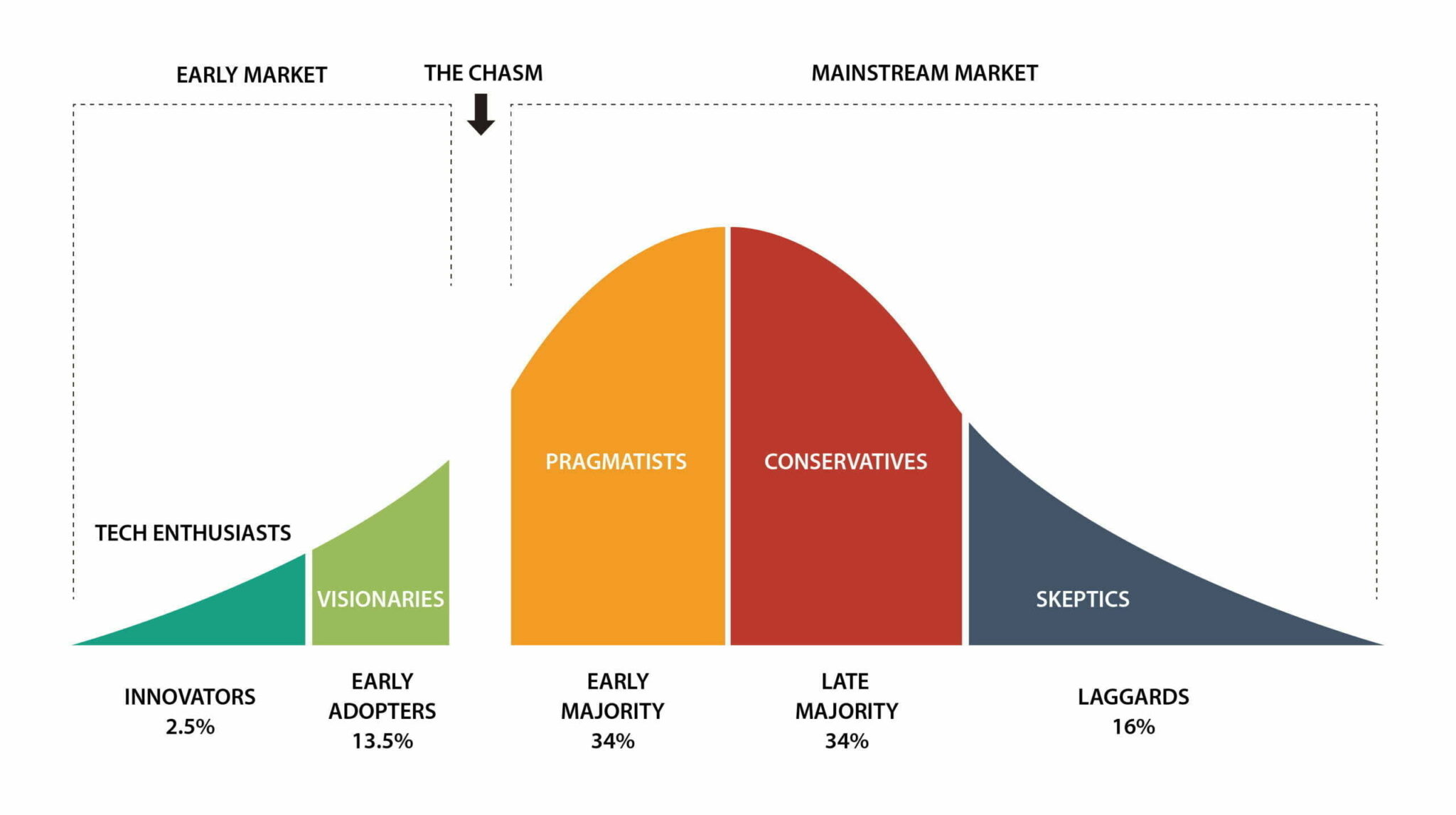 Given that Miles' clearly stated his appetite for risk, and the pushback in the thread on AI in business, I wonder whether we've actually progressed very far along the adoption curve. Early innovators, perhaps early adopters?[lightly edited with AI]Dave Crossland said:I would not be surprised if we're on the verge of a prosociality movement. This will be interesting given AI's proclivity for sycophancy.
I agree that the right way forward overall is to lean into AI – if only to test its boundaries, find its problems, and figure out its role in human society.1 -
Sure.Dave Crossland said:It seems to me now that we will see AGI in the next decade. By definition, the absolute automation of type design will be before then. Miles Newlyn says it's already there for the administrative parts of his foundry business.I've been working on my high jump at the gym lately; if my current progress continues as it has I should be able to fly by 2036.3 -
What I see happening is not the instant elimination of all jobs in font production, but a transition.
During this transition, the human work will gradually shift more to running/supervising the AI work, and within a year or two there will be a huge boost in “productivity” and correspondingly fewer human jobs and/or fewer work hours. Eventually font production oversight will become so trivial that it ceases to exist as a separate job, but is just a small element of other jobs. The trend for font production I expect to become significant within the next year.
Similar things are reasonably plausible in type design, but how near that transition might be, I am a lot less sure. I have seen efforts to automate even just filling in a single extra character, which at this point are still producing worse results than I thought they would be by now. Let alone generating entire fonts — but it is hard to be sure how much of the handicap is because the people doing it are not quite smart enough to realize that they need somebody with specialized font expertise to judge the results and feed back into the system.
At least initially, for seriously AI-assisted type design, I expect hybrid setups, where a human does some design work, an AI adds glyphs, and there may be a lot of back-and-forth iteration between them. If you are working in the Latin script, you could be designing “HAMBURGEFONSTIV hamburgefonstiv” and a handful of other characters, and having an AI generate more characters for you to review, and have multiple rounds of glyph-adding (and -modifying) iteration.
Even if this happens, and some years later AI has taken over most of the design work for most fonts, really high end type designers with name/brand value could perhaps still be designing fonts more “the old way” as premium goods (I hope!). But like hand-made goods in many other areas, they may become much less mainstream. I am thinking it would be like suits, and the spectrum of buying off the rack to somewhat tailored to handmade.
I also rather suspect that some of these progressions and transitions may be surprisingly quick, because the capabilities increase in the models is so darn fast.
Also an interesting question what will happen to prices of existing fonts. They certainly won’t go up, that’s for sure. Generally speaking, font prices in nominal dollars have already been flat for decades, meaning that inflation has eaten away at the effective price. Adobe font permanent license prices have been the same since they finished converting their font library to OpenType over 20 years ago, at $35 for a single style. I haven’t seen other foundries raising prices to match inflation.4 -
Having survived several technological paradigm shifts, not to mention MonoKong and Googlezilla, each one threatening to make the little guy obsolete, I can share my strategy for survival, which is to design and draw new and original typefaces, avoiding popular trends. As AI appears to be trending, no AI for Nicky.
4 -
reasonably plausible in type designI want this on a t-shirt.1
-
I rewrote that phrase so many times.
I expect it to happen. AI-generated fonts today are, well, mostly pretty awful.2 -
I suspect the ability to generate derivative works from remixing existing typefaces will improve. That’s not type design. I think what may happen is that ‘AI’ will reach the point of being able to produce plausible fonts that satisfy people who don’t want type design. I mean, there are already human beings making fonts that satisfy people who don’t want type design. So there is clearly a market for such things.6
-
James, it's a fair position I think for to say you think the rapid acceleration of the last 12 months is merely the infection point along a curve that will level off within 10 years.James Hultquist-Todd said:
Sure.Dave Crossland said:It seems to me now that we will see AGI in the next decade. By definition, the absolute automation of type design will be before then. Miles Newlyn says it's already there for the administrative parts of his foundry business.I've been working on my high jump at the gym lately; if my current progress continues as it has I should be able to fly by 2036.
But that isn't a rebuttal imho: the infection point being 2026 can still be true, and yet the soon decelerating improvement still puts enough volume under the curve to reach AGI before 2036.
I agree that it may go that way, although perhaps equally I see it may keep accelerating for longer than a decade, towards ASI, because it's in a RSI feedback loop which doesn't encounter a limiting factor that it can't overcome.
Katy, personally I define AGI as the technology that creates absolute deflation of the labour market: that's when no one (no capitalist, one with the money form of capital) is buying anyone's labor power (their time and expertise) to perform a task that the capitalist is willing to pay [a wage] for; and that's because the capitalists were paying for a set of equipment to do these tasks, but then the deflationary spiral caught up with them. That spiral is where, without enough wages are being paid overall, there are not enough customers, so capitalists no longer have enough revenues with which to pay for the labor power any more, further reducing overall wages paid. Sorry if that's a bit abstract, I can say more if you wish.
That doesn't mean people will stop making things, I think we will continue to make things as you say, for prosociality - for fun, as hobbies, in our free time.
Nicky can continue to do what he loves to do and defines as type design, without any market demand; so can Johnny.
2 -
I quite like Dave’s definition of AGI (although I also hate it). I like that it is realistic about the the actual nature and capabilities of the technology being essentially irrelevant to its social impact, i.e. it doesn’t need to meet any of the benchmarks being proposed to identify AGI in terms of perceptual and cognitive skills and tests, it just needs to be bought into by enough people with capital to demolish their own customer base.4
-
@John HudsonI suspect the ability to generate derivative works from remixing existing typefaces will improve.But where will the ideas for prompts come from?
I’ve designed several typefaces based on concepts which sound like they would be ideal AI mash-ups, for instance Bodoni Egyptian®. However, with just those two words as prompts, it would be impossible to produce my design, without, at least, the addition of “monoline,” and how that effect might be subtly tweaked—abandoned, for instance, in the heaviest weights, but applied elsewhere (almost) evenly between stems and serifs and upper and lower case.
My decision on that kind of monoline implementation, in fact the idea for the typeface, came at the intersection of how I used to comp headlines with marker pens in the 1980s, with my observation in the aughts of the difference between the very neat, thin serifs of the digital Bauer Bodoni, and the trace of (letterpress) process apparent in ITC Bodoni, combined with study of various old specimen books of “Bodoni” from various foundries. In other words, a visual comparison of the differences a typeface might encounter transitioning between media—letterpress (on different paper stocks), phototype, and digital. At first, I only thought to make the Thin version, with a line the same thickness as the digital Bauer Bodoni, filling out the family with other weights came later.
Prompting is a literary skill. But no matter how good a person is at describing type design concepts in words, they would be hard put to match the real world specificity and serendipity that occurs in using analog media. We will see a progressive drifting apart of the old analog reality from AI reality, caused by the recursivity of AI tags, which can only connect to that which has been digitized, passed through the literary, consensual filter of tokenization.
Still, despite the recursivity issue, I do expect new type design possibilities to emerge with AI, just as OpenType <calt>, which originated for cursive script joining, unexpectedly enabled the pseudo-random effect.0 -
I don’t make any predictions regarding correspondence of the output of the prompt corresponding to the intent or imagination of the person writing the prompt. I suspect a lot of what happens with ‘AI’ design will continue to be like ‘AI’ image and music generation: curiosity about how a prompt will be interpreted and hoping for a happy accident, rather than expecting to be able to control the output.1
-
https://x.com/MarkFonts/status/2125299389686305237Nick Shinn said:without, at least, the addition of “monoline,”0 -
I posted a thread about pics.google.com the other month because I see the text editing features introduced there as soon to be generic and whenever they appear then a significant milestone from the land of happy accidents towards high intent-output fidelity, for images, graphs, infographics, and eventually full and all documents.John Hudson said:I don’t make any predictions regarding correspondence of the output of the prompt corresponding to the intent or imagination of the person writing the prompt. I suspect a lot of what happens with ‘AI’ design will continue to be like ‘AI’ image and music generation: curiosity about how a prompt will be interpreted and hoping for a happy accident, rather than expecting to be able to control the output.0 -
Aha! “Computer, suggest some prompts for designing fonts like the following: …”Nick Shinn said:But where will the ideas for prompts come from?
[…]
Prompting is a literary skill.1 -
from the land of happy accidents towards high intent-output fidelityThat seems to assume that graphical intent can be accurately and adequately expressed in a textual prompt, which I don’t think is the case, except if willing to accept the accidents, happy or otherwise. I don’t doubt that the machine, given some suitably common and predictable cues will get in the ballpark of a lot of peoples’ expectations, but expectation and intent are not the same thing.I grew up around artists. They thought graphically. They explored graphically. They inhabited a dominantly visual, not textual world. Their intentions could not be put into words, which is why they made art not literature.2
-
"I grew up around artists. They thought graphically. They explored graphically. They inhabited a dominantly visual, not textual world."Guilty as charged.1
-
Yes, “monoline” is no doubt doable, but that wasn’t my point, as I attempted to explain by pointing to the unique real world, inter-media circumstances that caused me to think of the idea. Working within the tradition, as John put it in another thread (or earlier in this). That’s where the ideas come from.
I decided to produce a slab serif typeface minimizing the conventional, obvious variations in cap vs. lc vertical stem widths in the weights up to Bold, reducing it to a very subtle effect. Or at least, one that looks subtle to me. Unless I am mistaken, AI would not so contravene the default of accepted practice unless specifically instructed to do so. Training data bias.0 -
I think Impallari on that infamous TD thread a few years ago did demonstrate that pixel diffusion systems do not dogmatically stay within the bound of its training data inputs, and can develop novel forms that maintain coherence across a glyph set.Nick Shinn said:AI would not so contravene the default of accepted practice unless specifically instructed to do so. Training data bias.
I admit that he was specifically instructing the system to do so, to answer Ray's challenge.
I think you'll be disappointed, because correlating trillions of text tokens with trillions of pixels is what these systems are all about.John Hudson said:from the land of happy accidents towards high intent-output fidelityThat seems to assume that graphical intent can be accurately and adequately expressed in a textual prompt, which I don’t think is the case0 -
...correlating trillions of text tokens with trillions of pixels is what these systems are all about.Yes, and that is exactly my point: you get the correlation, not your intention.I cannot describe in words the typeface that I am imagining. Even my best attempt to do so will not prompt the machine to produce the typeface I am imagining, because those trillions of correlations do not map to what I am imagining. They might map to something interesting, something I happen to like, maybe even to something better than I am imagining, but only because I am rolling the dice. The fact that you can feed exactly the same prompt to an ‘AI’ model repeatedly and get different results back each time tells you that there is no mapping to intention.1
-
When designing yourself, do you find that what you imagine perfectly aligns with the final output?John Hudson said:
Even my best attempt to do so will not prompt the machine to produce the typeface I am imagining, because those trillions of correlations do not map to what I am imagining.0 -
To me, nothing ever perfectly aligns with what was first imagined. That is the beauty of it. Imagination is a step followed by many, many, trudging others.0
-
When designing yourself, do you find that what you imagine perfectly aligns with the final output?Well, this is another aspect: what I imagine is itself evolving as I do the practical work of making. So I have an initial idea, which is something that may or may not work once I start trying to make the thing. Generally, if it is working, it is working towards my idea, which in my case is often an overall notion of what a block of text is going to look like. I may also have ideas about what individual letters are going to look like, while others are going to come into focus as I proceed. So it isn’t that there is one thing I imagine and then create, but there is an imagined thing that evolves or fails.At no point in that process, can I describe what I am imagining in words such that the machine can output what I imagine, because what I imagine is visual, not verbal, and the machine can only correlate the things it has been trained on. It cannot see inside my head, and I cannot express what is inside my head except by making it.2
-
[We’ve gone far off the original topic, but I think this discussion is worth continuing and preserving in one place.]Here is an exercise to try:Pick an existing typeface that you know well. Now try to describe it in words, referring only to its formal, structural and graphical aspects, without reference to other similar typefaces or to a genre. Plug that description as a prompt into the ‘AI’ generative image model of your choice, and see how close you get to the typeface. Plug the same description into other ‘AI’ models and see how similar or different the results are. Plug the same description into a single ‘AI’ model repeatedly and see how consistent or not the results are.Now imagine trying to do that for a typeface that neither your nor the machine has ever seen, which only exists in your mind as an initial and incomplete idea.1






Categories
- All Categories
- 47 Introductions
- 4.1K Typeface Design
- 505 Type Design Critiques
- 599 Type Design Software
- 1.1K Type Design Technique & Theory
- 683 Type Business
- 914 Font Technology
- 29 Punchcutting
- 550 Typography
- 133 Type Education
- 335 Type History
- 82 Type Resources
- 114 Lettering and Calligraphy
- 33 Lettering Critiques
- 81 Lettering Technique & Theory
- 593 Announcements
- 102 Events
- 120 Job Postings
- 181 Type Releases
- 189 Miscellaneous News
- 270 About TypeDrawers
- 54 TypeDrawers Announcements
- 114 Suggestions and Bug Reports