A call for better metadata

I want to know who designed it, which foundry it came from, and whether there’s a description telling me a little more about it.
The OpenType specification defines more than 20 standard name IDs covering everything from copyright notices and designer names to descriptions, licensing information, and URLs. Yet, so many fonts leave some of these fields empty or put information in places where it doesn't belong.
Comments
-
I completely agree. Even in serious professional typefaces, studios sometimes don’t pay much attention to correctly filling in all the fields and don’t give it the necessary focus. I would also add to your call a call to software developers who create and edit typefaces — to place more emphasis on the font metadata fields in the user interface or to somehow encourage users to fill them in
0 -
Just yesterday, I happened to notice that if you enter a description for a style set in a "Style Set Names" field within FontForge and then delete that styleset, the description doesn't actually disappear; instead, it remains in the file and gets written into the copyright field when the font is generated.In other words, at least some of these errors might not be due to a designer’s carelessness, but rather to the limitations of the software we are forced to use.1
-
pavljenko said:
I completely agree. Even in serious professional typefaces, studios sometimes don’t pay much attention to correctly filling in all the fields and don’t give it the necessary focus. I would also add to your call a call to software developers who create and edit typefaces — to place more emphasis on the font metadata fields in the user interface or to somehow encourage users to fill them in
Ah, you mean the developers of type design software. That’s a good point. Making these fields more visible and easier to understand in the software could encourage everyone to fill them in properly.
0 -
Dsche said:Just yesterday, I happened to notice that if you enter a description for a style set in a "Style Set Names" field within FontForge and then delete that styleset, the description doesn't actually disappear; instead, it remains in the file and gets written into the copyright field when the font is generated.In other words, at least some of these errors might not be due to a designer’s carelessness, but rather to the limitations of the software we are forced to use.
I hadn’t considered that some of these mislabels could be caused by the software itself rather than the designer. It reinforces the point above about the need for software developers to prioritise font metadata and make sure these fields are handled properly, or for plugins that can run checks.
0 -
In 2016, we added the STAT table to OpenType to enable a more flexible approach to font naming in the kind of complex design relationships made more common in variable fonts. This moved away from the static naming fields of the name table, and enabled fonts and variable instances to be identified by attributes.Perhaps we need to something similar for font credits and other meta data? Perhaps a CRDT table?The name table has fields for font manufacturer, vendor, and corresponding URLs, copyright, and trademark, and a general ‘description’ field for everything else. It isn’t ideal for capturing the complex kinds of collaboration that are often involved in designing, making, and publishing a font.0
-
John Hudson said:In 2016, we added the STAT table […]Perhaps we need to [have] something similar […] Perhaps a CRDT table?[…]John, who actually knows about the existence (?) of a STAT table? And: where is it?Who will actually get it right when yet another table gets added?There are rumors going that even more such ‘sinister tables’ exist, such as the Math table, but I dare to say that only 3 or 5 people on earth know about to deal with it. That is the problem. When I’m at work in my font editor, where is the button “Edit table X”, “Edit table Y”?The complexity with all the different (or not so different) name entries alone is a huge mess. The vertical metrics ‘philosophy’ is crazy annoying. All this stuff is far too goofy and complicated, because the people programming it in the first place seem to love goofish complications which no one can understand. Then everyone else from the fontist to the user is the hooked one.There are too many secrets involved and therefore people get things wrong or incomplete.My plea:• Text applications with a hunger for much and more metadata should be set on diet• Metadata as a whole need a severe clean-out• Metadata should get a more slim and neat, standardized structure• Mandatory entries ought to get more clearly differentiated from optional stuff• Font applications should provide a much more easy and obvious way to see, check and handle all metadata options which exist, and provide a better guidance how to understand and to define them.
(writing this I have mainly the ‘Info’ box menu of FL in mind; I assume the situation is similar with other editors)
2 -
Who knows about the existence of the STAT table? Or the MATH table?
At the very least: every single font engineer, and a good deal of (at least) professional type designers will have at least heard of these things.
Font editors are there to reduce friction by writing font tables themselves, based on metadata set in the working file. They're an interface, with varying degrees of abstraction. I don't see why they should offer direct editing of tables (would you like to edit the glyf table manually?). Tools like TTX or DTL OTMaster already exist for this purpose.
5 -
“... the people programming it in the first place seem to love goofish complications which no one can understand”
In my experience, the people programming these solutions are all too aware of the complexities, because they are endlessly grappling with conflicting demands of multiple operating systems, multiple layers of software support for fonts, and a crushing requirement for backwards compatibility. Everyone would love easier solutions, but the “Yes, but what about...?” realities of solving real-world production problems is very, very real.8 -
This is the basic problem of long-living software like fonts. Obviously, if we were starting from scratch, we could make everything clean and tidy and get it all right the first time (ha!), but the OpenType font format sits on top of architecture that is now almost four decades old. The only way it’s functionality can be extended and improved is to add things on top of what is already there.7
-
I guess this comes down to responsibility. Whether you design, engineer, subset, or extend a font, you should make sure the necessary metadata fields are filled in correctly before making it public.
0 -
I wish it were as simple as “people being responsible.” This is made more complicated by the facts that:
- some of the metadata settings are quite complicated
- in numerous cases the general consensus has itself evolved over time (e.g. nameID 1 & 2 on Mac, the unholy nightmare of vertical metrics)
- even data fields themselves have been added over time, even after the invention of OpenType (e.g. WWS name table entry, STAT table…)
1 -
@ebuka The original point is well taken. But as others have mentioned, in our defense, it can be more complicated than it seems at first glance. Also, I have to say, getting all the *technical* requirements is hard enough; filling every single metadata field often feels like so much. That’s not an excuse, just a human explanation.Also, personally, I find the description field an inadequate place to try to tell the complicated story of a typeface. Especially as that story is evolving over versions. A short tagline is perhaps in order (guilty of leaving it empty ✋), but I hope you’ll visit the designer’s or manufacturer’s site for any interesting history.I consider Designer, Designer URL, Manufacturer, and Manufacturer URL as good baselines (along with Copyright and Trademark). Ideally following those will get you to the real story.0
-
Kent Lew said:but I hope you’ll visit the designer’s or manufacturer’s site for any interesting history.People die. Companies cease to exist. All it takes is failing to pay for hosting, and every trace of their websites vanishes.Am I exaggerating? In my collection, I have fonts that I downloaded from a type foundry’s official website—a site that once likely featured project descriptions and the rationale behind the design decisions, but now, nothing remains.Admittedly, as far as I know, no one currently includes such information directly within the font file itself—perhaps it’s time we started doing so.2
-
This would blow font files out of proportion. File size is crucial. When you purchase a font, get the PDF specimen as well, which is almost always freely available right on the font's page.3
-
Well, I just tested this by adding four paragraphs of explanatory text (a copy of what I have on my website) to the *Name ID 10 — Description* field; the size of the otf file increased from 44,340 bytes to 47,764 bytes.I used to include a separate description file in the archive alongside the font file, but experience shows that fonts tend to take on a life of their own quite quickly—so embedding the description directly into the file itself is a more reliable approach.0
-
That's a 7% file size increase, for the text alone. Not saying whether that that's too much or not, but one should just be aware of this. Take this stuff out before webfont compression, at least.0
-
SCarewe said:This would blow font files out of proportion. File size is crucial. When you purchase a font, get the PDF specimen as well, which is almost always freely available right on the font's page.
My point is more about when you come across a font in the wild, whether it’s a commercial font or one released under an open licence. You may not have access to its specimen or the original page, so the metadata embedded in the font itself can be the only way to learn about its designer, origins, and other details.
As @Dsche mentioned, people, companies, and websites can disappear over time. The font file itself should be one of the most reliable places to preserve concise information that might otherwise be lost.
A few extra bytes for meaningful metadata seem like a worthwhile trade-off to me, especially when that information could help someone identify or learn about a font years down the line.
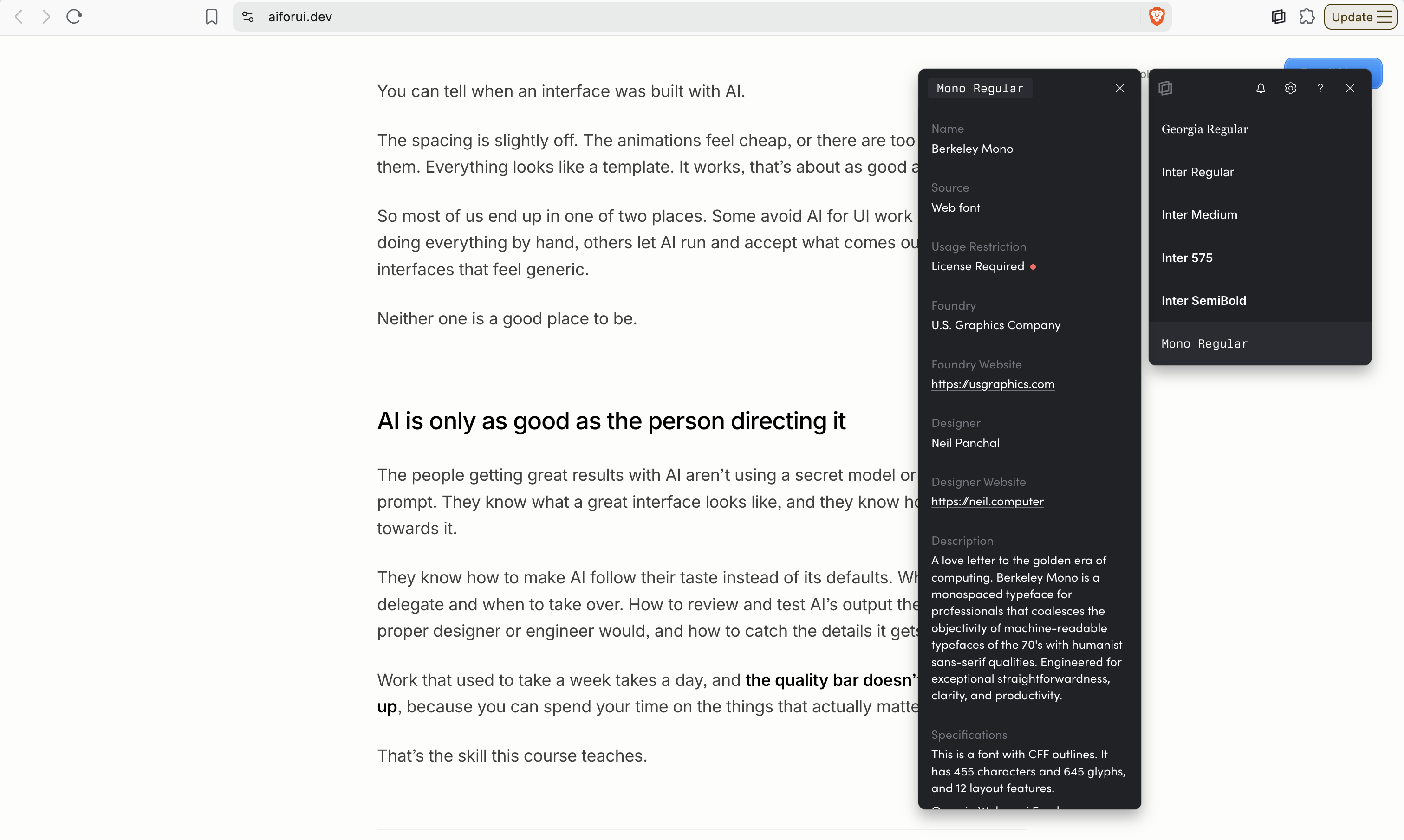
For example, the description in this screenshot gives some context about the typeface beyond its name and technical details.
 2




Categories
- All Categories
- 47 Introductions
- 4K Typeface Design
- 501 Type Design Critiques
- 593 Type Design Software
- 1.1K Type Design Technique & Theory
- 675 Type Business
- 910 Font Technology
- 29 Punchcutting
- 544 Typography
- 129 Type Education
- 333 Type History
- 82 Type Resources
- 114 Lettering and Calligraphy
- 33 Lettering Critiques
- 81 Lettering Technique & Theory
- 581 Announcements
- 101 Events
- 117 Job Postings
- 176 Type Releases
- 186 Miscellaneous News
- 270 About TypeDrawers
- 54 TypeDrawers Announcements
- 114 Suggestions and Bug Reports