diverging from conventions for Arabic joining

Peter Constable
Posts: 281
This is a question for Arabic script experts:
How strong or intrinsic are the conventions for which letters of Arabic script join on the left or the right? Is it conceivable that a designer could create a design setting some Arabic text in which some letters don't follow the normal conventions — e.g., having a beh not join on the left or on the right, or having an alef or dal join on the left?
Is it plausible that, given enough time, conventions could evolve so that common practice for joining (perhaps only in non-liturgical / Quranic text) is not what it is today?
How strong or intrinsic are the conventions for which letters of Arabic script join on the left or the right? Is it conceivable that a designer could create a design setting some Arabic text in which some letters don't follow the normal conventions — e.g., having a beh not join on the left or on the right, or having an alef or dal join on the left?
Is it plausible that, given enough time, conventions could evolve so that common practice for joining (perhaps only in non-liturgical / Quranic text) is not what it is today?
0
Comments
-
There are optional ligations, beyond standard joining behaviour, that occur in several styles of Arabic script. Some of these join together letter groups that would be separated under standard joining rules. For example, the ʾalif +ʿayn and dāl + ʾalif + lām sequences in this Ruqāʿ example (not to be confused with the Ruqʿah style that is the basis of much modern handwriting).
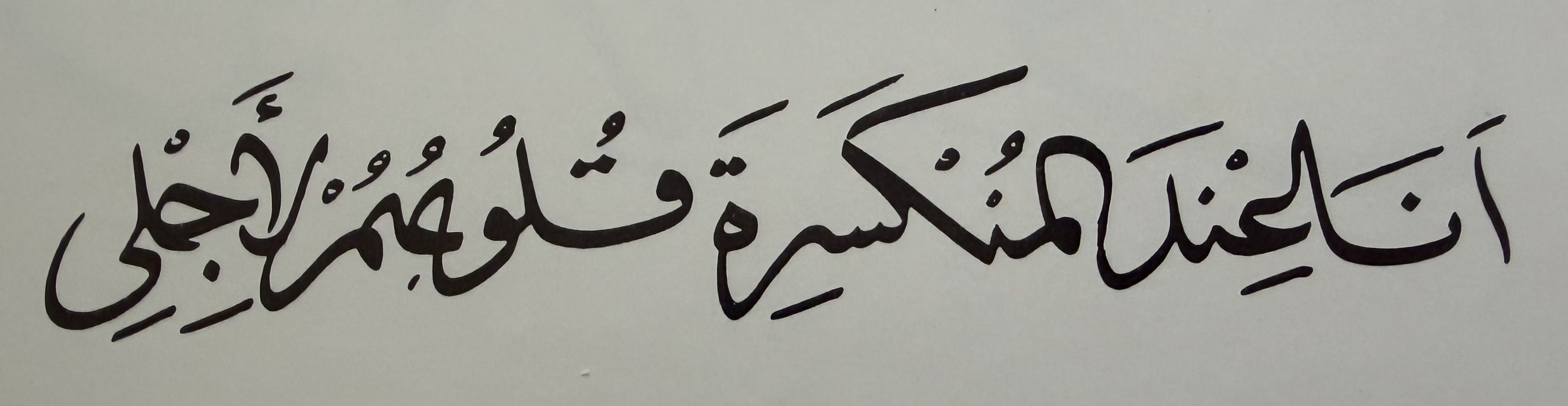 I’m not aware of any significant move towards changing or abandoning standard joining behaviours. There have been several proposals and models of disconnected Arabic script in the modern period, but none of them have caught on beyond the work of their inventors.3
 -
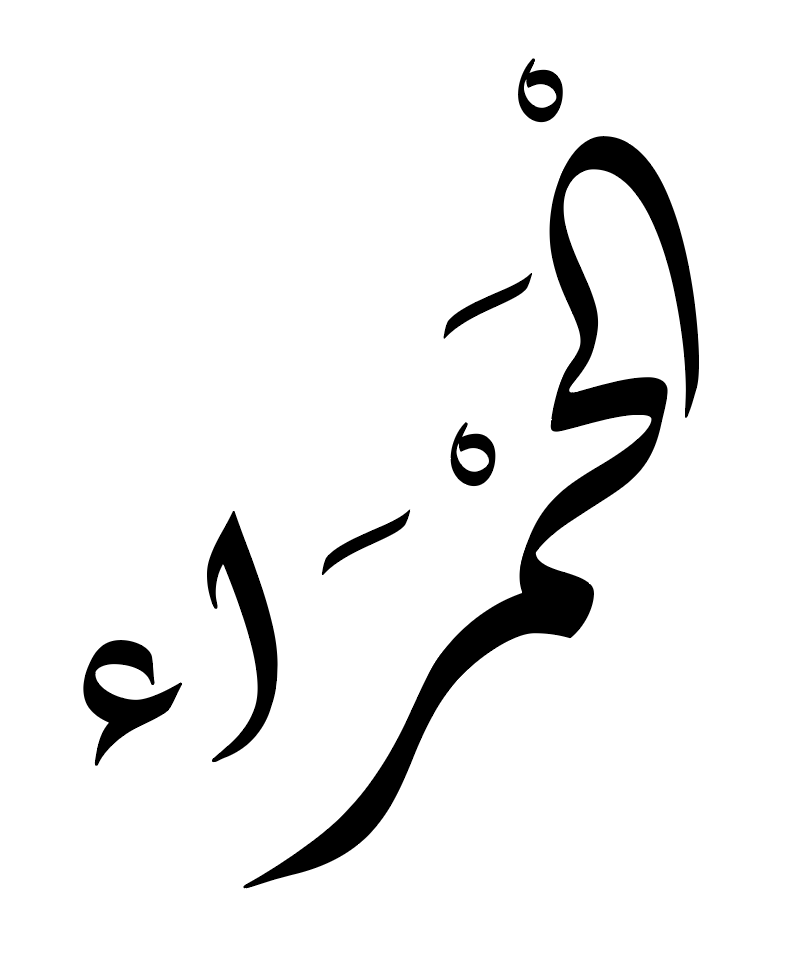
The Aldhabi font we made for Microsoft includes ʾalif + lām ligation. This kind of optional ligation, of course, has to be applied on top of the standard behaviour implemented in the joining features, using contextual substitutions. In Aldhabi, this is activated by the calt feature, as I recall, so users have an option to disable it.
2 -
Very insightful, John.
Speaking into the void here, but I did wonder if the limitations of hot metal type resulted in some 'subpar' non-joining Arabic typefaces being designed/crafted. I have no information on this, other than my question of whether limitations on metal-type production negatively impacted Arabic's joining behaviour.0 -
The majority of Arabic typography has involved some simplification of the script, and this precedes hot metal technologies. Most European reductions of the script to type involved a crude understanding of the ways in which letters in the various written styles combine, and reduced the number of variant forms needed to make those combinations. More complex graphical combinations, if supported at all, tended to be cast as ligatures, in order to fit within the typesetting model of sequential rectangular units. These inevitably fail to capture the flow of text as it would be written in the script, because they are inserted within the reduced set of joining forms.The biggest impact of hot metal typesetting was the introduction of ‘Simplified Arabic’, a Linotype typeface later known as Yakout, which was introduced for newspaper setting in Lebanon in the late 1950s. This design reuses the same form for many initial and medial letters, which allowed fitting to the Linotype 90-channel matrix case, and avoided the need for a supplementary or extended case. This speeded up composition. Similar techniques were used to fit Arabic to typewriters.Standard joining behaviour, in terms of analysis of which letters join on both sides vs on the right side only, is maintained in all this, though. What is lacking is the flexibility of the script in terms of how the letters connect. As a parallel, consider Latin cursive writing styles, in nearly all of which the o connects to following letters from the top. Now think of the various script style fonts in which all letters connect from and to the same location. That is the kind of simplification applied to Arabic, only of course applied to very many letters with various kinds of combining behaviours.2
-
There are some situations in Arabic script where non-joining letters also connect to the next letter. This happens especially when the writer wants to create a special letter fusion, which might be equivalent to a ligature in Latin. Letters that don't connect to the next letter are called «وارد» (meaning "to enter" in Persian), because most non-connecting letters derive their shapes from these four. In certain display contexts, «وارد» letters can occasionally connect to the following letter, but their shape changes far less than that of connecting letters, since greater alteration would make them too distinctive.
For connecting letters, there is no option to leave them unconnected. If they don't connect, their shape changes so much that it completely breaks the word form; a feature that varies far more from word to word in Arabic script than in Latin.1 -
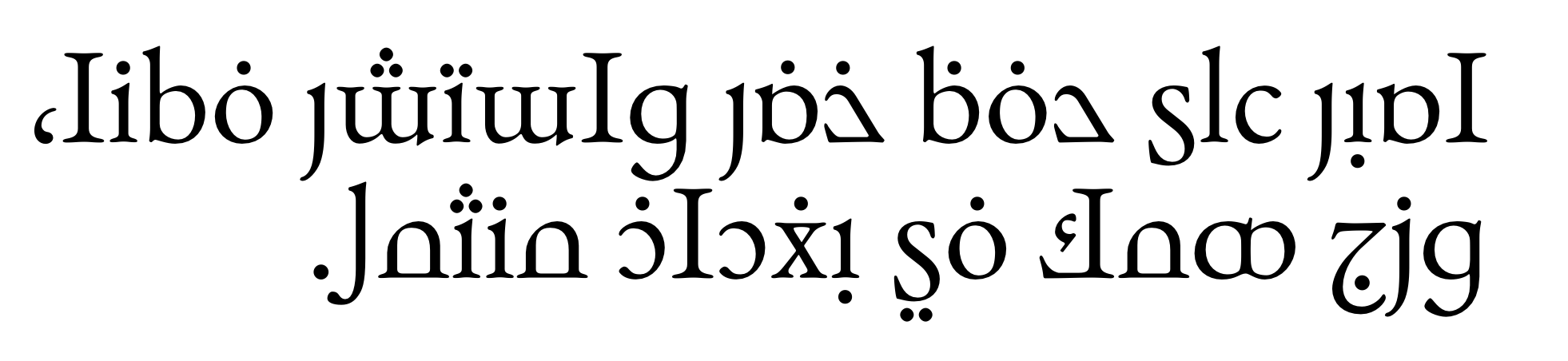
I wonder whether experiments like my Al-Gharamoun might still be usable for provocative settings, like the wordmark for a bar or something...
 -1
-1 -
Btw, what's behind my question is this: Unicode has a Joining_Type character property that is considered normative, and in software implementations it can drive (in combination with word position context) whether 'init', 'medi' or 'fina' features are applied. I was wondering if it might have made more sense for those features to be applied for all scripts based on word-position context alone, with actual joining alternates being up to the font designer, and for Joining_Type to be an informative property.0
-
The initial definions of the OTL init, medi and fina features were ambiguously worded, because they made reference to word position but were specified for scripts like Arabic in which word position is completely irrelevant to joining behaviour. Some years ago, we revised the wording of the feature descriptions to reflect how they are actually used — with one exception, noted below —, to implement Unicode ArabicJoining.txt properties. I believe it makes sense for those properties to be considered normative, especially in the context of OTL where string analysis can be performed by the shaping engine rather than having to be implemented via contextual substitution rules in individual fonts.
To my knowledge, word position analysis was only ever involved in one exceptional case: word-initial form substitution of Bengali ekar and oikar signs. [As an aside, those Bengali substitutions are functionally dependent on the init feature for Microsoft DWrite beng and bng2 shaping, because that engine is still subject to the cross-cluster contextual shaping limitation that was fixed in HarfBuzz and Apple Core Text more than a decade ago. There would be no way to implement these contextually at the GSUB level in a way that would work in DWrite.]
0 -
The examples of non-joining letters on the left actually joining up (as discussed by the others earlier) is accepted in certain calligraphic styles and the reader recognises that the connecting stroke is an artistic embellishment rather than a change to the integral structure of the letterform. Even in those cases, there are rules that govern such connections. However, I can't think of examples where the joining behaviour changed fundamentally. For example, a letter that used to join now stops joining completely, beyond artistic embellishments where a connecting stroke is drawn very thin, or open, or as a stencil. In other words, the connecting stroke is still somehow impliedPeter Constable said:This is a question for Arabic script experts:
How strong or intrinsic are the conventions for which letters of Arabic script join on the left or the right? Is it conceivable that a designer could create a design setting some Arabic text in which some letters don't follow the normal conventions — e.g., having a beh not join on the left or on the right, or having an alef or dal join on the left?
Is it plausible that, given enough time, conventions could evolve so that common practice for joining (perhaps only in non-liturgical / Quranic text) is not what it is today?
In terms of reading research, studies have shown that Arabic-specific orthography is deeply ingrained in Arabic readers to the point where it is extremely difficult to read when letters are shown without the usual attachments. If you'd like the citation let me know.
To the question, it is highly unlikely that these conventions would change, outside of the calligraphic swashes cited above.1 -
Christian Thalmann said:I wonder whether experiments like my Al-Gharamoun might still be usable for provocative settings, like the wordmark for a bar or something...
I don't want to derail the conversation but I saw this and I just have to say: Please no...2 -
That's fair. 🙃Nadine Chahine said:I don't want to derail the conversation but I saw this and I just have to say: Please no...0


Categories
- All Categories
- 47 Introductions
- 4K Typeface Design
- 495 Type Design Critiques
- 579 Type Design Software
- 1.1K Type Design Technique & Theory
- 672 Type Business
- 888 Font Technology
- 29 Punchcutting
- 540 Typography
- 125 Type Education
- 333 Type History
- 82 Type Resources
- 113 Lettering and Calligraphy
- 33 Lettering Critiques
- 80 Lettering Technique & Theory
- 569 Announcements
- 100 Events
- 116 Job Postings
- 170 Type Releases
- 182 Miscellaneous News
- 270 About TypeDrawers
- 54 TypeDrawers Announcements
- 114 Suggestions and Bug Reports