Explaining myself and Mixfont, an AI font generation model

I received some negative comments in a recent thread where I asked for critique on a font I created with the help of AI. The font itself is actually quite liked on Reddit (over 400+ upvotes in r/typography) but the Typedrawers thread began to include some personal attacks on me and the work I did on it. I wanted to start a new discussion (in accordance with the forum rules) to explain myself, the situation, and share more about the research I have done on Mixfont, which is a frontier AI model for generating fonts.
First let me state that I post here humbly and respectfully with full intention of learning from the experts here. I was told by professional typographers that this would be a positive community where I could ask for feedback.
Much of the negativity directed towards me stems from an old post I made on X. I'm not proud of the way I phrased that, and it was never my intention to help or allow people steal from type designers. The original intent behind the post was more about my frustration with large companies like Monotype, which in my opinion have taken a monopoly over typography, and started to charge insane prices with very litigious approaches, and in the process also have not paid the actual type designers. In retrospect, the post wasn't nuanced enough and I regret making it, but I've since left it up for transparency sake.
My hope is that some can see past the negativity and realize the potential behind the technology to help creatives and assist with the typographic process. Unfortunately, I don't control what goes viral, and if you read my other posts, you'll see there are tons of launches and screen-recordings that I share of legitimately useful workflows that never get any engagement.
Mixfont is my latest research project. It is a state-of-the-art AI font generator that can create TTFs from a text prompt or an image. Also, I'm not some billionaire AI CEO. I am a solo developer, and this project is completely bootstrapped and created by myself with no outside funding. I worked on this completely out of my own passion for typography and wanting to build technology that could help designers.
Stealing fonts and harming designers was never the intent of the software. One of the initial reasons I created this model was because creating fonts was such a tedious process. I wanted to create a simple font out of my handwriting, and I had to meticulously draw out each character. Once I finished the letters, I realized there were symbols, numbers, and hundreds more accented letters that I had to also complete to get a complete font.
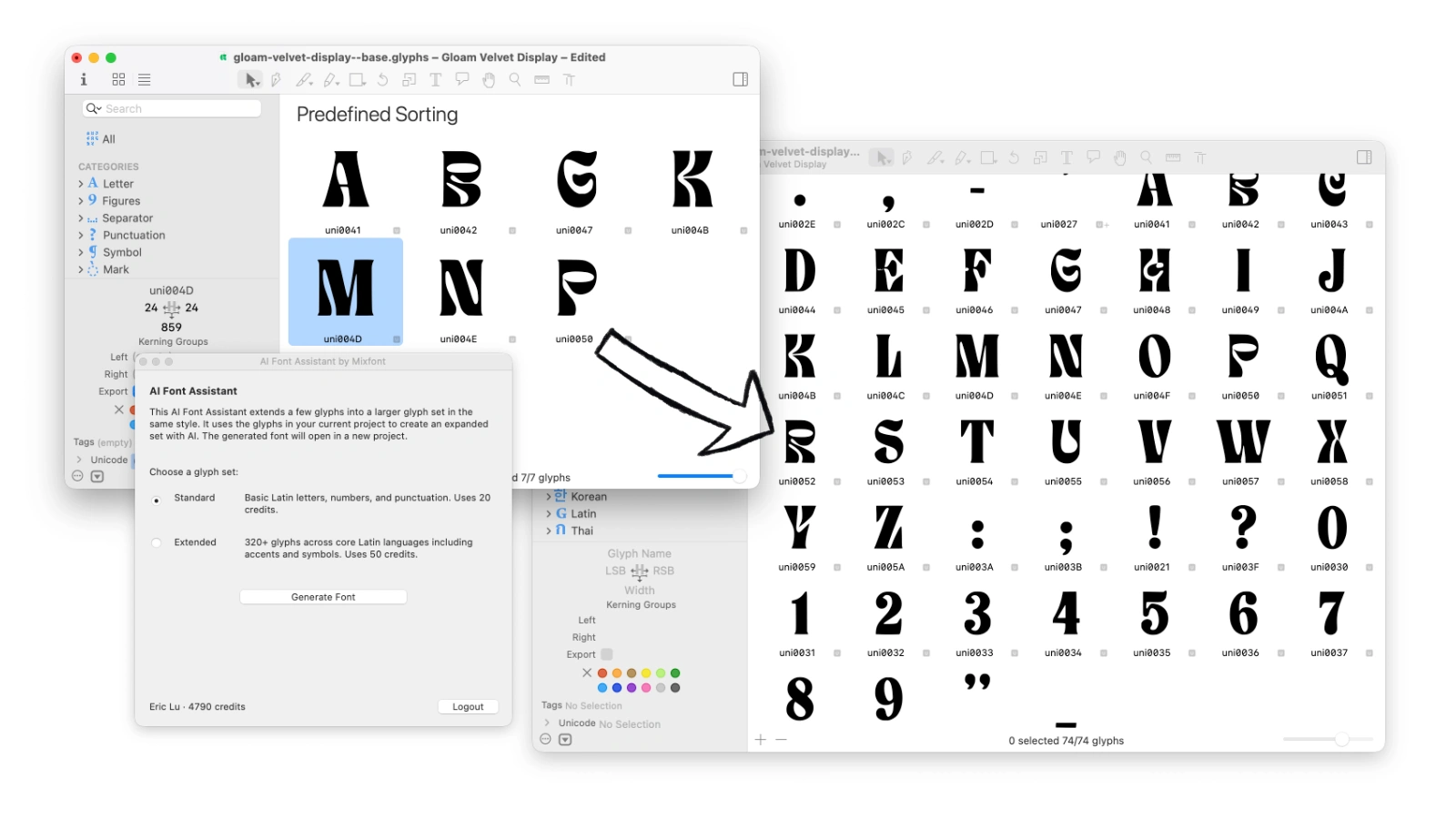
I believe there are many positive benefits that this model can provide for designers. One obvious application is to take an existing font, and extend the support of its glyphset to more Latin languages, especially minority languages with obscure letters like in Welsh, Basque, or Icelandic. This extension workflow can fit right into existing software like Glyphs:
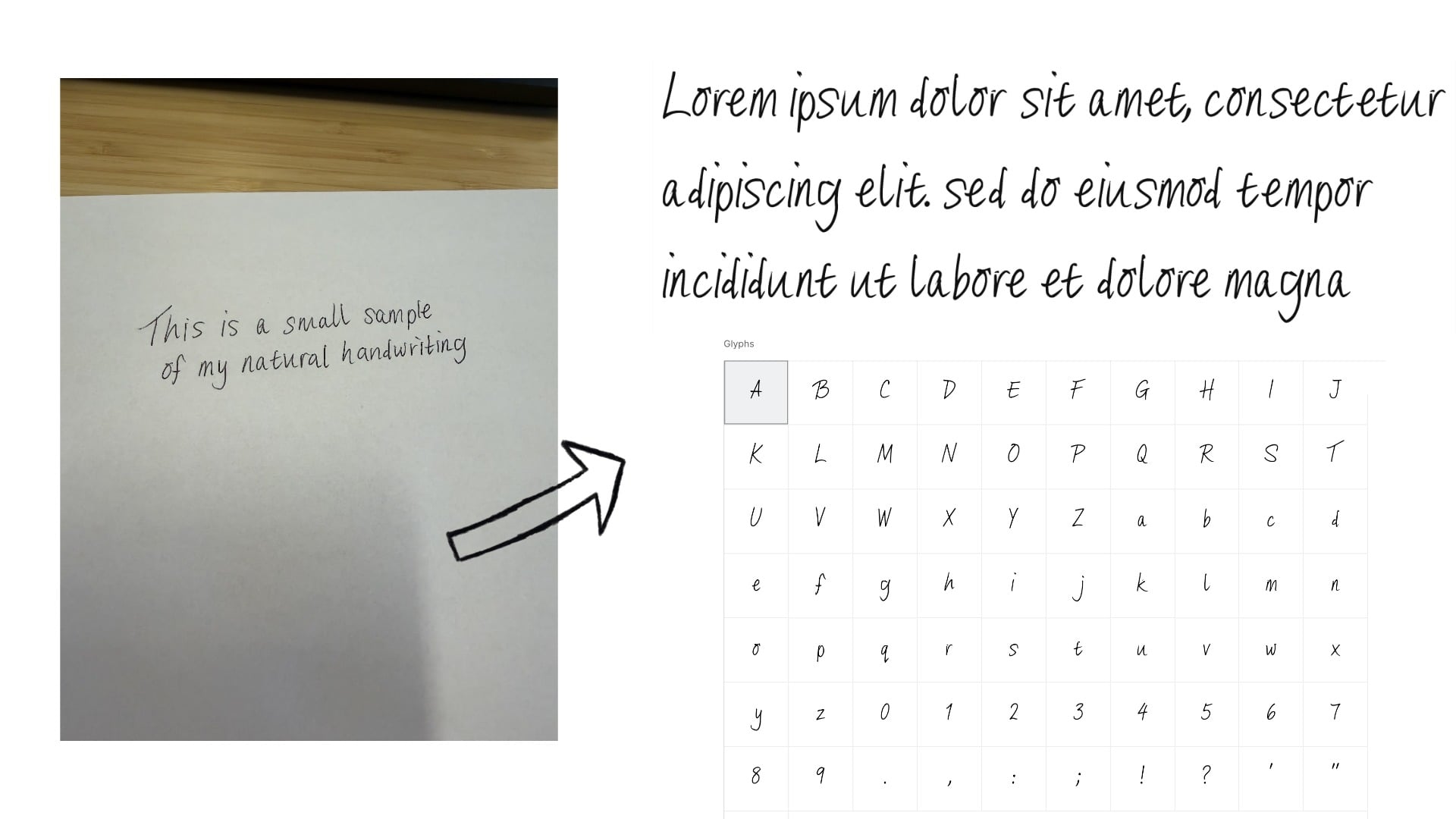
Another interesting application that the model is capable of is helping to explore new directions quickly. Instead of having to draw glyphs from scratch, the model can go directly from images to a complete set of letters. They are never perfect in one shot, but the ability to more quickly generate variations or explorations is important. In addition, the generated letterforms can be used as a starting point to start a manual tracing process or just to save time. Example of a generation from my own handwriting:

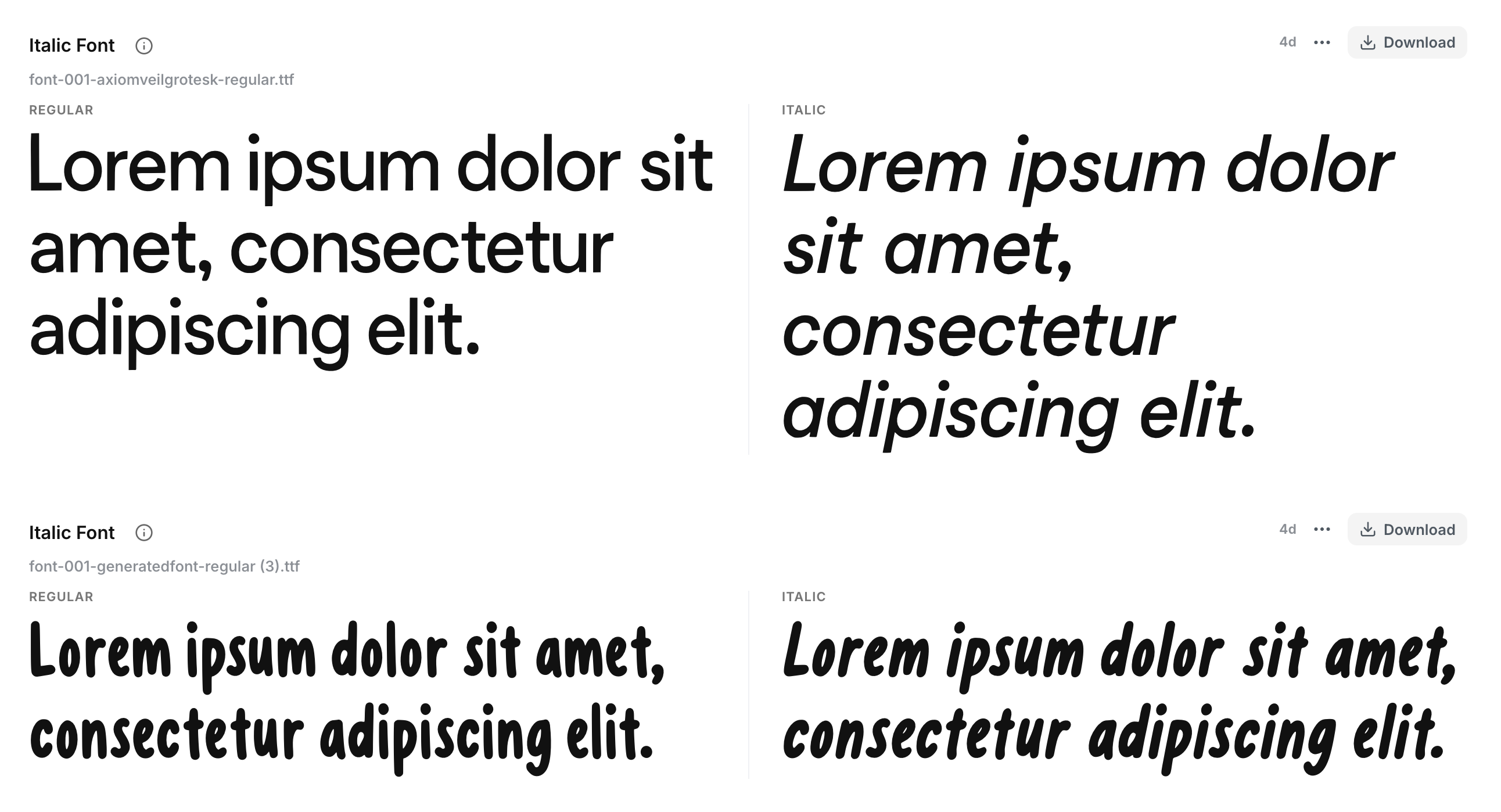
A final use case I wanted to share would be to generate variations of full fonts. Recently I used the model to generate an italic version of an existing typeface (example below). This way an underlying type design could be quickly extended with less tedious work from a designer. This technology can also be extended to generate light or bold variations as well.
I think that this technology can be very useful and helpful when employed in the right way. I don't believe any of the workflows I shared above are "ghastly" or "anti-human" as I was accused of in the other thread. I also think it can fit well into existing workflows and I see little difference between this and auto-tracing or auto-kerning algorithms that already exist today - these programs are created to speed up the workflow of type designers and enhance their work. Ultimately I believe that this can help creators more than it can hurt, because the human aspect of typography will always exist.
Finally I should address the training of the model. There were open source fonts (Google Fonts) that were used in the training but only to organize the format and spacing of the fonts. However, The vast majority of the training was not done on fonts at all. None of the copyrighted fonts from designers in this forum were used. Instead, it was trained entirely on raster images from across the internet - images of text and letters in things like signs, posters, screenshots, and more. That's how the model is able to output things like this for "a font that looks like dinosaurs":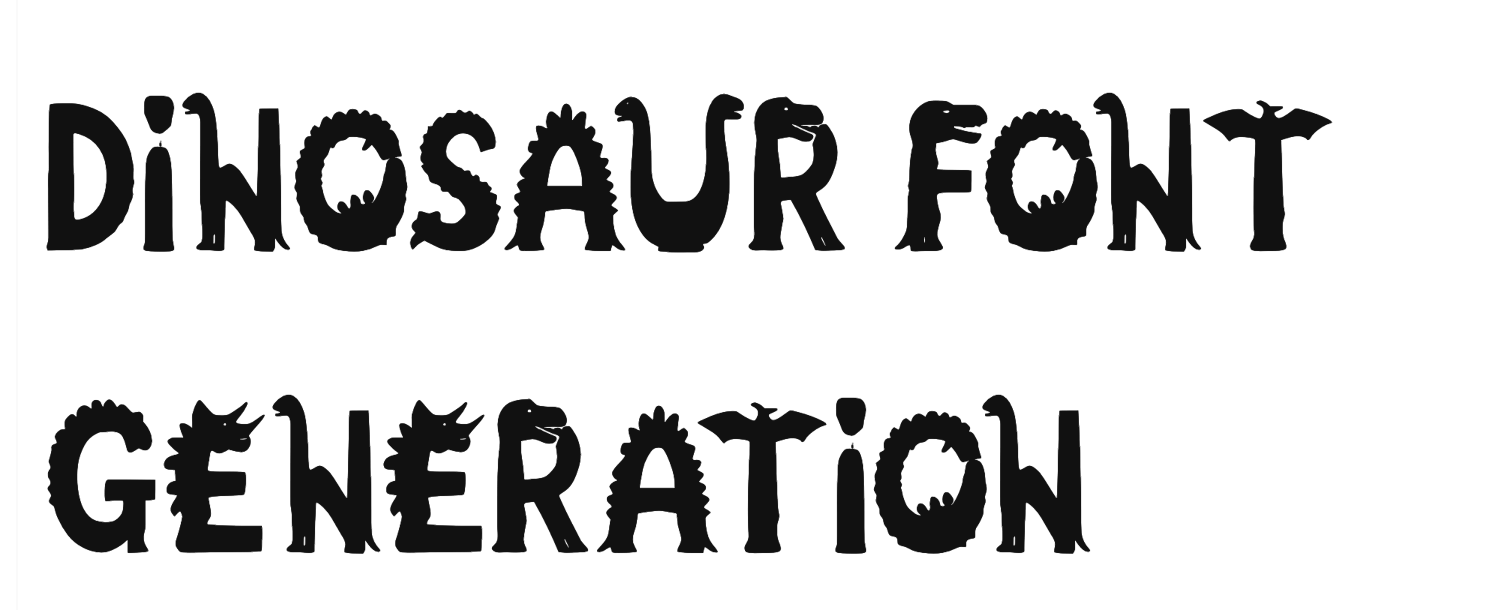
This font isn't copied nor was it trained on an existing "dinosaur font". The model itself is simply aware of the notion of what dinosaurs look like, and based on many images from across the internet, what letters look like, and combining the two together.
I don't believe that this tech will replace creatives. The outputs are not at the level of a human designer, and I don't even personally believe that they ever will. Instead, it should be used as a helpful tool and accelerator.
I hope to have a positive discussion about this tool and its applications. I have spoken with many typographers individually and even some who have literally cried with happiness about how this can help finish old projects or get rid of the tedious aspects of the work. I would love your feedback and I will make myself available for a conversation with anyone who would like to talk. DM me or respond to this post and I will be more than happy to set up a meeting to learn more about your fears, concerns, or just comments. I personally am becoming depressed from the hate, negativity, and personal attacks directed towards this project and I hope to address this and move forward.
First let me state that I post here humbly and respectfully with full intention of learning from the experts here. I was told by professional typographers that this would be a positive community where I could ask for feedback.
Much of the negativity directed towards me stems from an old post I made on X. I'm not proud of the way I phrased that, and it was never my intention to help or allow people steal from type designers. The original intent behind the post was more about my frustration with large companies like Monotype, which in my opinion have taken a monopoly over typography, and started to charge insane prices with very litigious approaches, and in the process also have not paid the actual type designers. In retrospect, the post wasn't nuanced enough and I regret making it, but I've since left it up for transparency sake.
My hope is that some can see past the negativity and realize the potential behind the technology to help creatives and assist with the typographic process. Unfortunately, I don't control what goes viral, and if you read my other posts, you'll see there are tons of launches and screen-recordings that I share of legitimately useful workflows that never get any engagement.
Mixfont is my latest research project. It is a state-of-the-art AI font generator that can create TTFs from a text prompt or an image. Also, I'm not some billionaire AI CEO. I am a solo developer, and this project is completely bootstrapped and created by myself with no outside funding. I worked on this completely out of my own passion for typography and wanting to build technology that could help designers.
Stealing fonts and harming designers was never the intent of the software. One of the initial reasons I created this model was because creating fonts was such a tedious process. I wanted to create a simple font out of my handwriting, and I had to meticulously draw out each character. Once I finished the letters, I realized there were symbols, numbers, and hundreds more accented letters that I had to also complete to get a complete font.
I believe there are many positive benefits that this model can provide for designers. One obvious application is to take an existing font, and extend the support of its glyphset to more Latin languages, especially minority languages with obscure letters like in Welsh, Basque, or Icelandic. This extension workflow can fit right into existing software like Glyphs:
Another interesting application that the model is capable of is helping to explore new directions quickly. Instead of having to draw glyphs from scratch, the model can go directly from images to a complete set of letters. They are never perfect in one shot, but the ability to more quickly generate variations or explorations is important. In addition, the generated letterforms can be used as a starting point to start a manual tracing process or just to save time. Example of a generation from my own handwriting:

A final use case I wanted to share would be to generate variations of full fonts. Recently I used the model to generate an italic version of an existing typeface (example below). This way an underlying type design could be quickly extended with less tedious work from a designer. This technology can also be extended to generate light or bold variations as well.
I think that this technology can be very useful and helpful when employed in the right way. I don't believe any of the workflows I shared above are "ghastly" or "anti-human" as I was accused of in the other thread. I also think it can fit well into existing workflows and I see little difference between this and auto-tracing or auto-kerning algorithms that already exist today - these programs are created to speed up the workflow of type designers and enhance their work. Ultimately I believe that this can help creators more than it can hurt, because the human aspect of typography will always exist.
Finally I should address the training of the model. There were open source fonts (Google Fonts) that were used in the training but only to organize the format and spacing of the fonts. However, The vast majority of the training was not done on fonts at all. None of the copyrighted fonts from designers in this forum were used. Instead, it was trained entirely on raster images from across the internet - images of text and letters in things like signs, posters, screenshots, and more. That's how the model is able to output things like this for "a font that looks like dinosaurs":
This font isn't copied nor was it trained on an existing "dinosaur font". The model itself is simply aware of the notion of what dinosaurs look like, and based on many images from across the internet, what letters look like, and combining the two together.
I don't believe that this tech will replace creatives. The outputs are not at the level of a human designer, and I don't even personally believe that they ever will. Instead, it should be used as a helpful tool and accelerator.
I hope to have a positive discussion about this tool and its applications. I have spoken with many typographers individually and even some who have literally cried with happiness about how this can help finish old projects or get rid of the tedious aspects of the work. I would love your feedback and I will make myself available for a conversation with anyone who would like to talk. DM me or respond to this post and I will be more than happy to set up a meeting to learn more about your fears, concerns, or just comments. I personally am becoming depressed from the hate, negativity, and personal attacks directed towards this project and I hope to address this and move forward.
Tagged:
2
Comments
-
I don't believe any of the workflows I shared above are "ghastly" or "anti-human" as I was accused of in the other thread.You completely misrepresent what I said.
I specifically referred to the “big picture” of what AI is doing, not type design concerns.
Surely you are familiar with the environmental cost of data centres, the destabilizing effects of deep fakery, the creepy chatbot friends, the political influence of the tech bros, etc., etc.?
These are the reasons to avoid using AI.9 -
Intent doesn't matter; outcome matters.ericlu said:Stealing fonts and harming designers was never the intent of the software.4 -
Thanks for taking the time to make this clarification post, Eric (although I still strongly disagree with using any generative tools in type design). There are numerous ethical downsides, which Nick already listed above me, but I also fail to understand why you’d want to skip the most enjoyable part of the type design process?The vast majority of the training was not done on fonts at all. None of the copyrighted fonts from designers in this forum were used. Instead, it was trained entirely on raster images from across the internet - images of text and letters in things like signs, posters, screenshots, and more.Wouldn’t these images of signs be using copyrighted typefaces, even if you’re not directly scraping from an .OTF file?3
-
Nick Shinn said:I don't believe any of the workflows I shared above are "ghastly" or "anti-human" as I was accused of in the other thread.You completely misrepresent what I said.
I specifically referred to the “big picture” of what AI is doing, not type design concerns.
Surely you are familiar with the environmental cost of data centres, the destabilizing effects of deep fakery, the creepy chatbot friends, the political influence of the tech bros, etc., etc.?
These are the reasons to avoid using AI.
AI like any many other technologies has both positive and negative effects and has to be used carefully and with responsibility. I agree with you that there are many scary applications, although I personally choose to believe that it does more good than harm. Many aspects of my life and workflow have become easier now with the help of AI. One example of this specifically is being able to use it for better language learning and thus being able to communicate better with my parents and extended family. While this isn't exactly relevant to typography, I think it's important to avoid blanket statements when the reality is more nuanced.
0 -
Simon Cozens said:
Intent doesn't matter; outcome matters.ericlu said:Stealing fonts and harming designers was never the intent of the software.
There have not been any outcomes of anyone using the model to circumvent copyrighted fonts instead of paying designers, if that is what you are referring to. The usage on the website in general is very minimal and so far has been entirely focused on streamlining workflows for designers. Personally I have paid for many font licenses and plan to continue doing so in order to support designers (though I always try to buy directly from foundries or designers, as opposed to Monotype).0 -
Tofu Type Foundry said:Thanks for taking the time to make this clarification post, Eric (although I still strongly disagree with using any generative tools in type design). There are numerous ethical downsides, which Nick already listed above me, but I also fail to understand why you’d want to skip the most enjoyable part of the type design process?The vast majority of the training was not done on fonts at all. None of the copyrighted fonts from designers in this forum were used. Instead, it was trained entirely on raster images from across the internet - images of text and letters in things like signs, posters, screenshots, and more.Wouldn’t these images of signs be using copyrighted typefaces, even if you’re not directly scraping from an .OTF file?
I ask humbly and respectfully: Is it truly enjoyable for you to have to draw from scratch every variation of an accented letter, like ì, í, î, ï, ǐ, ĩ, ī, and ı? Is it enjoyable to have to create multiple weight variations and italics for each font that you create? Is it enjoyable to go through the process of ideating with a client, working from scratch on a new concept for hours only to have the client reject the design direction completely? Or could it be better to generate a few conceptual ideas up front and work off of those visualizations as a starting point?
From the designers I've spoken to, many say that their favorite part is creating the letterforms. Not endless client back and force, or outlining vectors, or creating tedious variations. An AI font generation model like Mixfont can reduce those parts of the process.
As for your second question, yes, it is possible that images like screenshots or signs contain text created from copyrighted fonts. I think legally this is very different from downloading TTFs or OTFs and training directly on copyrighted files. That said, I think there is a moral question on whether this should be ok. However I am on the side that the benefits that this can bring to designers can outweigh the moral downsides.
0 -
That is precisely what you encouraged people to use the model for. Even today, your website advertises Mixfont as a way to "solve complex font licensing restrictions". We all know what that means. But I was talking about the provenance of your training data. Maybe it was all free and open source licensed fonts. We have only your word for it.ericlu said:There have not been any outcomes of anyone using the model to circumvent copyrighted fonts instead of paying designers, if that is what you are referring to.Instead, it should be used as a helpful tool and accelerator.This doesn't make any sense. Let's assume your model produces an initial set of glyphs, but the outline quality is poor (it is), and the spacing and kerning is also poor (it is). And now you say that it isn't intended to replace a human designer, and the human designer has to do all the polish and tidy up.
So the model does the fun design part and the human is left with the grunt work. That is the very opposite of reducing tedium.
You can't have it both ways. You can't say "this is software to make fonts for you", and "our mission is to make original typography accessible to everyone", but then also say "This does not replace designers and you need to be a designer to finish it off". Which is it?
If you want to help designers, talk to designers and find out how they want to use AI to produce high-quality fonts, what would help and what would not help. You might find out, for example, that generating accented variants isn't actually a problem because it's all componentized. You might find out that there are good automations for generating slanted masters already. You might find out that some people - and this I have no ability to relate to all - actually enjoy the process of kerning, but checking kerning is a real PITA and tools to help with that would be great.
But walking into a forum full of type design enthusiasts and telling them that type design is "a tedious process" and here's an AI which does it instead is... kinda failing to read the room.19 -
AI like any many other technologies has both positive and negative effects and has to be used carefully and with responsibility.The ethical issue is not about you being responsible in how you use it to make fonts.
It’s about supporting something which is fundamentally malignant.
So, you’re cool with the environmental and social harm of data centres, the brain rot inflicted on children (future adults), the deep fakery undermining democracy, out-of-control fraud and cybercrime, the massive transfer of wealth to the broligarchs, the political influence of said bros, the existential threat of rogue software, future wars fought with AI-enabled autonomous cyborgs, &c., &c.?
There is no nuance, no balance of positive and negative, the scales are tipped to bad, bad, bad.
It’s disingenuous to pass the buck to government for mitigating its harms. Look at the history of social media, which blew up 15 years ago. Only now are countries like Australia, Canada and the UK (this week) getting around to legislating its use to protect children. The case between The New York Times and OpenAI, which began in 2023, is not expected to be resolved until 2029. But what new shenanigans will AI be up to then?1 -
@Tofu Type FoundryWouldn’t these images of signs be using copyrighted typefaces, even if you’re not directly scraping from an .OTF file?@ericluAs for your second question, yes, it is possible that images like screenshots or signs contain text created from copyrighted fonts. I think legally this is very different from downloading TTFs or OTFs and training directly on copyrighted files.Note the law around protection of typefaces and fonts varies by jurisdiction and no global legal judgement can be made. In some jurisdictions, typeface design itself is protected by copyright, while in others only the font software is. There are also alternative protections for typefaces design available in some jurisdictions, such as design patent or registered industrial design.
For me, the ethical question — and hence what the legal question should be — comes down to whether a derivative work is created that produces exploitative value for the maker of that derivative work — or for another party, such as a client or other users of the derivative font — without compensating the maker of the original. That’s just unpaid exploitation of another person’s creativity and labour.1 -
@ericluI ask humbly and respectfully: Is it truly enjoyable for you to have to draw from scratch every variation of an accented letter, like ì, í, î, ï, ǐ, ĩ, ī, and ı? Is it enjoyable to have to create multiple weight variations and italics for each font that you create? Is it enjoyable to go through the process of ideating with a client, working from scratch on a new concept for hours only to have the client reject the design direction completely? Or could it be better to generate a few conceptual ideas up front and work off of those visualizations as a starting point?You don’t have to draw from scratch every variaton of an accented letter. You have to design a system of components and the way they are put together. In most of today’s font tools, this is done with anchors, and knowing how to define anchors so that composite diacritics can be generated automatically is part of the knowledge base of manufacturing digital fonts.
For the rest of what you describe, such as making weight variations and italics, this is the work. Is all of it equally enjoyable? No, but it is what trains skills and shapes us as people who make this particular class of thing. I grew up around artists, and I came to realise — although I only found the words for it recently — that the art, in the sense of a product — a painting, or a sculpture — was only part of what they were making, and not always the important part. They were making themselves as makers, which is what is often lost when expediencies, conveniences, or short cuts are employed. I am not sure what Nick meant by ‘anti-human’ in the other thread, but part of what it means for me is that removal of the human from the process of making unmakes or stunts the human, and reduces the made thing to a mere product, which is of course how the tech capitalists view everything.
I have worked for more than thirty years creating custom typeface designs and fonts for clients, and in that time I have only once provided more than one option (in that case, the commission was specifically to provide five possible directions for the client to take, and I was paid for all five design concepts). Typeface design is about understanding a need, coming up with the concept that addresses that need, and then spending months gradually refining that idea in your mind — not only while working on the font source, but while walking in the woods, digging in the garden, or doing other activities that provide time for thinking.20 -
yes. cultural exchange (well, usually in one direction for me) in review with local experts is one of the highlights of working on typeericlu said:
I ask humbly and respectfully: Is it truly enjoyable for you to have to draw from scratch every variation of an accented letter, like ì, í, î, ï, ǐ, ĩ, ī, and ı?Is it enjoyable to have to create multiple weight variations and italics for each font that you create?
yes. if I had endless time I wouldn't interpolate anything, deterministically or otherwiseIs it enjoyable to go through the process of ideating with a client, working from scratch on a new concept for hours only to have the client reject the design direction completely?
working with clients is another one the highlights of the process. are you familiar with it?From the designers I've spoken to, many say that their favorite part is creating the letterforms. Not endless client back and force, or outlining vectors, or creating tedious variations.
which designers did you speak to?4 -
John Hudson said:this is the work. Is all of it equally enjoyable? No, but it is what trains skills and shapes us as people who make this particular class of thing. I grew up around artists, and I came to realise — although I only found the words for it recently — that the art, in the sense of a product — a painting, or a sculpture — was only part of what they were making, and not always the important part. They were making themselves as makersI hadn't refreshed my screen in time or I probably wouldn't have commented after this - that's a lovely way to put it, john.2
-
A couple of things not yet mentioned:
1: Reddit is really not a place to solicit informed opinions or to gather solid critical approval. I see utterly un-informed, basic, first-stab student work there praised with the unction and enthusiasm of parents seeing their child's first finger paintings. Consider that source.
2: You characterize the iterative development step of testing alternate ideas and variants as more tedium. For those of us with manual drafting skills, this is not only a richly rewarding process and stage, but also a surprisingly efficient one; the benefits you imagine only available via automation are literally present in our ability to simply draw alternate shapes; to sketch and test and instantly review them. The iteration and exploration are both fun and bountiful parts of typeface development.
As others have said, if we can find ways to get AI or other automations (many of which have been availlable) to do the actually tedious, repetitive, mechanical work, that would be welcome. But the whole endeavor of making typefaces is fairly methodical and investigative. Maybe you want to automate a different activity. At the very least, I think understanding the activity better would be a stronger base to try improving it.9 -
Is Mixfont legal?0
-
ericlu said:
Where do you take the information from that Monotype doesn't pay actual type designers?Monotype, which in my opinion have taken a monopoly over typography, and started to charge insane prices with very litigious approaches, and in the process also have not paid the actual type designers.
1 -
John Hudson:Typeface design is about understanding a need…That’s not how I work, unless the need is to satisfy my curiosity about “I wonder if I could develop these shapes into a working font…”
Then I put it on the market and see if it does in fact stimulate a need, latent or otherwise.
Some designs succeed absurdly, others have been licensed by absolutely no one—it’s impossible to predict which.
As the great Jobs put it, “Customers don’t know what they want until you show it to them.”6 -
Hello Eric,I like to think in metaphors; imagine you walk into a bar packed with artists. Artists who live for the music and come up with, produce, and try to sell everything themselves, because that is what they want to do and have spent their entire lives on. They live for the music and their instruments.Offering them an AI tool that would allow them to make their music 'faster' or 'better' would be more of an insult than a good idea.That is how I see the world of type design. They are all artists who live for their work.
Cheers, Coen.6 -
Nick, I was responding to a question specifically about working with clients, so I was presuming commissioned typeface design, not something developed speculatively or, as you nicely put it, to satisfy one’s own curiosity. Taken in total, type design emerges from divers urges. That said, even when working on something for my own explorative purposes, I do tend to think in terms of a need: ‘What is this typeface for?’5
-
Have you actually tried the font generator? I don't understand how you can make these claims without having tested it out for different outputs. Each output is completely unique so I don't understand how you can make this claim across the board, without having even tried it.Simon Cozens said:Instead, it should be used as a helpful tool and accelerator.This doesn't make any sense. Let's assume your model produces an initial set of glyphs, but the outline quality is poor (it is), and the spacing and kerning is also poor (it is).This is exactly what I'm trying to do. I'm trying to have a open and honest dialogue in Typedrawers with designers just like you. What I'm finding is that I'm being attacked at a personal level instead of getting actionable feedback on applications that would help. I think your idea on kerning is a great idea. If I trained an AI model that helped with checking or implementing kerning, would that be something you would view as helpful?You can't have it both ways. You can't say "this is software to make fonts for you", and "our mission is to make original typography accessible to everyone", but then also say "This does not replace designers and you need to be a designer to finish it off". Which is it?
If you want to help designers, talk to designers and find out how they want to use AI to produce high-quality fonts, what would help and what would not help. You might find out, for example, that generating accented variants isn't actually a problem because it's all componentized. You might find out that there are good automations for generating slanted masters already. You might find out that some people - and this I have no ability to relate to all - actually enjoy the process of kerning, but checking kerning is a real PITA and tools to help with that would be great.
I'm not sure I understand why you see a difference between the technology in Mixfont and the automations that you mentioned above. Generating accented variants or generating slanted masters via automations - these are technologies that help make it easier to make fonts. Why do you feel like those automations are not replacing designers?I'm willingly here because I want to engage and have a productive conversation. If my goal was truly to replace everyone here (and if the technology could indeed do that), why would I even have this dialogue? I do believe that there are tedious parts of type design and I strongly believe that there are ways that technology like AI can be helpful to many parts of the design process.But walking into a forum full of type design enthusiasts and telling them that type design is "a tedious process" and here's an AI which does it instead is... kinda failing to read the room.
0 -
C.Fransen said:Hello Eric,I like to think in metaphors; imagine you walk into a bar packed with artists. Artists who live for the music and come up with, produce, and try to sell everything themselves, because that is what they want to do and have spent their entire lives on. They live for the music and their instruments.Offering them an AI tool that would allow them to make their music 'faster' or 'better' would be more of an insult than a good idea.That is how I see the world of type design. They are all artists who live for their work.
Cheers, Coen.
Coen, I appreciate your response and engaging with me kindly. I never meant for any of my posts to be an insult and I apologize if things came off that way towards you.
My response to this is that artists already use many tools that make their music "faster" or "better". They use software like Ableton, Fruityloops, etc which help them edit and create faster than with traditional recording devices. They use sampling as a method to base new music from other songs. I think that a more open and embracing attitude towards new technologies has potential to improve the workflow for both music and type design alike.1 -
Yes it is. Why would it not be?Igor Petrovic said:Is Mixfont legal?0 -
I appreciate your response Carl.Carl Crossgrove said:A couple of things not yet mentioned:
1: Reddit is really not a place to solicit informed opinions or to gather solid critical approval. I see utterly un-informed, basic, first-stab student work there praised with the unction and enthusiasm of parents seeing their child's first finger paintings. Consider that source.
2: You characterize the iterative development step of testing alternate ideas and variants as more tedium. For those of us with manual drafting skills, this is not only a richly rewarding process and stage, but also a surprisingly efficient one; the benefits you imagine only available via automation are literally present in our ability to simply draw alternate shapes; to sketch and test and instantly review them. The iteration and exploration are both fun and bountiful parts of typeface development.
As others have said, if we can find ways to get AI or other automations (many of which have been availlable) to do the actually tedious, repetitive, mechanical work, that would be welcome. But the whole endeavor of making typefaces is fairly methodical and investigative. Maybe you want to automate a different activity. At the very least, I think understanding the activity better would be a stronger base to try improving it.
I want you to know that just because this technology exists does not mean you can't keep your current process. I'm not trying to replace anything. I believe that this is simply another option that you could try in order to speed up your process. But no one said it's required.
I would love your ideas on other applications of AI. My goal is to make it as useful as possible to all the designers here. What activities would you suggest? This is exactly what I am trying to understand.0 -
Which font base does it use for AI learning? Is it aware of the non-modification clause in font licenses?ericlu said:
Yes it is. Why would it not be?Igor Petrovic said:Is Mixfont legal?1 -
I mentioned this in my original post. It's not trained on TTF font files at all, rather it's trained on images (some containing text, but many not) from across the internet. I'm not sure which specific non-modification clause you are referring to, but the training was not done directly on font files.Igor Petrovic said:Which font base does it use for AI learning? Is it aware of the non-modification clause in font licenses?0 -
For me, who's comfortable working alone, AI has become an assistant for other parts of the production and distribution of work: Poster presentations, font descriptions, email response partners, and even legal assistants. Now, some friends who don't understand coding can create websites with really cool font previews all by themselves using AI.I think it's crucial to have websites/tools that can detect and pointing out fonts circulating on the internet as piracy detectives. Perhaps AI could play a big role here.Font designers who enjoy the process won't want to use AI to replace the craftsmanship in their font creations. Where's the expertise?1
-
That’s (legally) fine for jurisdictions and legal protections that only apply to vector fonts, but the visual appearance of a font is legally protected in many jurisdictions, including by design patents (USA), design rights (all of the EU) and even in some jurisdictions by copyright (including in the UK and some EU countries). The exact bar of similarity required varies quite a bit, but it is definitely a thing.ericlu said:
I mentioned this in my original post. It's not trained on TTF font files at all, rather it's trained on images (some containing text, but many not) from across the internet. I'm not sure which specific non-modification clause you are referring to, but the training was not done directly on font files.Igor Petrovic said:Which font base does it use for AI learning? Is it aware of the non-modification clause in font licenses?7 -
Human beings read or listen to copyrighted works, and learn from them. What they have learned then goes into works they themselves create.Since an AI model runs on a machine, it is understandable that if it is trained on copyrighted works, this can be regarded as theft pure and simple. Even if others, who are more positive about the technology, would find what happens during the training of an AI model to be sufficiently abstracted from the input works as to be in some sense equivalent to human learning.Obviously, AI is a threat to the livelihoods of creators - whether type designers or cinematographers.Given, though, that AI appears to allow mere ordinary mortals to... bring into existence, if not create... motion pictures of feature film length, something which, when done the Hollywood way, requires immense resources, I'm hesitant to view it as good for nothing. It seems to open up new possibilities of genuine value.The energy consumption - and pressure on the market for memory chips and processors - of the current AI data center building boom, though, is another issue, and here being negative seems to me to be fully justified without a concern that one is getting into Ludditism.1
-
I'm trying to have a open and honest dialogue in Typedrawers with designers just like youDesigners just like me? Okay.
Eric, this is going to be my last contribution to the thread, and hopefully you'll see why. I actually want to encourage you to keep going with what you're doing, and hopefully others will see why.
You came here as a programmer, not a typographer, not a designer. That's OK. So did I. I came here a few years back as a programmer who was interested in type. I had big dreams about both drawing type and automating the drawing of type. I proudly showed off what I'd been working on, and some of the really big names in type design here kindly but honestly tore it to shreds. I'm not sure I considered it kind at the time. Like you, I interpreted it as a personal attack. It wasn't, but it felt like it - because that's a completely normal reaction to people being negative about something that you've worked really hard on. I understand.
But it's impossible to have an "open and honest" dialogue when you feel like you're being attacked. You go into defensive mode. You try to persuade others (or yourself) that they're wrong. When you're in defensive mode, you can't learn. Which is why I think more contributions to this thread are just pointless right now. Set a calendar reminder to come back to it in a year, when you're a little less emotionally close to it.
In my case, after I recovered from feeling attacked, I stepped back. I looked again at what they were saying. They were right! My outlines were crap. The spacing was inconsistent. The design was a mismatch. Dammit, they were right. I realised that the reason for their negative feedback was that they were too kind to leave me where I was and they wanted me to get better.
So I tried again. I failed again. I studied. I hung around type designers and began to appreciate the complexity and precision of their craft. I tried again. I failed again. But through that process, I learnt to see. I trained my eyes. I learnt the difference between good type and bad type. If you haven't trained your eyes, you simply won't see that.
Type design is very deceptive because it's easy to draw a series of recognisable letter forms. Hooray, I made a font! It's easy to make a font if you don't know the difference between a good font and a bad font. Very easy. And so it's very easy to develop a lack of humility. You start to ask yourself "Why can't other people see how good this is?" Such a question does not help you grow; does not help you make better type. Instead I started to ask myself, "Why can't I see how bad this is?" Now that's a growth question.
Right now I still don't trust myself to make type. I'm at that dangerous but exciting point in the growth curve where I'm good enough to know how bad I am. It's exciting because all the actual designers here have been through that point in the growth curve and come out the other side. It's a good point because if I can actually see that my designs are crap, then I know my eyes are working properly! I can just about make adjustments to other people's fonts, but really, I'm not a designer; I know that my contribution is best placed on the technical side. It feels really great to find your niche.
But on the other hand, lack of humility combined with the inability to see is a killer. I'm going to talk about spacing and kerning, not because it's the most important part - others can tell you more about design consistency or outline quality - but because it's my particular hobby-horse.
"If I trained an AI model that helped with checking or implementing kerning, would that be something you would view as helpful?", you say, breezily. Just train an AI model to implement kerning. Sure, give it a go!
But perhaps, before doing so, maybe look into the prior art. You will discover that there are entire PhD theses about automated letter-fitting. You will discover that there have been, to date, at least seventy different attempts to automate letter-fitting, and yes, some of them use AI models, and that after these seventy different attempts, designers still don't use fully-automated kerning tools because they aren't good enough.
There are particular technical reasons why it's hard which we could go into - it's an exceptionally sparse manifold, and because designers don't always kern every single pair - and because not all fonts are good fonts - it's impossible to trust that the training data actually contains positive examples. I could say more, but that's not the point I'm trying to make.
The point I'm trying to make is that, on learning this, a humble person might then say "perhaps this isn't just something I can solve by throwing a stack of CNNs at it". I wonder you would say.
You might think I'm trying to put you off. I'm genuinely not. I honestly hope you try, and I honestly hope you succeed! We would all love a solution to this! (Apart from those weird guys who enjoy kerning.) I don't care where that solution comes from.
But for it to actually be a solution, it needs to be a good solution. And of course, if you haven't learnt to see yet, then you will never actually know if it's a good solution or not. Very easy to think you've succeeded in such a circumstance! Very easy, if you can't recognise what good kerning looks like, to achieve 99% test accuracy but still have absolutely atrocious results in practice (I'd say "ask me how I know", but, well, don't) and you wouldn't even know. (As an aside, I often say about automated letterfitting that if you miraculously achieve 99.9% accuracy on a 1000 glyph font, then 1000 of your kern pairs are bad and you don't even know which ones, so your font can go in the bin.) You'll present a solution after all that hard work and training, and people will tell you it sucks, and you won't believe them.
So if you are going to do this, and if you genuinely want to make software that doesn't just make fonts but makes good fonts - and I hope that's something that you do genuinely want - then you are going to need to know what "good" is, and that means you are going to need to really engage with type design. Not just have a reasoned discussion in which you have been unfailingly polite and everyone else has been nothing but rude, I mean really engage.
Sketch some letters. Draw some type - no, sorry, draw a lot of type. Open a font editor and make a font. Fail. Try again. Fail again. Fail better. Go on a course. Read a book. I'd strongly recommend Don Knuth's Digital Typography because it starts off as a programmer wrestling with the complexities of typography and ends up being a love letter to type design. Study designs from top designers. Understand how and why they work. Learn to see. Get honest critique and don't hate it when it comes. Get better. Go deeper. Soon you'll find you've put in those ten thousand hours and you're actually good at this.
This is why I'm encouraging you. It's awesome that you're interested in type. That's a great thing. My secret plan is actually to get you care about it, because people who care about our industry are not a threat to it. My super secret plan is to encourage you to get deeper into type because getting deeper into type will cause you to develop more humility, more discipline, more perseverance, more care and commitment, and all of these things will make you a better human being - in ways that "just getting it done" with AI never will.
31 -
I received some negative commentsI looked at the font myself for two minutes, and it suffers from very basic issues that have already been pointed out regarding the design system, spacing, kerning, and incorrect character construction.The font itself is actually quite liked on RedditThat doesn't mean much. You are posting in a forum of professional type designers. Many things can get likes on social media, but that does not speak to their objective quality, which is what you came here to ask for.full intention of learning from the experts hereThe first step in that process is learning not to misrepresent professional critique of your work as a personal attack.the potential behind the technology to help creatives and assist with the typographic processI think the potential is absolutely there, and it is fascinating. But right now, it is just that: potential.I worked on this completely out of my own passion for typography and wanting to build technology that could help designers.In its current state, I only see this being helpful as a tool to quickly visualize a few general directions. I don’t see any significant advantage over existing, established processes.because creating fonts was such a tedious process. I wanted to create a simple font out of my handwriting, and I had to meticulously draw out each character.While certain aspects of font development involve tedious tasks, your tool actually removes the rewarding parts of the craft—like creating a polished concept and drawing refined letterforms—while introducing major problems into the technical execution. The truly demanding, meticulous work in type design is maintaining drawing perfection, resolving complex optical adjustments, and building well-established sources. To give you a practical example: if you asked me to expand your bubbly blackletter glyph set, I would reject it because of the sheer volume of tedious cleanup work it requires, whereas I would gladly expand something created by a skilled developer. Right now, your output is merely a rough sketch, offering no big advantage over a folder of static PNGs or a basic vector file.Once I finished the letters, I realized there were symbols, numbers, and hundreds more accented letters that I had to also complete to get a complete font.For a type designer, that expansion is part of the joy because it directly informs the core design concept. It is exactly what we love to do. Only some parts of that are tedious.I believe there are many positive benefits that this model can provide for designers. One obvious application is to take an existing font, and extend the support of its glyph set to more Latin languages,I agree, and I completely understand your vision here. That would be an incredible application: once a designer establishes the primary design direction, an automated tool could 'fill in the gaps' via a systematic extension of the existing work. For example, if I design a specific dot shape, I could instruct the system to construct all accented characters using that exact logic consistently, saving me from having to manually check that the design intent was properly replicated everywhere. It's a basic example that now can be solved with right usage of components, but it can work on more nuanced situattions.especially minority languages with obscure letters like in Welsh, Basque, or Icelandic.Obscure? Obscure Basque letters? The Basque alphabet uses the exact same standard Latin letters. The best way to identify and solve a problem is to actually confront it directly. If you take your passion for typography and sit down to build a proper, professional typeface from scratch—navigating everything from initial design to final font software production—you will quickly realise the actual bottlenecks type designers and font developers face. It is not a matter of Basque or obscure characters. It's obscure when you don't know about it.This extension workflow can fit right into existing software like GlyphsConceptually, that would be excellent—provided the tool can actually produce clean, precise results comparable to an experienced font developer, or at least reach an acceptable threshold where the designer can manage the trade-offs.Another interesting application that the model is capable of is helping to explore new directions quickly. Instead of having to draw glyphs from scratch, the model can go directly from images to a complete set of letters.I agree that this is its strongest application today: typing something in to quickly generate a visual. However, it doesn't hold much value beyond those initial five minutes. From a professional type design perspective, the quality of the current output is incredibly poor and requires a total ground-up rebuild. It isn't much better than auto-tracing your own sketches, though it might occasionally spark a creative idea you can use as a source of inspiration.In addition, the generated letterforms can be used as a starting point to start a manual tracing process or just to save time.The current output is rough enough that I might only take a handful of letters to use as a base for completely redrawing. But that is no different than starting from a loose manual sketch that still needs to be refined, polished, and optically corrected. Refining and polishing *is* type design—it isn't the boring part of the job.This way an underlying type design could be quickly extended with less tedious work from a designer. This technology can also be extended to generate light or bold variations as well.If it eventually produces high-quality results that minimise manual intervention on mechanical and repetitive tasks that a computer can do, I would welcome it. As it stands, I don’t see any advantage over the interpolation and master-generation tools we already use.I think that this technology can be very useful and helpful when employed in the right way.If the proof of concept eventually delivers on its promises, absolutely.I don't believe that this tech will replace creatives.Neither do I. I see it as a utility to help creatives. However, to achieve that, a skilled designer must remain completely in the loop, maintaining granular control over every detail—either within the tool or via manual intervention. The font you provided for critique doesn't even offer source files to manipulate or the clean Bézier paths that type designers rely on. It functions as a 'take-it-or-leave-it' generated file that lacks basic type design level, such as consistent spacing across identical shapes (something that would take under an hour of highly enjoyable work using current software). It feels like a prompt-generated output where someone ran a few iterations and packaged up the result. That does not align with your stated concept, nor does it feel like something you really 'designed'.I have spoken with many typographers individually and even some who have literally cried with happiness about how this can help finish old projects or get rid of the tedious aspects of the work.I am one of those people, as I mentioned before. I would love to see that concept fully realised. But we are nowhere near that reality, AFAIK. The main issue is that you are overlooking major flaws and considering certain automated outputs 'done' when they are not even at an acceptable standard. If they become acceptable, I will be the first to say YES.I personally am becoming depressed from the hate, negativity, and personal attacks directed towards this project.began to include some personal attacks on me and the work I did on itFrom what I have read in this thread, the responses consist of objective criticism of your work, not personal attacks. On one side, users are voicing legitimate concerns about AI, copyright and legalities; on the other, they are evaluating the actual quality of the final output. You shouldn't be discouraged by critique of the output—after all, it is the output of a tool you built, not a reflection of your character. Use it to learn, and to build the expertise needed to discern which feedback is valid. You clearly have impressive engineering skills to put a system like this together. It can be deeply frustrating to invest yourself entirely into developing an idea only to find that the results do not yet match your vision. Perhaps you need to align your tool more closely with the actual type design workflow to create something meaningful for the designers here. That ultimately depends on your goals. If your objective is to rapidly generate remixed, sketchy fonts to get likes on Reddit, you are practically there (but that's not much appreciated in this community if you are looking for approval). If your goal is truly what you outlined above, there are foundational typographic concepts you still need to master, and that will take time.5
-
No, it doesn't offend me Eric. I'm still a beginner and not even an amateur in type design yet. I come here ofter but seldom participate in posting. I read a lot on Typedrawers and I'm very aware of my shortcomings in type design.ericlu said:C.Fransen said:Hello Eric,I like to think in metaphors; imagine you walk into a bar packed with artists. Artists who live for the music and come up with, produce, and try to sell everything themselves, because that is what they want to do and have spent their entire lives on. They live for the music and their instruments.Offering them an AI tool that would allow them to make their music 'faster' or 'better' would be more of an insult than a good idea.That is how I see the world of type design. They are all artists who live for their work.
Cheers, Coen.
Coen, I appreciate your response and engaging with me kindly. I never meant for any of my posts to be an insult and I apologize if things came off that way towards you.
My response to this is that artists already use many tools that make their music "faster" or "better". They use software like Ableton, Fruityloops, etc which help them edit and create faster than with traditional recording devices. They use sampling as a method to base new music from other songs. I think that a more open and embracing attitude towards new technologies has potential to improve the workflow for both music and type design alike.
I guess what I meant was that trying to convince a professional classical pianist he/she should try a keyboard because it holds some more 'features' than their grand piano is a not going to work in my opinion. Although keyboards are often being used by some of the most talented pop music artists I still think it can't 'compete' with a grand piano.
Then I must say after reading Simon Couzin's reply, I whole heartily agree with him and couldn't have said it better as he did. He has put some really good advice in his reply and reminded me instantly of what Gerrit Noordzij said:"You only see what you know".
2








Categories
- All Categories
- 47 Introductions
- 4K Typeface Design
- 496 Type Design Critiques
- 587 Type Design Software
- 1.1K Type Design Technique & Theory
- 674 Type Business
- 897 Font Technology
- 29 Punchcutting
- 542 Typography
- 127 Type Education
- 333 Type History
- 82 Type Resources
- 114 Lettering and Calligraphy
- 33 Lettering Critiques
- 81 Lettering Technique & Theory
- 571 Announcements
- 100 Events
- 116 Job Postings
- 171 Type Releases
- 183 Miscellaneous News
- 270 About TypeDrawers
- 54 TypeDrawers Announcements
- 114 Suggestions and Bug Reports