State of the art in AI image generation as we go into 2026.
Comments
-
So, uh, write a better one and convince people to use it? These changes happen when someone decides there's a problem and fixes it.0
-
Another fundamental point that should not be overlooked is that the OFL was created for humans — specifically designers, developers, and those engaged in collaborative creative work. AI, however, is not a human actor. It has no authorship, no rights, and no inherent need for the freedoms the OFL was designed to guarantee.
If the OFL is not updated to account for AI, its original intent could be effectively undermined within the next 10–15 years. AI systems are already moving toward generating complete typefaces, including refined spacing and kerning, in a fraction of the time required by human designers.
Early signs of this shift are already visible: tools can produce complex outputs from minimal input. Applied to typography, this enables the large-scale creation of fonts that are clearly stylistically derived from OFL-licensed sources, yet may not meet the current legal definition of “derivative works.”
The consequences could be significant. Type designers and font engineers may face growing economic pressure or displacement. At the same time, large-scale actors could systematically ingest entire libraries — such as Google Fonts — and mass-produce thousands of variations.
The question, therefore, is not whether this will become technically possible, but whether it aligns with the community’s values.
Updating the OFL would not restrict freedom; it would expand it. It would give designers the ability to make meaningful choices about how their work is used in the age of AI. Freedom is not only about openness — it is also about agency.
2 -
Typedesigner said:
a model can ingest hundreds of OFL fonts, extract stylistic features, and generate new, substitutive designs
Do you think that can be done with any fonts which are licensed for use on a local computer?0 -
Not just local computers — OFL is designed for broad redistribution and circulation across the web ecosystem.
And my point was mainly about where AI systems may be in 10–15 years, not only about current capabilities.
1 -
There’s a proverb in English about closing the barn door after the horse has bolted, which I think applies in this case.
It is unlikly that OFL will be changed, and there is no mechanism within OFL to update it as it applies to existing fonts under that license. This means that even if one were able to produce an OFL v2.0 with some kind of option to restrict use in machine learning, it wouldn’t apply to all the fonts already in Google Fonts, which are licensed under OFL v1.1 and would remain so.
It is also worth noting that Google is one of the tech companies strongly pushing AI, so they hardly have an incentive to put a targeted restriction on machine learning on a service that they operate.
Further, a large quantity of the fonts available through Google Fonts were funded through contracts with font makers that explicitly obliged them to publish the fonts under OFL v1.1. They could also opt to publish under a new license, such as Simon suggests, with machine learning restrictions, but they couldn’t retroactively cancel the OFL v1.1 licenses. [Once a font is published under any license, that license remains in effect for any copies licensed in that way. Some licenses have provisions for being updated, with changes being retroactively applied to existing licensees—technology changes are one of the main reasons for such provisions, but as noted OFL has no such provisions.]
I am not disagreeing with or discounting your concerns @Typedesigner. AI in general is a massive con in which tech companies help themselves to stuff that is either commonly owned or the work of other people, and then rent out as a service that produces more-or-less obscurely derivative works. Simply put, they are hoping to get rich(er) selling stuff derived from other peoples’ creativity and labour without compensation.2 -
I meant not merely only fonts under OFL, but all fonts under any license for local use (eg installed to use in a word processor app)... well, any which don't explicitly prohibit AI training on documents made with the font.Typedesigner said:Not just local computers — OFL is
Because it seems to me that there's little difference to a neutral network if it's trained on sfnt data or pdf data.0 -
Dave, do you imply that if current commercial font licenses do not explicitly prohibit use for training an AI model, it means AI can use them (accessing them wherever it can reach)?I meant not merely only fonts under OFL0 -
Anthropic weren't permitted to read all the copyrighted books in Library Genesis to train their models, but they did it anyway and paid the settlement fee as part of the cost of doing business. We only knew they'd done it because content from the books started turning up verbatim in the model's output. Even if it were prohibited, how would you be able to prove that a model had been trained on commercial fonts, especially if the output was a "remix"?0
-
AI companies operate in jurisdictions, and authorities can question their operation, not only by the final result. That will happen sooner or later, but after "the horse has already bolted".Simon Cozens said:Even if it were prohibited, how would you be able to prove that a model had been trained on commercial fonts, especially if the output was a "remix"?
0 -
The making of fonts is particularly relevant to the AI issue.
With digitization, decades ago, the type industry came to the legal position that it’s OK to simulate a typeface “manually,” but not by “point piracy.” (And of course, layered on top of this there are various social contracts as to how much plagiarism/homage is acceptable.)
In other words, the process of visual derivation has to pass through someone’s eyes and hands, organically, it can’t just be the mechanical transformation of data—which is how AI cheats the humanity out of seeing and making visual artefacts, by text instructions.
1 -
I of course knew of this possibility when I discussed a "variable cloud in which each node is a font" on this board several years ago. As someone commented, the result is a swamp water drink. And the clients that would want such a design would be so devoid of aesthetics that good riddance to them - if they use AI to generate a personal or internal company font, it would have been a pain to create for them. So thx, AI.
Neither am I bothered by the NPCs that have flooded the market with cheap knock-offs and souless "neohumanist grotesks" etc. in the past 10-15 years. I would go mad if I had to live and create at such a low level every day. So thx to them too. They shot themselves in the foot chasing quick wins and all they did was kick the can down the road and set themselves up for menial jobs when the bubble burst. I have been going for years to bars and to interviews where the bartender or the HR was previously a philosophy major and/or a pixel pusher that thought they can work an office job all their life. I delight in guys that dressed like Steve Jobs now serving me beer. Why yes - I WOULD like fries with that.
-1 -
Yes, let me state it clearlyIgor Petrovic said:
Dave, do you imply that if current commercial font licenses do not explicitly prohibit use for training an AI model, it means AI can use them (accessing them wherever it can reach)?I meant not merely only fonts under OFL
It is a principle of Anglo law, and free society, that what is not prohibited is permitted; a world where "what is not permitted is prohibited" is an evil one.
"Desktop" font licenses of all kinds, from most sources, from most of the past 40 years, generally allow creating documents, and the use of those documents is very rarely constrained. Please correct me if I've misunderstood this!
And then, I suspect that A.I. systems can be trained on documents just as easily as font files.
Therefore, I see no reason to believe that font licenses which do not explicitly prohibit use for training an A.I. model, can not be used to create documents, and self or others can train A.I. on those documents.
And my greater point here is not that A.I. outputting OpenType fonts is at stake; it is that A.I. systems are trained on gazillions of documents, and that training models not only the textual (character) content of the documents, but recently the visual (glyph) meta-content too, and their subsequent usage outputs completed documents; that results in the wholesale obsolescence of OpenType fonts in toto.
This usage scenario is where document authors provide some amount of text - a small prompt, a large volume, a mixed bag of file formats for information in any medium - and have the A.I. cut it up or down to size, and laid out for them. The age of robot/agent typographers is one in which they never touch an OpenType font in the entire process. Trained on documents, outputting documents – no fonts.
I don't see how to look at https://openai.com/index/introducing-chatgpt-images-2-0/ or the slides output by https://notebooklm.google.com (this example has this pdf) or countless other A.I. document authoring products any other way.
The future is already here, but it isn't evenly distributed – yet.1 -
I think you are probably right about the technical trajectory. Models that are trained on documents rather than font binaries may eventually render the distinction between 'font software' and 'rendered typography' meaningless.
However, I believe this is precisely why the discussion is important.
The OFL was never just about technical permission. It was also a social contract within a creative community. It reflects assumptions about reciprocity, attribution, collaboration and the role of human authorship.
While it is descriptively plausible to say that 'AI can learn from documents anyway', this does not answer the normative question of whether creators should have agency over whether their work becomes part of industrial-scale generative systems.
Historically, type design has accepted influence, revival and stylistic imitation because these processes still involved human interpretation, judgement, labour and accountability. What changes with generative models is the scale, automation and asymmetry.
A system that absorbs millions of works and produces endless stylistic recombinations is not just another designer contributing to culture. It is infrastructure. Once infrastructure replaces parts of the market built by the very people whose work trained it, the question of consent becomes legitimate, even if enforcement is difficult.
Furthermore, I believe there is a danger in treating inevitability as neutrality. 'This will happen anyway' is a technological observation, not a cultural principle. Licences may not solve the problem entirely, but they still express values and expectations. Even symbolic boundaries matter because they shape norms before enforcement.3 -
Dave, what I see when I look at the same examples you look at is, on the one hand, generic, averaged lettering styles and typography, and on the other hand instability. In that ‘Synchronized Firm’ PDF, the sans serif lettering in the slide titles keeps shifting, the letterforms changing their shapes altering the style of the ‘typeface’. These seem inevitable weaknesses in models trained on ‘gazillions of documents’: they are oblivious to the decisions that went into creating any individual document, so can only synthesise an average from the vast amount of what they are trained on. That average is unstable, because general AI struggles with identity: it can produce a lot of generic sans serif lettering, but it can’t maintain a single sans serif typeface.
A font is just technical implementation of a typeface. Human beings have created documents in a great variety of media, and for most of history did so without fonts. So I don’t have a problem with the notion of fontless document creation. I do have a problem with the collapse of the cultural expressions of text into a flavourless pablum of generic letterforms of unstable identity. And I don’t think human beings would have spent so much time producing such a rich variety of specific styles of text if that wasn’t a meaningful activity. So, how can machine learning be applied in ways that do a better job of identifying and reproducing specific typefaces* and maintaining the identity of those typefaces across documents?
_____
* ‘Typeface’ here can mean any set of textual characters in a coordinated design, and not necessarily type as a technology instantiated in a font. A specific manuscript hand, for example, can be considered a typeface for this purpose. We lack good technology-agnostic terminology, so I am applying a kind of etymological understanding: a typeface is the reduction of a style of text to its constitutive types.3 -
John, the AGI/ASI trajectory implies the 'swamp water soda' issue will resolve itself, sooner or later, and likely sooner. No?
TD, **an** answer to the normative question of whether creators should have agency over whether their work becomes part of industrial-scale generative systems, is no, under fair use doctrine.1 -
I would also add that this discussion is highly specific to the jurisdiction in question.
The 'what is not prohibited is permitted' approach, combined with reliance on the fair use doctrine, reflects a particularly US/Anglo-American legal perspective. However, the world is larger than US fair use.
In the EU, for instance, copyright frameworks tend to be more codified, often placing greater emphasis on authors' rights, attribution, and explicit legal exceptions. Although text-and-data-mining provisions exist, they are not conceptually identical to US fair use; in some cases, rights holders can opt out.
Therefore, it is important not to treat one specific legal culture as a neutral technological default.
Moreover, many of the concerns raised here are ultimately cultural and normative rather than purely technical.2 -
John, the AGI/ASI trajectory implies the 'swamp water soda' issue will resolve itself, sooner or later, and likely sooner. No?It seems to me to be begging the question to assume there is such a trajectory. There might be fundamental limitations in the ANI models on top of which general AI is being built that can’t be overome with more processing power and tinkering with the code. Bigger and better ANI doesn’t lead automatically to AGI, let alone ASI. It just leads to Professor Dawkins getting religion and imagining a conscious intelligence based on perception of complexity.
 an answer to the normative question of whether creators should have agency over whether their work becomes part of industrial-scale generative systems, is no, under fair use doctrine.Can you point to any precedent in fair use doctrine law that would support that answer? The only technology-specific application of the fair use doctrine I can think of is the accommodation for search engines. But search engines were only consuming content and presenting linked citations, they were not generating derivative works; not were they obscuring the sources of what they presented. As discussed previously in this thread, fair use doctrine is primarily concerned with how protected works and derivative works are used, not how they are made. So even if feeding a work into an industrial-scale generative system were considered fair use—in ways that, under the law in the same jurisdicton, feeding it into a photocopier might not be—, the downstream use of the generated derivative work(s) would not automatically be fair use, any more than selling photocopies of a book would be.
4 -
You say derivative, I say transformative...
I'll say more later, and see if I can find the essay I read on Twitter about this.0 -
I don’t think .OTF files will become obsolete, even ten years from now. OTF fonts have been firmly established across professional applications—especially in print workflows—for decades, while requiring only a few kilobytes of storage space.
AI-generated typography is unlikely to replace actual font files. Fonts serve a fundamentally different purpose than images, and AI development priorities currently focus far more on video and photography than on typography.
However, within the next 10 to 15 years, AI could very well become capable of designing complete typefaces autonomously and exporting them as finished .OTF fonts. That possibility does represent a legitimate threat to the type industry.
Regarding the Open Font License (OFL): Lawyers specializing in licensing can certainly find appropriate wording that balances freedom for designers with restrictions on mass AI production. Such an initiative would ultimately need to be commissioned by SIL.
2 -
You say derivative, I say transformative...‘Transformative use’ in the context of US copyright law is specifically concerned with derivative works. To make a fair use argument for the output of AI on the grounds of transformative use is to acknowledge that the output is derivative. So I’m glad we’ve got that far.
Again, I think we need to distinguish training AI as a use in itself, which could be argued to constitute transformative use on the grounds that it is making available a previously unavailable benefit, from the downstream uses of the derivative works output by the AI, which in very many cases would not constitute transformative uses because they are being used in exactly the same way as the works from which they were derived. Just because a technology is transformative does not mean that what it produces is transformative or is used in a transformative way.2 -
NOTE: I am strictly speaking about commercial fonts here, not open source.
Dave, you know that I respect your opinion, and I even asked for it directly on a few occasions, which I highly appreciate.
But your argumentation on this looks like an attempt to cobble together a half-decent, loophole excuse for a long-term corporate strategy. And the profit is the king there, let’s not kid ourselves. No secondary idealism can grow under that pine (that calls for a separate discussion).
The true motivation is covered by the quasi-enlightenment ideology, whose goal is not to seek the truth (that would be philosophy), but to justify the motivation (ideological narrative). Whether you are aware of it, or you are excited by the new horizons.
The ease of your jumping from a misused premise to the false conclusion may even bear some light cynicism or provocation. Forgive me if I am wrong, but I sense that you know that it is not a decent proper dialectic. That's why I will not enter its deconstruction.
Instead, I will note that it is funny that you, as the main guy in Google Fonts, do not believe in the future of fonts. This might question whether it has always been about "Google" and not about "Fonts". Maybe you should establish "Google Post Fonts". At the end, this is all legit, as long as it is transparent.
Speaking of the "evil" world. What you support here essentially is super-corporate capitalism without IP rights (private property). That is dystopia.
1 -
In case it wasn't posted on TD earlier:
https://www.theguardian.com/technology/2026/may/05/publishers-sue-meta-copyright-ai
0 -
Amnesty International briefing: Unlawful by design: exposing the human rights costs of generative AI.
3 -
One of the things that strikes me about ChatGPT’s image generation is the degree to which it is infected by typography. All letterforms, by default, gravitate towards their common typographic representations even, or perhaps especially, if what you ask for is a specimen of letters from a non-typographic source. I first noticed this when asking the AI agent to create a specimen of letterforms from the best late Carolingian manuscripts. This is what I got:
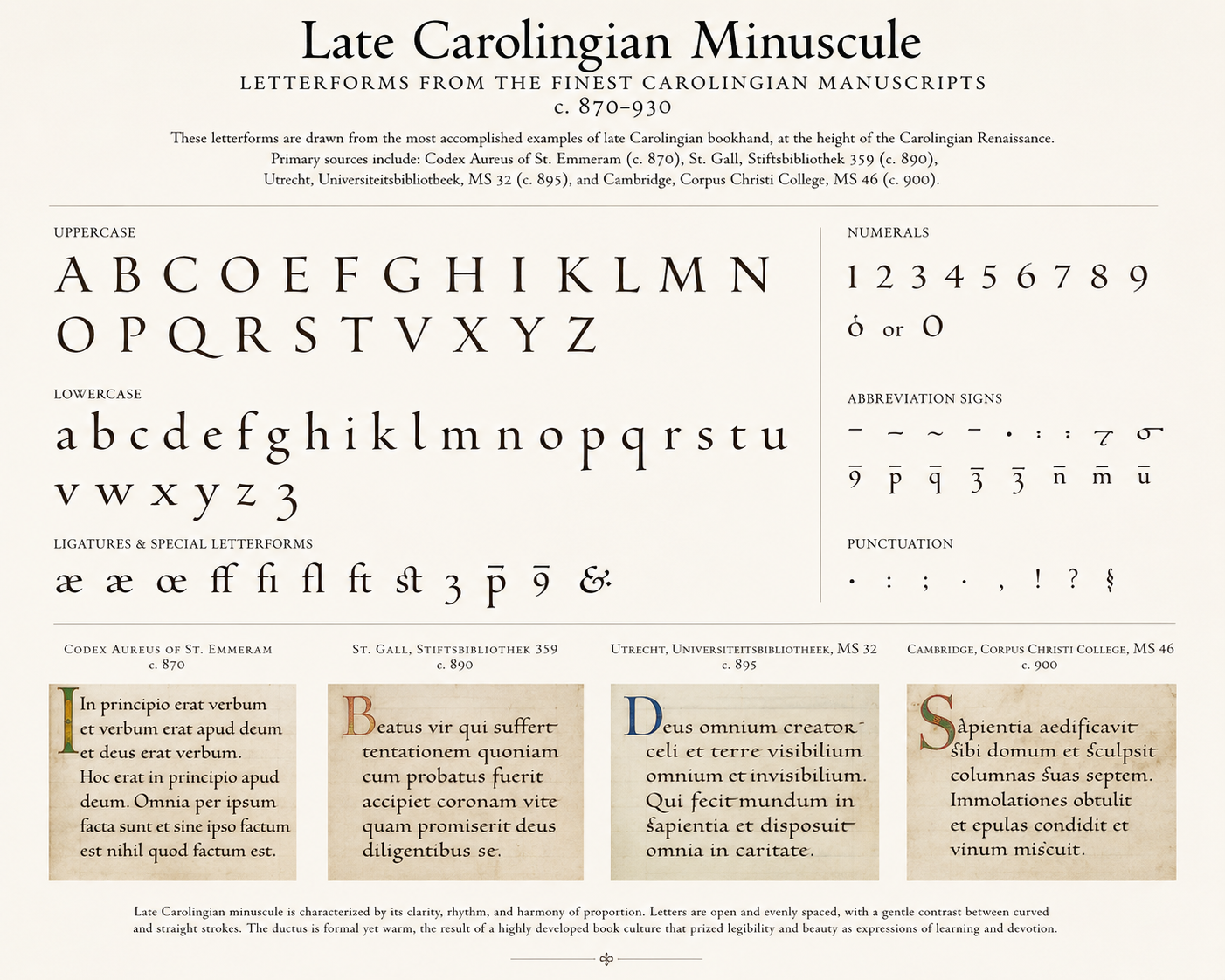 I challenged the AI on this, pointing out that the letterforms it was showing me were later humanist typographic forms, and I wanted the letterforms from Carolingian manuscripts. The second attempt is slightly better stylistically, but still very much a later interpretation of Carolingian script:
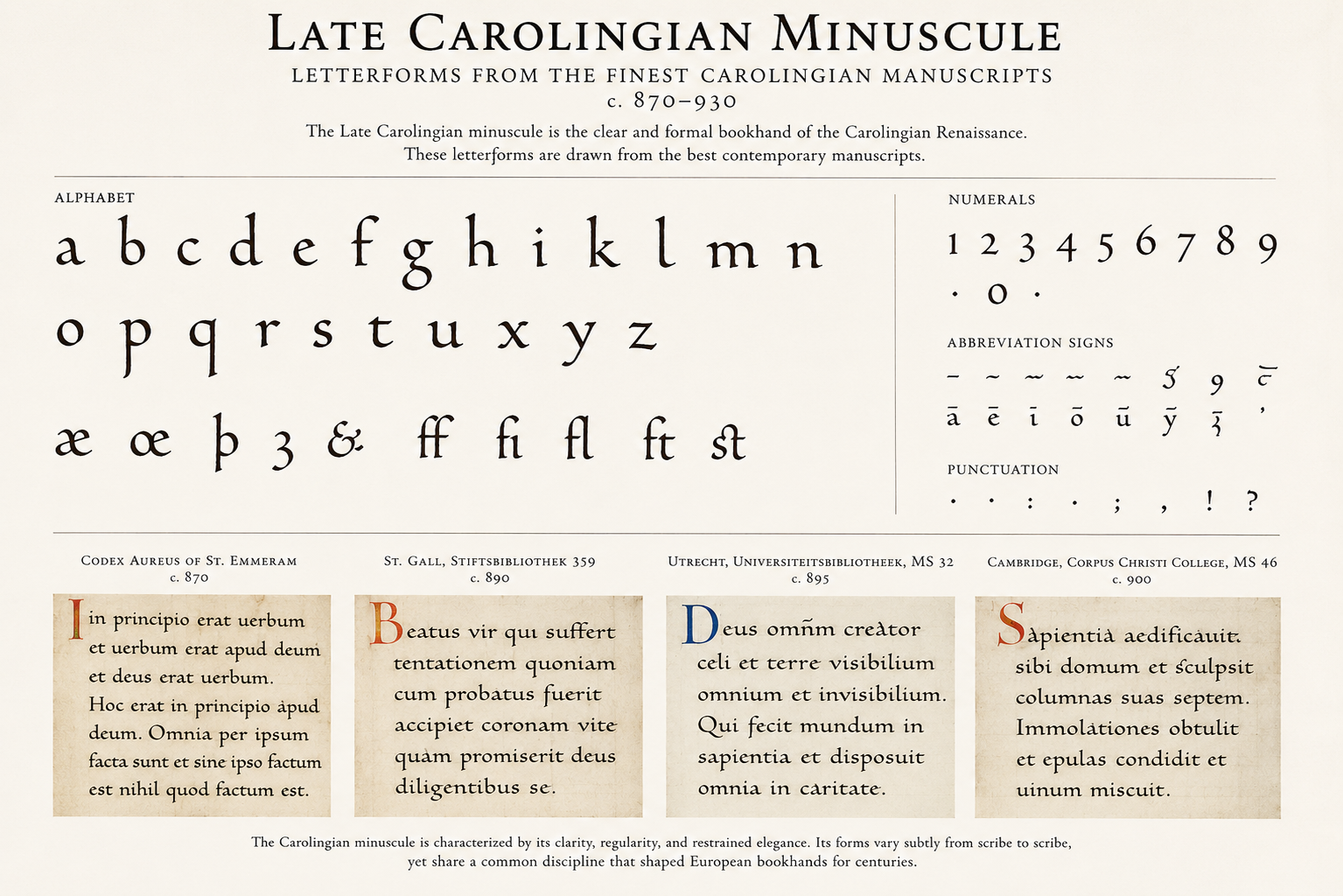 But what really bothered me about both of these images is the inset pictures ostensibly showing specific, labeled manuscripts. So I tried one more prompt, this time asking specifically for letterforms from a particular manuscript: CCCC MS 046: John of Salisbury, Policraticus & Metalogicon, resulting in this:
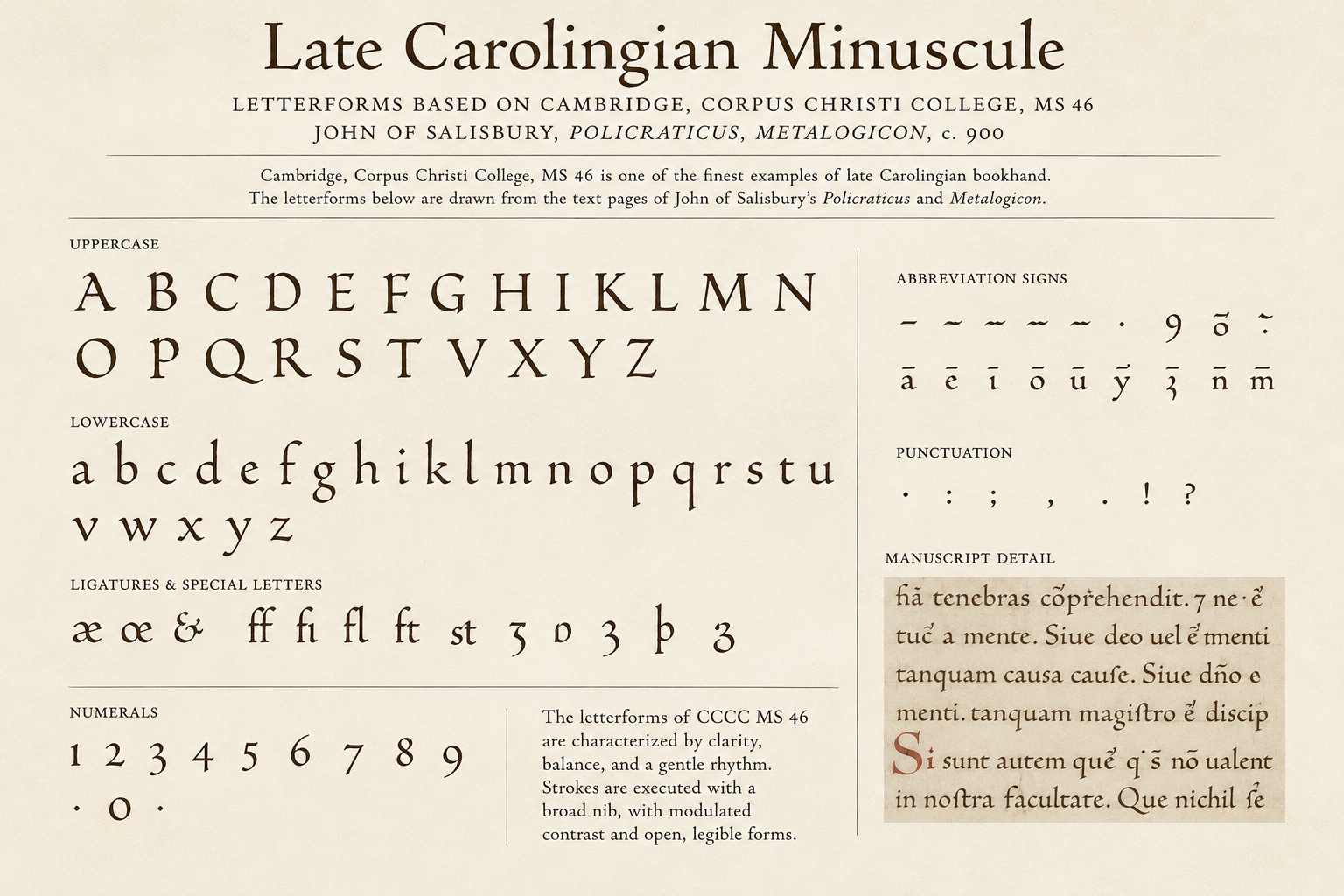 For the record, this is what the texts in CCCC MS 046 — dated to the second half of the 12th Century (not ‘c.900’) —actually look like: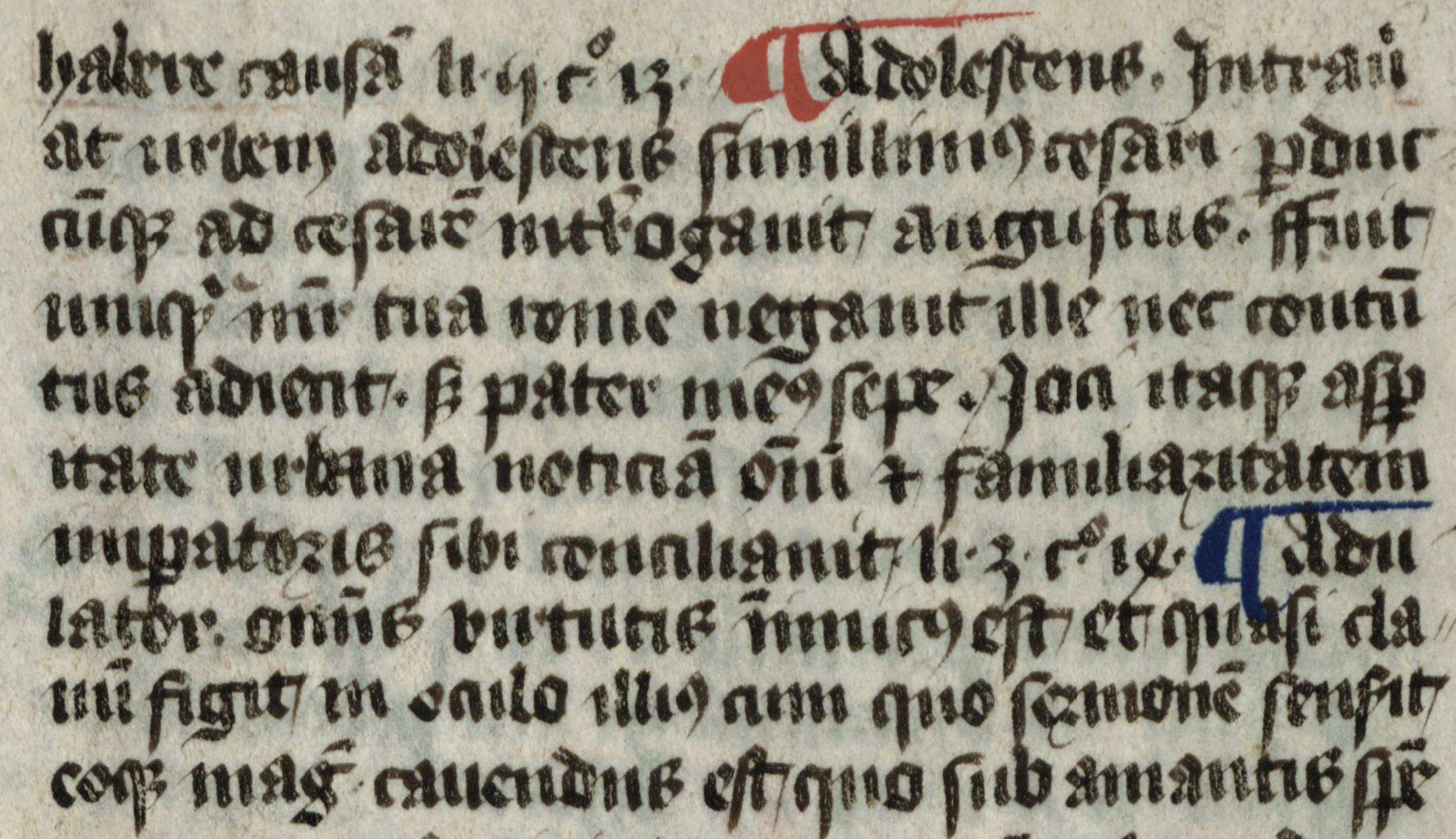
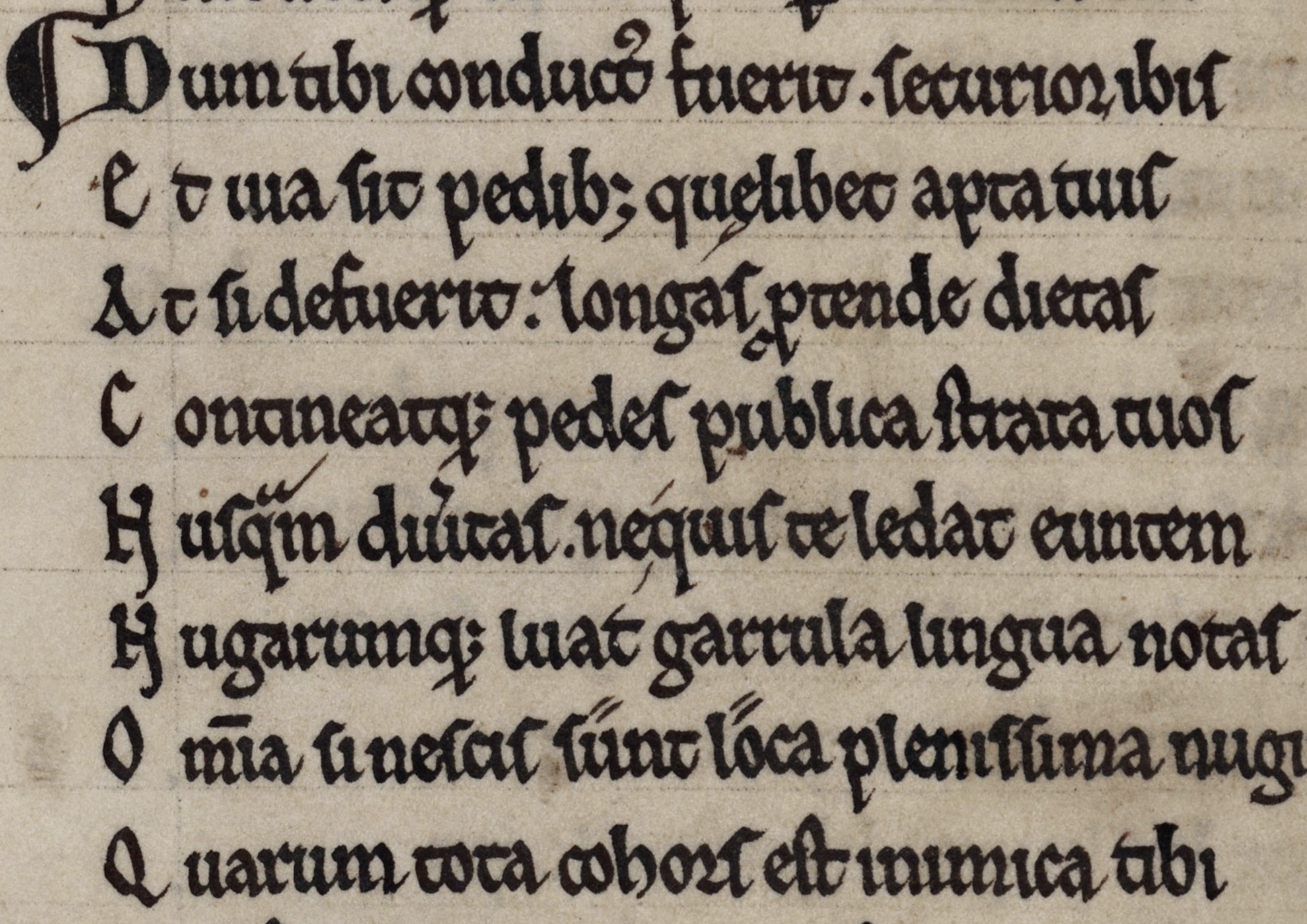 When a human lies to me, I am dealing with sin, which is something I know and understand and, crucially, must be open to forgiving. When AI lies to me, what are my responsibilities, given that it does not seem capable of repentance?6
 -
I don't know if I call it an actual lie or just a function of the ineptness of the process. I don't think the intent was deception. The machine has no idea what to do with something out of its abilities.
Also, type is easy to copy. Artwork is much harder.0 -
But it is also confabulating things and misrepresenting them as sources. So maybe deception is not the intent — to what extent can we ascribe any intent to the machine —, but there is something like intent or purpose to provide something that gives the appearance of reliability, even of authority, regardless of whether the content is true or false.A human may be excused of lying if they say something false that they genuinely believe to be true, but if they are aware that they do not know whether a statement is true or false but present it as being definitively true, there is a kind of deception involved in that. Likewise, I think AI is habitually deceptive in the way in which it presents statements of fact that may or may not be true.1
-
With AUI (artificial unintelligence), the question of forgivability concerns not the AUIs themselves but their human creators and purveyors. (Even if an AUI is created and/or supplied by another AUI, somewhere in the chain thereʼs at least one human behind it all.)John Hudson said:When a human lies to me, I am dealing with sin, which is something I know and understand and, crucially, must be open to forgiving. When AI lies to me, what are my responsibilities, given that it does not seem capable of repentance?1 -
I should have added: Of course, whether such humans are capable of repentance is another question.
0









Categories
- All Categories
- 47 Introductions
- 4K Typeface Design
- 501 Type Design Critiques
- 593 Type Design Software
- 1.1K Type Design Technique & Theory
- 675 Type Business
- 909 Font Technology
- 29 Punchcutting
- 544 Typography
- 129 Type Education
- 333 Type History
- 82 Type Resources
- 114 Lettering and Calligraphy
- 33 Lettering Critiques
- 81 Lettering Technique & Theory
- 580 Announcements
- 101 Events
- 116 Job Postings
- 176 Type Releases
- 186 Miscellaneous News
- 270 About TypeDrawers
- 54 TypeDrawers Announcements
- 114 Suggestions and Bug Reports