State of the art in AI image generation as we go into 2026.
Comments
-
What is interesting for me while interacting with ChatGPT on various topics is its pharisee position on general ethics, when advising one how to deal with real-life problems. While being pretty much workaroundish about his moves

I do not complain about it, just notice how it kind of resembles a widespread parenting model when some of us were kids 30-50 years ago (do not do what I do, but do as I tell you).0 -
AI depends on the "make me one of those but a bit more like one of these" theory. What I mean is, there has to be something like it already done by someone that can be accessed and manipulated. There is no "original thought" happening. What is the point? To me, AI is only of value if it can do the drudgery part of the job, not the creative part.6
-
I have experimented with giving ChatGPT image prompts based on a mental idea I have for a new typeface. I have tried to describe the idea in terms of both structure and concept, providing iterative suggestions to see if I can nudge the results anywhere even in the same ballpark as what I have in my mind. ChatGPT fails completely at this kind of thing for exactly the reason that Chris identifies: it is unable to make anything without reference to something that already exists. My prompts are all interpreted in terms of existing styles and banal associations, so the results constantly veer towards irrelevant pastiche.
It is also apallingly literal. Today, I gave the new ChatGPT image tool this prompt:
A wide image of uppercase letters, A-N on one line and M-Z on a second line, in a style inspired by the spirit of Palladian architecture.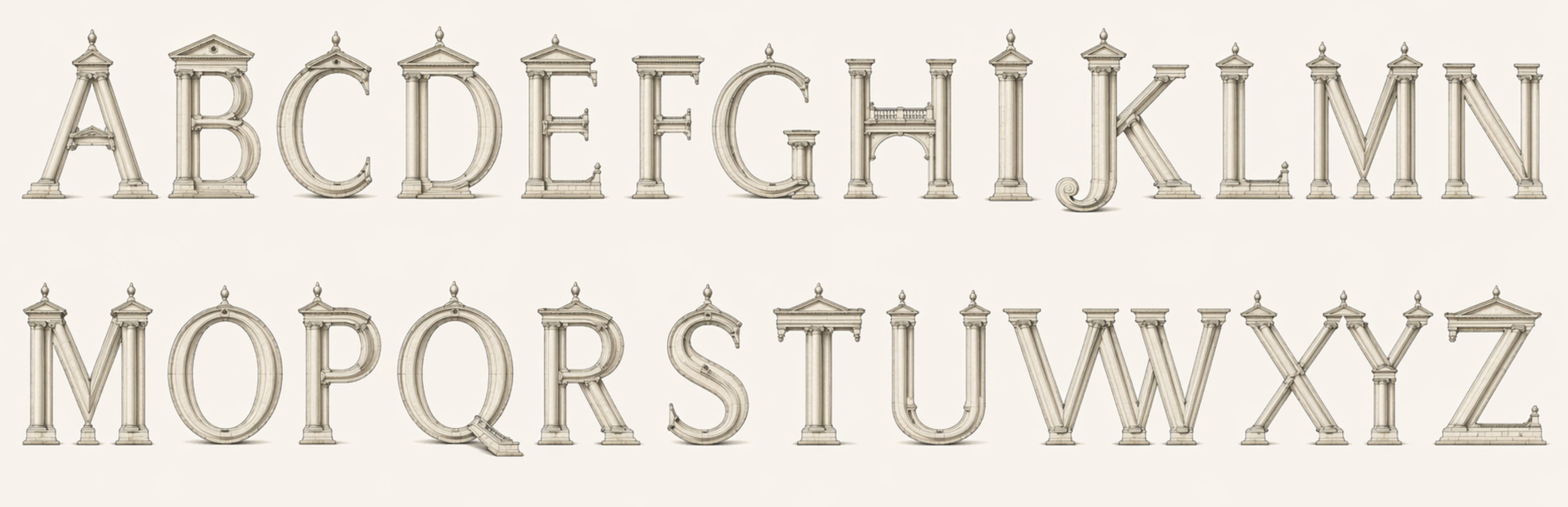
 7
7 -
Instead of artificial intelligence we get artificial smart ass. 3
-
It feels to me like it may be precisely the opposite: AI spews plausible-but-problem-filled output, and it’s up to the humans to clean it up.Chris Lozos said:To me, AI is only of value if it can do the drudgery part of the job, not the creative part.3 -
LLMs produce output that appears plausible but contains underlying issues. Yes. Identifying and correcting those issues is left to humans. Yes.
That, however, assumes the user can recognize what’s wrong in the first place. And they can't. For most users, “good enough” is simply enough.
2 -
Type design has always been a place for people with design talent, skills, and perseverance enough to carry out a long task. AI seems to be targeted towards someone who wants to circumvent all of that and get instant gratification, even if the product is less than desirable. I assume the AI developers are trying to sell their software merely to make money, not to make good type.5
-
I think a lot of the best of what we are seeing is not “AI generates images for you out of nothing,” but rather “AI riffs on something you give it, in major productive ways.” Not quite as dramatic, but maybe more useful.
Also, actual software coding is where more of the action has been taking place lately—the big AI companies putting more effort into it.
I still expect to see AI-generated fonts (or even extensions to fonts) Real Soon Now. This year for sure.3 -
The video at https://openai.com/index/introducing-chatgpt-images-2-0/ is worth a watch, as well as scrolling down the whole page
It isn't "AI Generated Fonts" that are vexing type designers, I think, but that this creates final production-ready documents without ever touching any font files at all.5 -
That presentation is what brought me back to this thread. Don’t just flip through it; zoom in and read the prompts.Here’s a near-future scenario: a new business owner prompts an AI to create a logo and a style guide for their business. Assume the AI is fully informed about all aspects of that business. In the style guide, there are custom typeface specimens.The business owner uploads the style guide to an image or video generator and can produce all the material they need without ever touching a font; print-ready business cards, vectors for vinyl-cut signs, video presentations, and so on.A typography expert could zoom in and pick out flaws, but the material is satisfactory to both the client and their customers.Why would this business need fonts? To the business owner, what they’ve done is cheap and effective.3
-
That future is already here, it just isn't evenly distributed...
I didn't look with a microscope but there was only a single Latin glyph I noticed that was drawn incorrectly (an uppercase G)
I asked a few friends and the non Latin is still behind, like where Latin was about a year ago. It's questionable how much source material exists for non Latin vs the overabundance of Latin in the world... But ... Tick tock.2 -
Input and editing is an interesting case. In theory, AI could be live (re-)drawing text as it is input, making fonts unnecessary even in direct text authorship unnecessary. It seems, however, a really inefficient way to go about things. And, of course, there’s a bunch of companies lining up to charge users a subscription to do this stuff, while most of the existing infrastructure of text authorship, editing, and presentation is free or effectively free.
Hmm. Maybe I can make and market a font that is specially tuned for AI prompt writing. I have no idea what that would mean, but then I have no idea what most font marketing claims mean.1 -
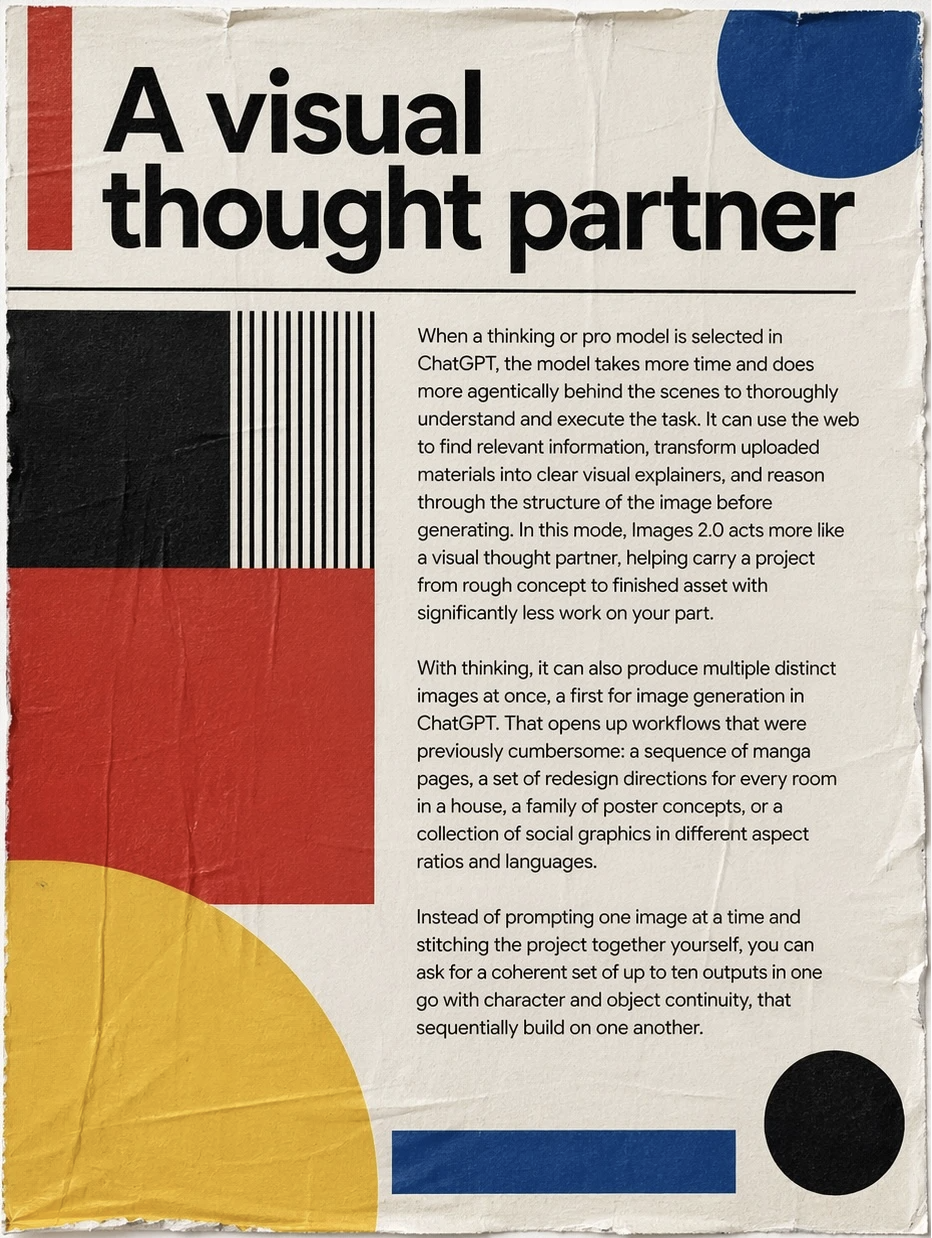
I did scroll down through all the images in the presentation, and it would be churlish not to acknowledge that the sheer productiveness and surface sheen is impressive. But they are also 100% pastiche of styles of images previously made by skilled human beings. Ironically, the style used for the explanatory image panels is pretty close to what I anticipated in 2023, in the conclusion of my chapter on text technologies for the Bloomsbury Handbook of Global Typography: a pastiche of modernism, lacking any of the spirit of modernism. The bad thing that the machine is very good at.
1 -
Watching the video, I had a flashback, without knowing why exactly. Then, looking focused, I realized it was caused by one of the typefaces looking familiar to me. I found the evoking screenshot and inspected it, comparing it to my font Zoran.
I am not stating anything, just don't know what to think.
This is an unpleasant fog we are wandering in. I have no hi-res image to properly compare. It is not even a fixed font, in the next take it might look somewhat different. Even with differences, you can't tell if it was used, but subtly modulated. There are no clear copyrights or proof of sources used.
All of that gives a pretty shady sentiment around AI. I don't care about discussing the future of AI, believers vs skeptics, etc. I need more arguments that it is completely legal. Until that is addressed, it is a gray zone business.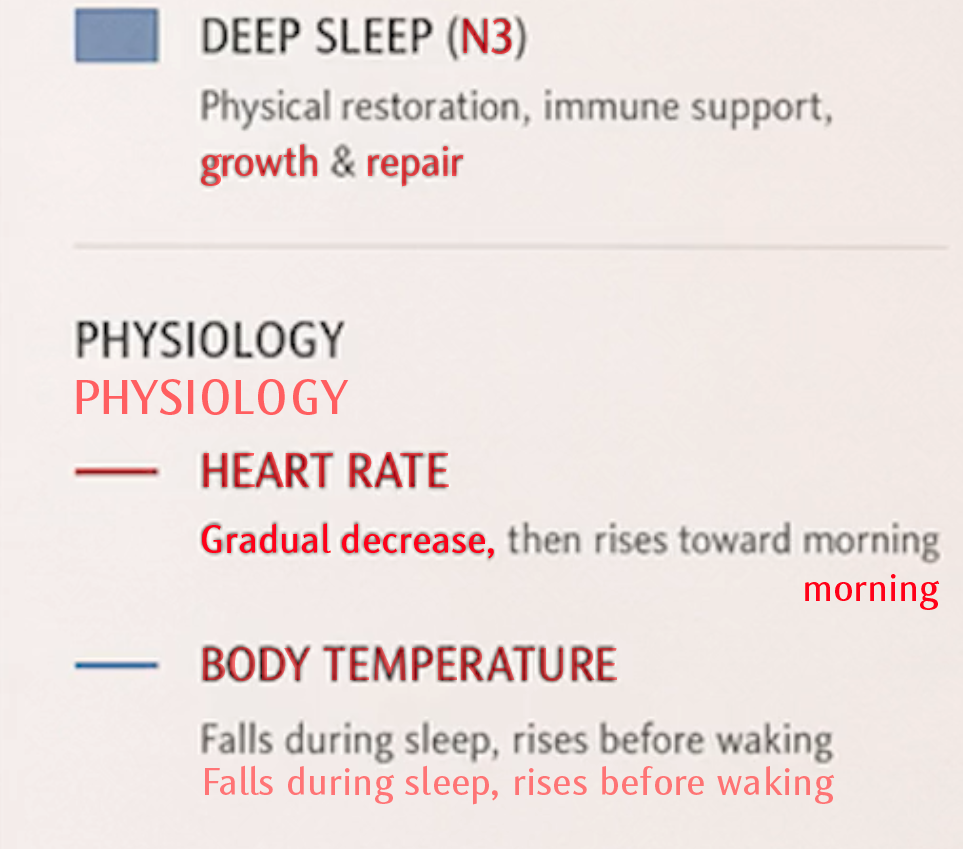 3
3 -
AI type tends towards the generic, unsurprisingly, merging things the machine has learned from multiple models. A lot of type designers are going to see familiar forms and proportions in the results, without necessarily being able to point to direct copying or a clear path of derivation. Apart from the legal and ethical questions, consider just how characterless and boring these generic letterforms quickly become.
Ray described a hypothetical business owner using AI to produce first a graphic identity and style sheet, and then using AI to produce a whole variety of textual, graphical and video material. It might not pass analysis by a typographic expert, but would be, he suggests, ‘satisfactory’ for the client and customer. We’ve been here before. In the 1980s, during the desktop publishing revolution, business owners or their staff were creating brochures, reports, signs, etc. and they often thought the results satisfactory or, at least, good enough, and cheaper than paying someone who had knowledge, skills, and experience. But the results didn’t remain satisfactory, and while DTP killed off typesetting per se as a business, professional graphic design and branding agencies flourished because companies wanted to differentiate themselves and their products from ‘good enough’.
The massive derivative productivity of AI may similarly produce a fresh demand for non-AI creative work — the work of making things that have not been made before —, precisely because it becomes too easy to make a masssive amount of very repetitive stuff very quickly. Things like Studio Ghibli films — to use an example that has already boomed and busted as something people find interesting to pastiche with AI —are special because they are infrequent, carefully crafted, and the product of the vision and inventiveness of particular people with particular experiences of the living in the world. Being able to rapidly generate things that superficially resemble Studio Ghibli animation in massive quantity is technically impressive and incredibly boring very quickly. I predict the speed of boredom will ultimately exceed the speed of AI generation. People will get bored of what they are making even while the prompt is still being processed.
I am not much fussed by the notion that some significant quantity of text will be created without fonts. Making fonts is how I make my living, yes, but I have always been interested in a broader history of text manufacture that encompasses all manner of tools and media. If people are going to make texts using AI without fonts, that AI is going to need new models. The first step will probably be direct reference to specific existing typefaces, i.e. prompts that include the names of the fonts the user wants the text to be displayed in, with the expectation that these will be accurately rendered. People like specific typefaces, not generic serif and sans. They have their favourites, and just as people running Monotype machines wanted types that were only available on Linotype, and vice versa, they are going to want the new machines to give them access to what they know and like. The next step will presumably be the design and creation of new type styles specifically as models for machine learning. This may well involve much smaller glyph or character sets than designing a complete font, leveraging AI to fill in the blanks, but probably with an iterative approach allowing the maker to fork AI-generated glyphs, edit them, and feed them back into the system.
5 -
I want OpenAI to send a team to India to spend a year photographing every painted sign, truck, and license plate. Then train a new model on that and see what kind of wild stuff it comes up with.2
-
Several years ago, I designed the Bodoni Egyptian® typeface. Sounds like a prompt, doesn’t it?
Easy enough for AI to mimic, with or without fonts, but I’d like to believe that there’s something in the way that I designed and drew it that represents an inimitable human quality that people who specify type style can relate to. My taste; not to everyone’s liking, but unique and special enough, as determined in a font, with all the specificities of spacing and kerning, and not the result of a user’s prompts spun out by algorithms.
When I designed Neology®, which mixes grotesque and geometric characters in a quite readable manner, I discovered, in using the typeface for various projects, such as my blog, that I didn’t like the mixture and really did prefer the specificity of the Neology Deco version. From this I conclude that the specificity that a type designer embeds in a particular font—a particular weight, too, not an elastic variable instance—is what makes a typeface useful to the highest, and most distinctive degree. As a conceptual entity that typographers can work with in creating layouts, useful because it has meaning for them, connecting with so many other signifiers of design culture, in their understanding of what that is. And this is surely what art directors want for the brand they’re promoting.0 -
In more general terms: the form of a text is a cultural product. The media of text manufacture has changed and will change, and so will the form, but a notable aspect of previous changes in text media is how much has been preserved alongside that which is novel. Fonts as a medium may go away, but the typefaces that they implemented will persist because they exist in culture, not in data bytes or photo strips or Linotype matrices, etc.. And people will also need to find a way to implement new typefaces — or whatever term they choose to refer to specific and repeatable forms of text elements — within a fontless medium. Perhaps as training sets for AI text manufacturing?1
-
So far during license checks, no client has disputed the font in question. Could be discussions on whether they respected the license or not. But I still haven't got the reply: "That's not that font".
My main concern at the moment is that AI could become an excuse for avoiding font licensing at all. Not that the user relies on AI, but uses it in a conversation as a theoretical black box, while still using the actual font or its derivative. Anybody can say, even for the live text (webfont), that it was created by AI. How to prove it?
Now they can download the font from a pirate site, delete metadata, load it into the AI, and say give me a minor derivative. And then what?
I understand the logic of relying on honest and refined clients. But the problem I have is that we build a discourse where rudeness, disrespect, and negligence become a solid argument. Again, you try to check the license, the user says "That's not the font", then what?
2 -
Igor: I need more arguments that it is completely legal. Until that is addressed, it is a gray zone business.
It isn't clear to me; but personally what I read on social media is that the argument that it is completely legal in the USA rests on the US copyright law principle of Fair Use.John: a pastiche of modernism, lacking any of the spirit of modernism
I recently read about Mark Fischer, who wrote some tantalizing books about how we are "haunted by futures that failed to happen", and that Western cultural recycling is useful for the oligarchical owners of cultural production conglomerates because actually imaging a future means imagining upending the status quo, so they are strongly incentivised to foster repeats, and avoid fast forwarding1 -
Fair use in US copyright law concerns the context of use in which copyrighted material is used, not the technology of reproduction or derivation. So e.g. fair use covers contexts like commentary or criticism, education, and satire. If we consider AI as a technology for making derivative works akin to, say, a video editing suite used by a human to cut together a video derived from copyrighted material, then a fair use claim would a) acknowledge that the resulting work is derivative, and b) the resulting work is being used within the kinds of contexts permitted by fair use. So far as I can see, neither is commonly the case for AI: derivation is obscured rather than acknowledged, and derived works are used in contexts beyond those permitted by fair use.
What this suggests to me is that training of AI on a creative work, e.g. Igor’s typeface, may be deemed fair use — something the courts would need to decide on, not something that should be presumed —, in the same way that it was deemed fair use for search engines to gather data from copyrighted material.* But what the end user does with the output of AI, the context in which that output is used, can’t be considered automatically fair use, any more than the output of any other technology is. So then we have the practical problem of identifying the source of derivative works from systems that obscure their input rather than acknowledging it. Igor has identified something that looks like it might be derived from one of his typefaces. It may well be, as well as incorporating things that the machine has derived from other typefaces, mixed together in differing amounts into something a bit generic.**
_____
* I have read some suggestions of technical measures to disallow AI training, akin to robots.txt that in theory tells web crawlers not to include website content in search engine data. Such measures are regularly ignored on the grounds of fair use.
** Like a recipe that turns individually tasty ingredients into a bland gruel.😛2 -
What good is a new typeface if it is not truly a "new" typeface.3
-
Is it currently permitted to use Google Fonts for training AI models? If so, the license should be updated to explicitly prohibit this kind of use.1
-
Google Fonts are under the Open Font License, so doesn’t restrict any kind of use.
What’s interesting about that license is that it permits creation of derivative works so long as those are also under the OFL. So in theory, if an AI becomes able to produce something like a font — i.e. not an image, but some kind of mechanism to generate text in a reproducible ‘typeface’ —, that would be subject to the OFL requirement if it could be demonstrated that it was derived from training on Google Fonts.5 -
To be precise, this is the Open Font License (OFL) version 1.1, released on 26 February 2007. At the time, AI was not a significant concern in the type industry, which is why a revised version of the licence that clearly regulates—and, where necessary, restricts—the use of AI would be welcome.1
-
The Open Font License is a libre license. It doesn’t put any restrictions on how a font can be used or what it can be used for.0
-
Well, it does require that derivatives also be OFL, and say you can’t sell an OFL font by itself as a product.
But otherwise, yes.1 -
I wasn’t counting those as use restrictions. They’re distribution restrictions (see my previous comment about possible OFL distribution restrictions being applicable to AI-generated derivative work).1
-
I think it's more informative to call them distribution requirements instead of restrictions. But yes. I agree with John on this, personally; it seems to me that type designer is misunderstanding what universal freedom means.
Additionally, the OFL (unlike eg creative commons licenses) has no upgrade compatibility clause, so making any changes at all, is impractical.0 -
I think we need to acknowledge that the OFL, in its current form, no longer fully achieves what it was originally designed to protect. In 2007, AI was not a realistic concern. Today, however, a model can ingest hundreds of OFL fonts, extract stylistic features, and generate new, substitutive designs without ever triggering the OFL’s derivative‑work requirements. That means the license no longer protects what it intended to protect.
This isn’t about restricting freedom. It’s about recognizing that the definition of “derivative work” has become technologically outdated. When a model produces reproducible typographic output that is clearly based on OFL‑licensed material, that is functionally a derivative — just in a new technical form.
Other open‑source communities are already responding to this shift. The OFL is one of the few major libre licenses that has no answer at all to AI training. Introducing a new, AI‑aware version of the OFL wouldn’t force anyone to adopt it, but it would finally give designers who want to prevent uncontrolled AI extraction a real option. Freedom also means having meaningful choices.
1










Categories
- All Categories
- 47 Introductions
- 4K Typeface Design
- 495 Type Design Critiques
- 579 Type Design Software
- 1.1K Type Design Technique & Theory
- 672 Type Business
- 888 Font Technology
- 29 Punchcutting
- 540 Typography
- 125 Type Education
- 333 Type History
- 82 Type Resources
- 113 Lettering and Calligraphy
- 33 Lettering Critiques
- 80 Lettering Technique & Theory
- 569 Announcements
- 100 Events
- 116 Job Postings
- 170 Type Releases
- 182 Miscellaneous News
- 270 About TypeDrawers
- 54 TypeDrawers Announcements
- 114 Suggestions and Bug Reports