Why is there so much confusion around the Cyrillic breve (and other diacritics)?
Answers
-
Yes, I was aware of the German umlaut—but there’s not much variation possible in the size of its dots!
0 -
Even English has words like Châteauneuf-du-Pape, Piñata and Erdős number.1
-
Erik said:café in English
Indeed, your comment gives me a sense of déjà vu!Christian Thalmann said:Even English has words like Châteauneuf-du-Pape, Piñata and Erdős number.
That said, I expect the hypothesis in @Thomas Phinneyʼs comment is well founded if not absolutely, precisely accurate in its wording: Although diacritics often find their way into English, they tend to act, to use his phrase, “as appendages/extras” rather than part and parcel of the fundamental system; commonly, they are omitted outright.2 -
In English, diacritics frequently omitted by people who do not know how to type/enter them. Occasionally they could contribute to disambiguation (e.g. résumé and pâté.) But English is also just chock full of heteronyms: words that are spelled the same, but pronounced differently, with different meanings. These are super common (lead, tear, close, desert, alternate, object, convict, moped, invalid, etc.). I am not suggesting that adult native speakers/readers find any of this confusing. But I expect it is one of the things that contributes to English being so hard to learn.
In languages such as German, French, Spanish and Italian, it seems there are many words that would be spelled identically if not for the diacritics.
Apparently only a little of this in Cyrillic with the breve, from what I can find easily? It is more that with a breve it is a completely different letter, from a native speaker POV? Clarification welcome.
2 -
I would say that failing to distinguish between *и* and *й* is a sign of gross illiteracy (though lately I have noticed some confusion between the words *войны* [wars] and *воины* [warriors] among, shall we say, young internet users).However, the situation with the letter *ё* is truly chaotic; it is often omitted—even in children's books—where it is actually necessary. Over time (literally within a single generation), the pronunciation of certain place names changes because they are initially written without the *ё* under the assumption that everyone knows how to read them (which is not the case!), and soon the correct pronunciation vanishes completely; there are many such instances.4
-
Even my Russian teacher two years ago told us not to pay too much attention to the ё, because people are using it less and less. It was very confusing.2
-
SCarewe said:Even my Russian teacher two years ago told us not to pay too much attention to the ё, because people are using it less and less. It was very confusing.There was a (historically brief) period when the keyboards of portable typewriters—and later, early computers—simply lacked a key for the letter *ё*. Technical limitations offered an excuse for such carelessness, and that is understandable. That era has passed, yet the laxity remains; by now, the issue has become almost a matter of religious conviction.Personally, I am a staunch advocate of the letter *ё* and try to include it in all the typesetting work I am commissioned to do—though clients often object, and I have to yield.Incidentally, in one of the children's books I mentioned, the very first sentence of the first chapter contains a word that requires the letter *ё* (yet omits it): *Почему ты плачешь, когда поешь?* "Why do you cry when you eat?" (It should be *Почему ты плачешь, когда поёшь?* "Why do you cry when you sing?").The difference is significant, and I have no clear explanation for why this carelessness continues to spread.3
-
It is more that with a breve it is a completely different letter, from a native speaker POV? Clarification welcome.Yes, и is a vowel, and й is a consonant. In Russian and Belarusian, й is a soft letter that only occurs after a vowel in native words. In Ukrainian, й can occur at the beginning of syllables, including the beginning of words, — mostly followed by о, since the Ukrainian alphabet does not include the Russian ё /jo/ —, where it takes a harder pronunciation like the English y in yoghurt or the Serbian ј in један.When talking about Cyrillic letters and diacritics, it is important to note that they do not have consistent pronunciations across different languages. So, for example е is a compound /je/ in Russian, but a simple vowel /e/ in Ukrainian, which in turn has distinctive compound letters є /je/ and ї /ji/) that do not occur in the modern Russian alphabet.Since we’re talking more generally about diacritics now, it is worth noting that liturgical books will often use an acute accent to indicate syllabic stress, which can occur on any vowel and, hence, on any compound letter. In Ukrainian, this results in e.g. твої́м.0
-
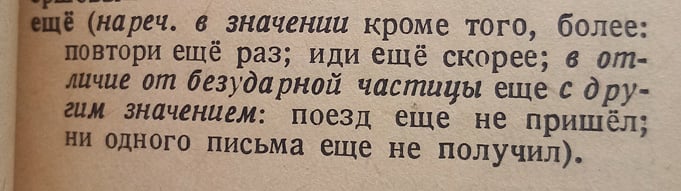
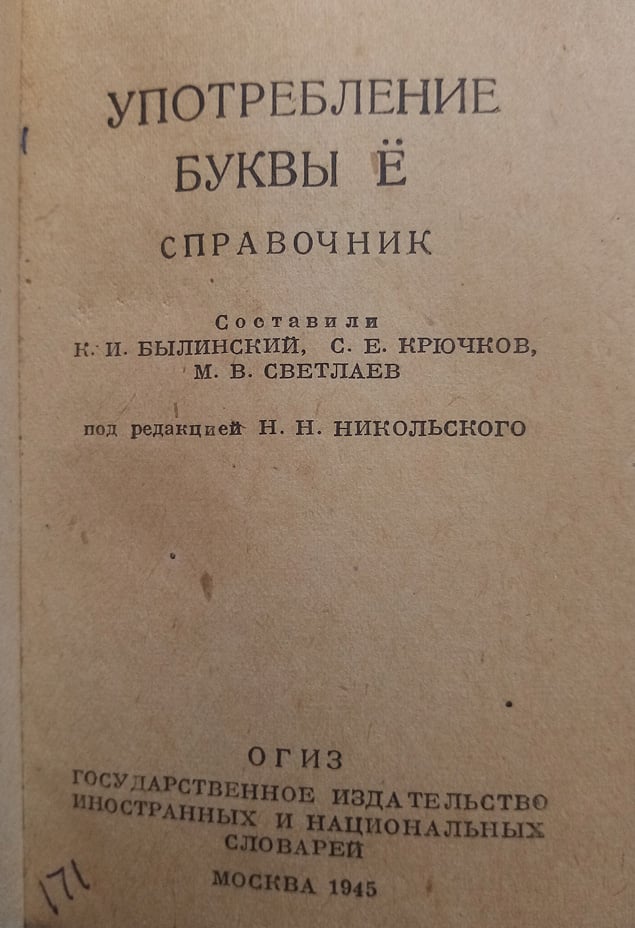
There is a truly puzzling story surrounding the Russian letter *ё*: a 1945 reference work lists the words *еще* (meaning "still" or "yet") and *ещё* (meaning "more" or "additional") as distinct, independent words.I have never observed such a distinction in actual speech—not even among older speakers. Nor is it possible to verify this distinction through books, precisely because the use of the letter is optional.Thus, it remains entirely unclear whether we are dealing with a figment of the compiler's imagination or an example of a word’s sudden demise caused by the neglect of diacritics.
 2
2 -
Christian Thalmann said:Even English has words like Châteauneuf-du-Pape, Piñata and Erdős number.It would be more strictly accurate to say, in cases like those of which you have given examples, that English texts may contain accented letters, due to the fact that foreign words can be incorporated into an English text, and when it is done, an attempt may be made to reproduce those words accurately in their original form within the language to which they are native.That would avoid giving the misleading impression that accented letters are in any way intrinsic to the English language and its script.0
-
I have trouble thinking of the Brontë sisters as not intrinsically English.John Savard said:Christian Thalmann said:Even English has words like Châteauneuf-du-Pape, Piñata and Erdős number.It would be more strictly accurate to say, in cases like those of which you have given examples, that English texts may contain accented letters, due to the fact that foreign words can be incorporated into an English text, and when it is done, an attempt may be made to reproduce those words accurately in their original form within the language to which they are native.That would avoid giving the misleading impression that accented letters are in any way intrinsic to the English language and its script.
Christianʼs examples of Châteauneuf-du-Pape and Erdős are flawed, as foreign proper names; but château and piñata, like café and déjà vu, are well established as English words, perhaps even common (or common‑ish) English words, not so recherché as, well, recherché. But, yes, their diacritics are essentially optional, as I have pointed out.
However, diacritics in loanwords do not always preserve their use in the source language. The acute accent in maté is not only absent in its Spanish source; itʼs contrary to Spanish spelling‐pronunciation rules and seems to be there only to prevent confusion with the otherwise homographous mate and encourage disyllabic pronunciation. Prevention of mispronunciation and of homography seems to also be the motivation for the acute in saké; note that its Japanese source doesnʼt use an accent mark or even letters (but to be fair: itʼs possible the English spelling comes from a French spelling). It wasnʼt all that long ago that the spelling aëroplane was common; that word came from (obsolete) French aéroplane — different diacritic altogether!
But English actually has broad rules, however increasingly disused, that encourage diacritics in some contexts beyond loanwords. The dieresis is traditional in many words where the same vowel appears on either side of a morpheme boundary, as in microörganism and reëngage. And in poetry and lyrics, the grave accent indicates that an E is not silent, as in blessèd.
Even so…these latter usages are optional and nowadays rare. But theyʼre not extrinsic interlopers. It would be more strictly accurate to say that in English, the use of certain diacritics is on a secondary tier. And their relative rarity and disposability would seem to contribute to Thomasʼ observation and hypothesis about Anglophone designers tending to view diacritics as “appendages/extras” which they make accordingly too small.6 -
Erik said:
However, diacritics in loanwords do not always preserve their use in the source language. The acute accent in maté is not only absent in its Spanish source; itʼs contrary to Spanish spelling‐pronunciation rules and seems to be there only to prevent confusion with the otherwise homographous mate and encourage disyllabic pronunciation.As you yourself point out in your next example, from the Japanese, what is going on here seems obvious.Since French (at least in Canada and the United Kingdom, if not so much in the United States, but to an extent even there) is the only language with diacritics with which English speakers might possibly be hoped to have at least a nodding acquaintance (as opposed to "may be assumed to know", which, of course, is wildly overoptimistic), if one wishes to indicate that M-A-T-E is not pronounced "mayt" but "matay", the French acute accent lies to hand.As for the Brontë sisters, aren't they Germans? But then I think that Beethoven was a Dutchman.But speaking of the umlaut, it certainly is true that, for a time, it was indeed an English practise to use the diaresis. And in the works of Edgar Rice Burroughs, one will see what I thought was the perfectly ordinary English word "rôle" still rejoicing in its French circumflex.
0 -
Brontë is ultimately of Irish origin (anglicised spelling). Beethoven's name goes back to Flemish, yes, but his ancestry is German for at least two generations.
By the way, using the term umlaut here is not accurate, as the name suggests. It serves a different function here, but I don't want to drift too much off-topic.1 -
Technically speaking, Umlaut refers to the underlying linguistic process of vowel coloring; the two dots should properly be called Umlaut’s Monster.5
-
SCarewe said:Brontë is ultimately of Irish origin (anglicised spelling).Since I couldn't stand Wuthering Heights in high school, I had failed to look this stuff up. A quick web search has since remedied my ignorance. I see that the Brontë sisters' father was the one who had the bright idea to use a diaresis, and other people had tried to get the name pronounced right by spelling it Bronté. I had also not known that it was originally Ó Proinntigh... and was changed to Bronte from Prunty because Prunty was a common name, though it had no danger of being mispronounced, while Bronte was the name of some Greek colony in Sicily or something like that.But if it were to have pseudo-Greek roots, clearly they ought to have spelled it Brontæ!
1 -
We named our daughter Zoë, because that’s the way it’s traditionally spelled in English.
At least, since it first became used in England in the 1850s.1 -
Apparently, βροντή means «thunder», and that would normally be transliterated as brontē. Another accent!John Savard said:But if it were to have pseudo-Greek roots, clearly they ought to have spelled it Brontæ!0 -
John Savard said:But if it were to have pseudo-Greek roots, clearly they ought to have spelled it Brontæ!
Yeah, you never know what youʼll find upon seeking synonyms in the Brontǣ̈saurus.Christian Thalmann said:Apparently, βροντή means «thunder», and that would normally be transliterated as brontē. Another accent!1






Categories
- All Categories
- 47 Introductions
- 4K Typeface Design
- 497 Type Design Critiques
- 591 Type Design Software
- 1.1K Type Design Technique & Theory
- 674 Type Business
- 907 Font Technology
- 29 Punchcutting
- 544 Typography
- 129 Type Education
- 333 Type History
- 82 Type Resources
- 114 Lettering and Calligraphy
- 33 Lettering Critiques
- 81 Lettering Technique & Theory
- 580 Announcements
- 101 Events
- 116 Job Postings
- 176 Type Releases
- 186 Miscellaneous News
- 270 About TypeDrawers
- 54 TypeDrawers Announcements
- 114 Suggestions and Bug Reports