[Do]lorem ipsum

michele casanova
Posts: 88
This video was pointed out to me as interesting because it reconstructs the history of "Lorem ipsum".
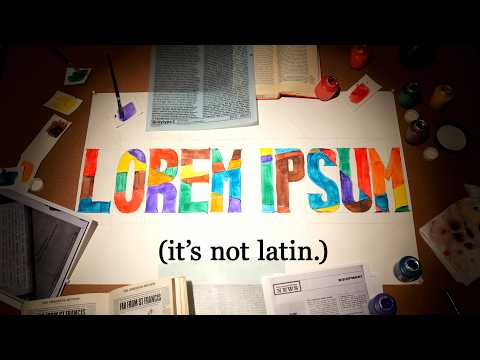 https://www.youtube.com/watch?v=kL1PDqzqhM4
"Lorem ipsum" was apparently created in 1966 by James Mosley (1935-2025) from four pages (36, 56, 70, and 118) of this 1914 edition of Cicero's "De finibus bonorum et malorum": https://archive.org/details/bub_gb_ufOZBzV878IC/page/36/mode/2up
The text (specially modified to be meaningless and to have a letter frequency similar to English, for example, by reducing the number of Qs) was requested by Letraset to create "dummy text" sheets.
The "Lorem Ipsum" text was then used in Aldus PageMaker 3.0 (1988 ca.) with some changes and the introduction of obvious errors ("nibh", "zzril").
Was all this information already known?
Tagged:
4
Comments
-
A little known, I think.
https://www.lipsum.com/0 -
Risto Mandre said:A little known, I think.
https://www.lipsum.com/In the video they indicate that they contacted several sites used to generate "lorem ipsum" to update the story (using Web Archive you can see that the site lipsum.com previously showed different information and that it was changed between May 27th and 28th).1 -
I see, thank you.0
-
I love that Before and After magazine comes up in the video. Does anyone else remember that? It was a really great little publication.3
-
I loved Before and After back in the day and devoured issues when they came out.2
-
This is sort of an aside, but I watched the movie Megalopolis recently and was surprised to see the traditional type specimen text “Quosque tandem arbutere, Catilina, patientia nostra?” recited in English by one of the characters. In fact, the plot of the movie is loosely based on that text, and the main character is even named Catalina. Makes me wonder if Coppola discovered it on a type specimen.3
-
There is plenty of room for new kinds of dummy text.
When I had a client in financial services, I would take typical paragraphs of financialese and reverse the order of the words in sentences (not letters in words) for presentations. It made no sense but looked appropriately convincing, with words like “investment” popping up frequently.
I’ve never used lorem ipsum or quosque tandem for testing type designs, due to the paucity of y’s and w’s. As Alastair Johnston theorized in Alphabets to Order, Latin text was good “prime rib” for specimens, because without those characters and their awkward diagonals, you get nice even colour. (That was before global kerning.)
And of course, Latin text had a certain cachet, appealing to the better class of publisher.3 -
I saw the video also, and while I knew that the text came from a work by Cicero before, I learned much that was new, such as the specific edition used at Letraset. It is true that Latin lacks letters we use now. So I've come up with an obvious solution. Use a public-domain document in another language that isn't English. To have lots of variety in the letters used, why not Polish?Of course, though, just as the characteristics of Latin differ from those of English, so, too, do those of Polish. And if one instead chooses a language more closely related to English, then the text used might be distractingly comprehensible.Of course, I suppose another idea would be to use a text in English that is too well-known to be distracting. Say, instead of "Lorem ipsum...", maybe "It was the best of times, it was the worst of times..." or "It was a dark and stormy night; the rain fell in torrents - except at occasional intervals..." and so on.0
-
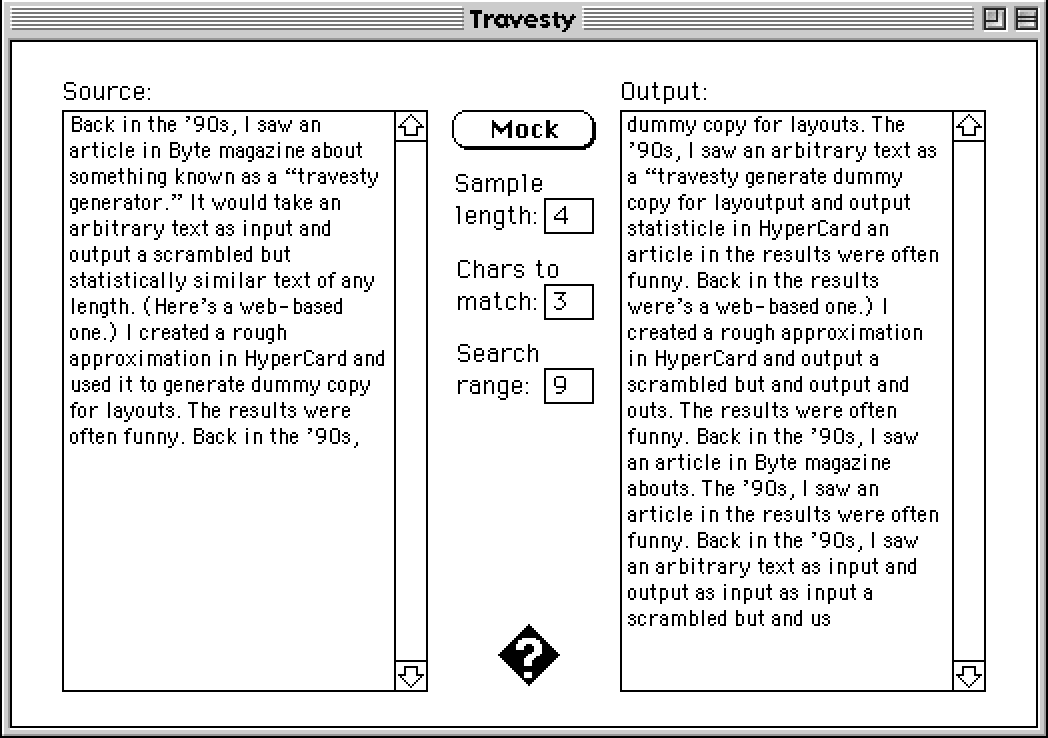
Back in the ’90s, I saw an article in Byte magazine about something known as a “travesty generator.” It would take an arbitrary text as input and output a scrambled but statistically similar text of any length. (Here’s a web-based one.) I created a rough approximation in HyperCard and used it to generate dummy copy for layouts. The results were often funny. Longer texts worked better.
1 -
I will simply have to find ways to use the words layoutput and statisticle in real sentences.3
-
"A Travesty Generator for Micros" (November 1984)Mark Simonson said:Back in the ’90s, I saw an article in Byte magazine about something known as a “travesty generator.”https://archive.org/details/byte-magazine-1984-11-rescan/page/n136/
https://archive.org/details/byte-magazine-1984-11-rescan/page/n456/ (code)"Travesty Revised" (July 1985)1 -
Yep, it was the first one. I guess I saw the article some years before I made the HyperCard stack (1991). My algorithm wasn’t as sophisticated as the code in the magazine, but it kind of sort of does something similar.0





Categories
- All Categories
- 47 Introductions
- 4K Typeface Design
- 496 Type Design Critiques
- 587 Type Design Software
- 1.1K Type Design Technique & Theory
- 674 Type Business
- 899 Font Technology
- 29 Punchcutting
- 542 Typography
- 127 Type Education
- 333 Type History
- 82 Type Resources
- 114 Lettering and Calligraphy
- 33 Lettering Critiques
- 81 Lettering Technique & Theory
- 574 Announcements
- 100 Events
- 116 Job Postings
- 173 Type Releases
- 184 Miscellaneous News
- 270 About TypeDrawers
- 54 TypeDrawers Announcements
- 114 Suggestions and Bug Reports