What is the South American "satillo" in shape and use?
Answers
-
Geographically, Central America it is part of North America, but politically and economically it is a distinct region. When I was growing up, Mexico was often considered part of Central America, but since it entered the free trade agreement with the USA and Canada it has been integrated into the northern region.2
-
Americans have a hard time even believing that Mexico is part of North America, and so accepting the Spanish-speaking countries of Central America as part of North America as well would be almost impossible.
I admit that, despite having resided in my native US for all but six months of my life, I should have been more circumspect in characterizing general American belief, particularly as regards geography, a subject on which we Americans are collectively, notoriously not very solid. That said, I maintain that traditionally if the question “What continent is Central America part of?” arises perplexingly, an American turning to an American reference book would typically find that the answer is North America. (Of course nowadays, the reference source is frequently [almost always?] an electronic resource, as in Kent Lewʼs response.) In my experience, the acceptance you consider almost impossible is in fact usual, whether it comes from well‐remembered school lessons or from ad hoc lookups. (That said, I shouldnʼt be surprised if a non‐negligible number of less academically oriented Americans may have trouble with that acceptance, emotionally if not factually.)
To confirm my impression of the traditional American stance, I looked at some American dictionaries from this century and last that happened to be handy: Merriam‐Webster, American Heritage, Funk & Wagnalls, Thorndike‐Barnhart…. All described Central America as a region within North America. (Notwithstanding John Hudsonʼs reminiscence, Mexico was excluded from Central America in all the dictionaries that addressed the topic, even the oldest one in the group, one Winston Dictionary for Schools from 1941.)
Itʼs my impression that in Europe the consensus varies as to whether North and South America are two separate continents or else form a single continent, (the) America(s); therefore, what continent Central America is part of will also vary. I found the Oxford English Dictionary affirms Central America as part of North America; on the other hand, Franceʼs Petit Larousse illustré considers lʼAmérique a single continent of which North America, Central America, and South America are three distinct, non‐overlapping regions (with Mexico, incidentally, divided between North and Central). I didnʼt research other European sources.Perhaps in Europe, people do consider Central America as part of the continent of North America. After all, the Panama Canal is much closer to South America than it is to Mexico
Iʼve heard of the Panama Canal being considered the dividing line between North America and South America, but I did not find support for that view (nor particularly look for it in my very cursory research). All the entries I found that addressed the North/Central/South question consider Panama part of Central America and (except in Larousse) also part of North America, without finer granularity.
1 -
(Notwithstanding John Hudsonʼs reminiscence, Mexico was excluded from Central America in all the dictionaries that addressed the topic, even the oldest one in the group, one Winston Dictionary for Schools from 1941.)Bear in mind that I grew up in the UK and Canada, so didn’t necessarily get the same information as a contemporary estadounidense did.
0 -
John Hudson said:(Notwithstanding John Hudsonʼs reminiscence, Mexico was excluded from Central America in all the dictionaries that addressed the topic, even the oldest one in the group, one Winston Dictionary for Schools from 1941.)Bear in mind that I grew up in the UK and Canada, so didn’t necessarily get the same information as a contemporary estadounidense did.When I went to school, we had the Winston Dictionary for Canadian Schools in our classrooms.But the John C. Winston company, like Ginn and Company, is still American. Because we have so many American textbooks in our school classrooms, we learned Parisian French in French class, not Quebecois French.However, unlike the dictionary used in elementary school classrooms, the atlases we used were one by J. M. Dent and sons that used maps from Bartholomew over in Edinburgh for elementary school, and The Oxford School Atlas in high school. So there we stayed within the Commonwealth. Oh, and the map on the wall usually included advertising for candy bars from Rowntree, in those days schools were so strapped for finances.However, while I am confident that Mexico is not now, and never has been, a part of Central America, I make nothing of it. People make mistakes. I certainly did, in thinking that Central America was generally, or even frequently, recognized as a continent, although I did turn up one reference to it as such by means of a Google Books search - in Alexander von Humboldt's Cosmos, of all places.
0 -
I'm surprised to see this information in Wikipedia. I always learnt that Central America is a continent per si and includes the whole Caribbean islands, never part of North America. In all the stuff I have, there are three Americas clearly established. Of course, there is a debatable political layer here as different cultures divide Americas accordingly to different criteria.
When you change Wikipedia language to Spanish, the different approaches are registered as Hispano and Anglo-Saxon "traditions":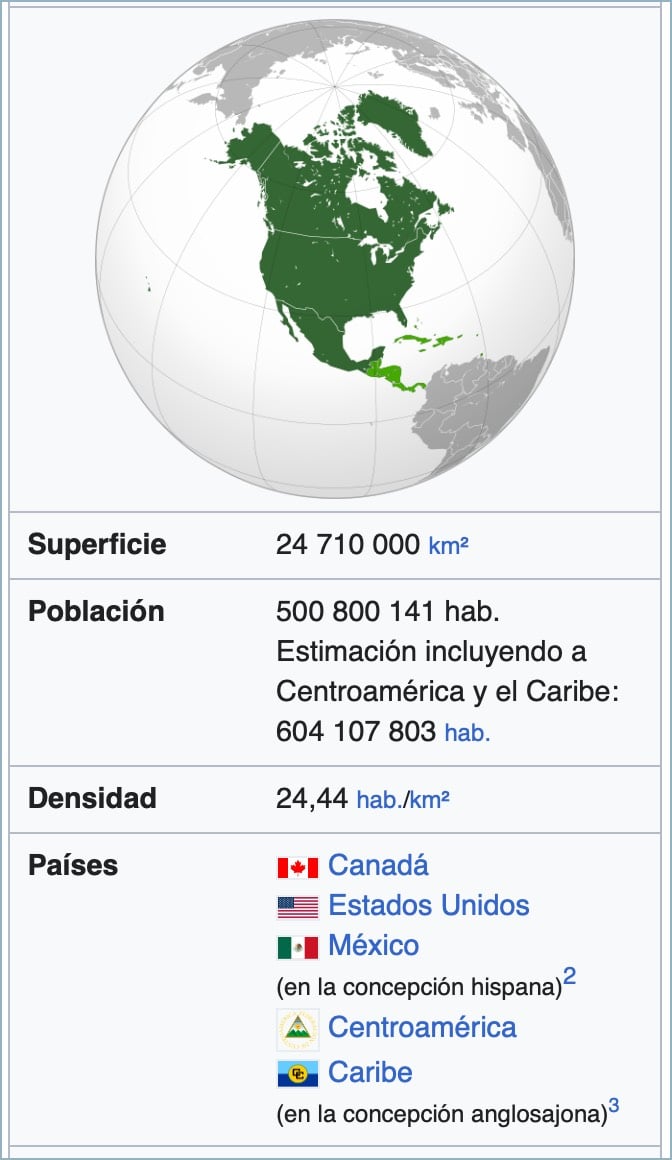
1 -
Igor Freiberger said:I always learnt that Central America is a continent per si and includes the whole Caribbean islands, never part of North America. In all the stuff I have, there are three Americas clearly established.Well, at least someone else has believed that Central America is not part of either North or South America, but instead a continent per se (as such).The only difference I was previously aware of between Canada and the United States on the one hand, and Spanish-speaking and French-speaking countries on the other, in respect of basic terminology for New World geography, is that in Canada and the United States, "America" almost always means the United States and only the United States; if one wants to refer to that which is composed of North, South, and Central America, one has to say "the Americas". That is very much not the case, though, where Spanish or French is spoken; the U. S. of A. is invariably "les Etats-Unis" in France, and "l'Amerique" always means what we call "the Americas".What has surprised me, though, is that no one saw fit to comment on my little witticism a few posts back in which I paid homage to the Goddess of Confusion.
0 -
A sub-continent, perhaps? Like South and Southeast Asia?
Defining a continent as distinct from a region is as political a process as defining a language as distinct from a dialect.
[Note to self re. further reading: Lewis & Wigen, The Myth of Continents: a Critique of Metageography, 1997.]1 -
Since I am "American" born and bred (but of Greek 1st Generation parents and partially raised by immigrant Greek grandparents), I qualify as being a product of U. S. schools. I don't recall much about Central America in our Geography classes and always held it as [like John's "sub continent" statement] some different distinction other than pure geographic boundary.0


Categories
- All Categories
- 46 Introductions
- 3.9K Typeface Design
- 489 Type Design Critiques
- 572 Type Design Software
- 1.1K Type Design Technique & Theory
- 659 Type Business
- 874 Font Technology
- 29 Punchcutting
- 528 Typography
- 121 Type Education
- 327 Type History
- 80 Type Resources
- 111 Lettering and Calligraphy
- 32 Lettering Critiques
- 79 Lettering Technique & Theory
- 560 Announcements
- 95 Events
- 116 Job Postings
- 169 Type Releases
- 179 Miscellaneous News
- 269 About TypeDrawers
- 53 TypeDrawers Announcements
- 114 Suggestions and Bug Reports