Is there any standard glyphsets for Indic languages

mitradranirban
Posts: 147
The data obtained from tools like Hyperglot and Shaperglot are often incomplete, confusing and contradictory. How can I get glyphset which will provide essential conjunct list for various Indic languages
Tagged:
0
Best Answers
-
Conjunct lists require analysis of dictionaries and other proofread texts. There is a temptation, of course, to apply analysis to large online corpora, but in my experience this never works well because of typos and spelling errors in such data. Even a lot of online dictionaries have errors because they have relied on OCR of older print editions.
Some consideration needs to be given to transcription of foreign loan words and names, especially those occurring frequently in news media.
Conjunct lists, per se, are of course most important in the context of highly conventional scripts, such as Bangla, as opposed to highly systematic scripts, such as Telugu and Kannada. You don’t need conjunct lists for the latter because fonts can be developed to present arbitrary conjunct sequences. For Bangla, though, you need a ligature form for every conjunct, because there is no generalised system of conjunct representation. A lot of other scripts contain a mix of conventional and systematic conjunct representation methods, e.g. Devanagari has conventional ligature forms for many conjuncts as well as the option of using half form sequences.
1 -
What John said. I'd also take care to distinguish between conjunct lists which operate at the orthographic level, and "glyphsets" - which are highly dependent on design and engineering decisions, so very difficult to specify in the general case. With a "productive" engineering setup, you can get a wide range of conjunct coverage with a comparative small glyphset; see Noto Bengali for examples.2
-
Odia involves both conventional ligature and systematic subscribed form representations of conjuncts, and individual fonts may differ in how specific conjuncts are shaped. This is a bit like the varying representation of conjuncts in reformed Malayalam, in which there is a subset that is either presented with explicit virama or with subscript forms, and which method is used for individual conjuncts within that subset varies across fonts.
My own fonts always tend to lean towards traditional conjunct representations, so involve more conventional ligatures, in part because Unicode provides ZWJ/ZWNJ mechanisms to affect other representations, but not vice versa.1


Answers
-
When I first made Mukti in 2002, I used the component model similar to Noto Bengali. However later shifted to full conjuncts model.
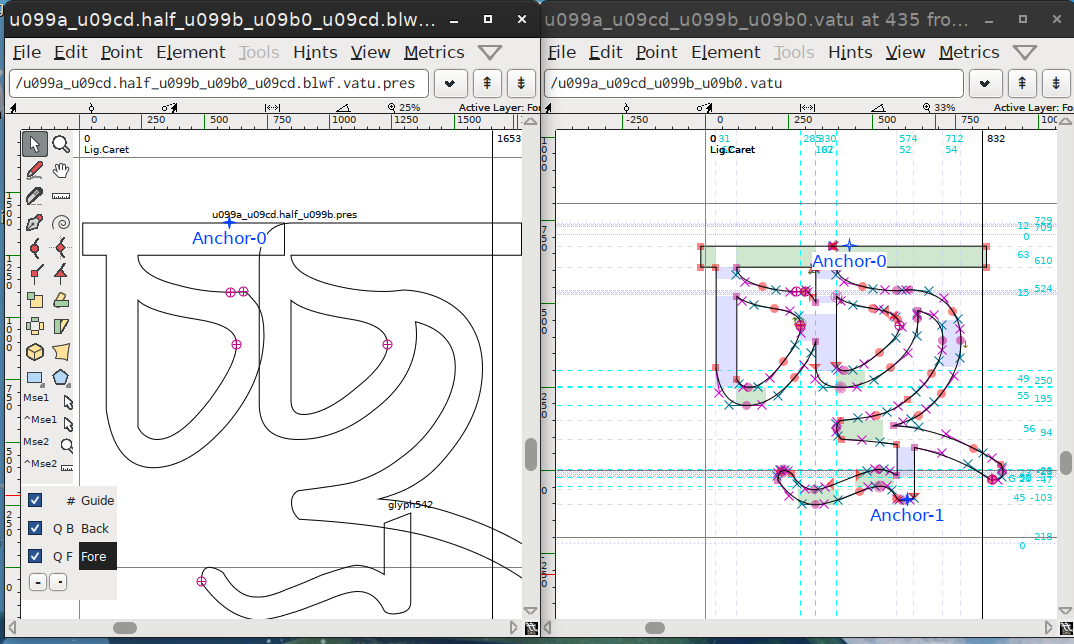
However in languages such as in Odiya, I find some fonts using traditional conjunct forms whereas some use simple below base for second components. So I wanted to know whether there is any data on what are the minimum conjuncts that must be present to consider a language supported.0
Categories
- All Categories
- 47 Introductions
- 4K Typeface Design
- 497 Type Design Critiques
- 590 Type Design Software
- 1.1K Type Design Technique & Theory
- 674 Type Business
- 904 Font Technology
- 29 Punchcutting
- 543 Typography
- 128 Type Education
- 333 Type History
- 82 Type Resources
- 114 Lettering and Calligraphy
- 33 Lettering Critiques
- 81 Lettering Technique & Theory
- 577 Announcements
- 101 Events
- 116 Job Postings
- 174 Type Releases
- 185 Miscellaneous News
- 270 About TypeDrawers
- 54 TypeDrawers Announcements
- 114 Suggestions and Bug Reports